In a recent interview with Mark Ramsey (Hear 2.0), marketing smart-guy Seth Godin talked about his new book, The Dip, and how some of the ideas therein apply to the future of radio.
Radio: As good as it gets?
Reply

In a recent interview with Mark Ramsey (Hear 2.0), marketing smart-guy Seth Godin talked about his new book, The Dip, and how some of the ideas therein apply to the future of radio.
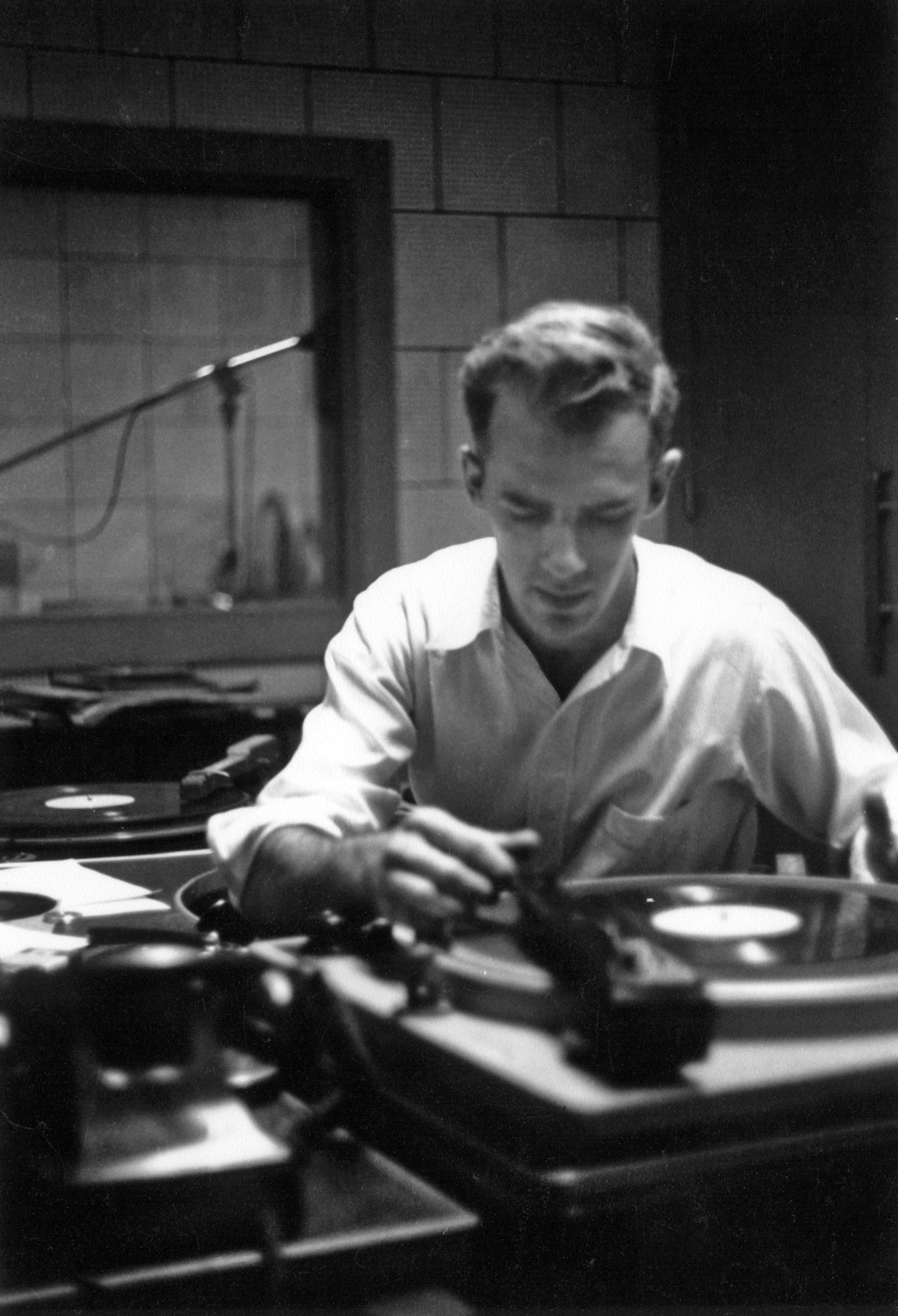
I love this photograph of my father. It was taken in the control room (Studio A) of KBOA in Kennett, Missouri, probably around 1950.
Anyone that has ever “cued” a record recognizes that sense of touch and the delicate balance of the heavy tone-arm on the oh-so-easy-to-scratch record.
A skill (if you could call it that) that hasn’t been needed for many years. I’m glad I didn’t miss those final years of high-touch, hands-on radio.
We had one of the early automation systems (for our FM station) but it felt like telling someone how to make love to your girl friend.
And the thrill of having the program director walk into the studio while you were on the air and put the hot new single into “current” box. Is it as much fun to see the new single come into the rotation on a computer monitor?
Before I get carried away, allow me to say –for the record– I don’t miss using a grease pencil and splicing blog to edit tape. If I had to choose, I’d be th digital boy I have become.
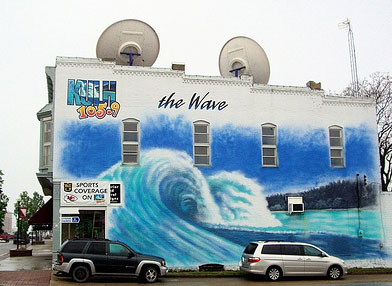
Please tell me I’m not the first person to see this mural (radio station in Chillicothe, Missouri) and not want to go inside, sneak upstairs, remove my shirt and lean out the window (closest to the street) and scream “Help! Help!”
Mark Ramsey says (Hear 2.0) his research repeatedly shows that once you get beyond traffic and local sports headlines and weather, "local news" per se is one of the things (radio) listeners – even information listeners – want least.
And that’s fundamentally because information fans tend to be interested in one of two things: What fascinates or entertains them and what impacts them personally. And neither of these things are explicitly "local."
Is this true? Hmm. I’ve lived in Jefferson City for more than 20 years and I don’t know the name of the mayor and have very little interest in what’s going on "locally." Until, of course, something doesn’t work.
I listen to our state news reports on our local affiliate but can’t remember the last time I listened to the "local" newscast. But I’ve always suspected –and hoped– I was the exception.
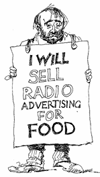
eBay is ready to begin auctioning advertising airtime on 2,300 participating U.S. radio stations. The venture –which puts eBay into competition with Google– includes both conventional terrestrial radio and Internet radio advertising. Stations in all of the 300 top-ranked radio markets are covered. Advertising inventory includes primetime spots with 90 percent in morning drive, midday or evening commute hours from Monday through Friday.
How (if at all) will this impact companies like ours that barter our services for radio station commercials? When you finish the quiz, close your Blue Book and raise your hand.
Internet’s ad share surpasses radio for the first time. Radio’s share of advertising revenues held flat in the first quarter — taking 6.6% of spending. But for the first time the Internet has a bigger share. It took 7.7%. TNS Media says radio is now fifth — behind TV, magazines, newspapers and the Web. [Inside Radio]
 Fifty years ago, Jerrell Shepherd mastered a form of broadcasting alchemy that turned small town radio lead into gold. It wasn’t much of a secret, however, since he readily shared it with countless radio station owners and managers who made the pilgrimage to Moberly, Missouri, in hopes of bringing some of Shepherd’s sales and programming magic back to their stations.
While most small market broadcasters were content to get “their fair share” of local advertising budgets (the bulk went to the local newspaper), Shepherd’s sales reps were trained to ask for it all and believed in their hearts they deserved it.
Mr. Shepherd’s approach to programming his stations was deceptively simple: report anything and everything that happened in each of the communities covered by his stations’ signals. The KWIX and KRES “Red Rovers” showed up just about every high school football game, junior high choral concert and chamber of commerce ribbon-cutting. And the Shepherd stations put it all on the air. Always with local sponsors. Lots of local sponsors.
Dave Shepherd grew up in the radio business and built on his father’s success, growing The Shepherd Group to 16 stations before selling them to a Florida-based company called GoodRadio.TV, for $30 million earlier this year.
I got Dave on the phone for a little chat and he talked about where small market radio has been… and where it’s going. He shared some thoughts on the Internet, iPods, HD, satellite and Google Radio.
He says he decided to sell because it just wasn’t as much fun as it used to be. And, in the next breath, he wondered if some of his father’s small town magic might work in The Big City.
AUDIO: Interview with Dave Shepherd 25 min MP3
In another lifetime I wrote radio “spots.” A lot of ’em. So please feel free to skip this “shop talk” post.
TechCrunch is getting reports from advertisers that Google Audio Ads have been added as an option to their Adwords accounts. Interesting to see the data collected with the “About Your Ad” form (Goal of ad; target customer; key messages; call to action; etc.).
And this from the comments on the post: “I’ve been using Audio Ads for months now. I like how you can listen to the actual snippet of your ad being played on the station. I don’t like how you can’t choose a specific radio station, only the type of format and DMA.”
Wonder how they’re getting the mini-air check? I can see how advertisers would love that.
Bonus link: “Analysts Peek Into Google’s Pitch to Radio” (Radio World)
“the future of any audio entertainment that is financed by advertisers is a future where the content is child-safe and Disney-friendly – a future specifically monitored by agents with agendas to ensure that the inoffensive, the harmless, and the docile float to the top of what’s “acceptable.” – Mark Ramsey (Hear 2.0)
Which only means that we’ll have to pay for the good stuff.
Thanks to David for pointing me to this series of interviews (YouTube) with Ira Glass. His weekly program, This American Life, is the best example of what radio can and should be. But that doesn’t sound quite right to me any longer, since I began listening to the program via podcast.
So let’s call it the best example of what storytelling can and should be. “Radio” makes it about the medium. And it never was, not really.
My take-away from the first segment of the interview is that it takes as much time to find a good story, as it does to write and produce the story. He says the TAL team spends about half of their time searching for that good story to tell.
PS: I had never seen Ira Glass and he looks exactly like he sounds.