We’re just days away from “relaunching” our corporate website. I added the quotation marks because what we’re really doing here is applying a new template to a few thousand existing pages. Our current look is more than three years old and it’s time for a fresh face. And the nature of our company has changed a lot in those three years. I think the new look reflects that nicely. Andy Waschick and his development team at Gestalt have done a fine job of giving us just what we asked for on this project. My role has been that of the stock dog that runs around yapping and nipping at the cows legs, hearding them in the right direction. In order to do my job, I have to be a little annoying. But I’m pleased with the result and will post here when the new look is up.
Category Archives: Learfield
Learfield Interactive
I have three “pet projects” (for lack of a better description) at work. They make a little money but not much. One could make a good argument that these are things we shouldn’t be messing with. But I am quite proud of them and today seems like a good time to bench-mark them.
Legislature.com (how lucky were we to get that domain?) has to be one of the more expensive subscription services on the net. We charge $750 a year for a live stream of debate audio from the Missouri House and Senate. All the more amazing since those two bodies offer a live stream for free. In addition to the live stream, we archive each day’s debate. We’ve got it all going back to 2002. Don’t ask me “who cares?” because I don’t know. It’s a little bit of history and it seemed dumb to discard it.
UPDATE: We registered Legislature.com on September 16, 1999. Roger Gardner called me the day before and asked if the domain was available. I assured him someone had snapped it up but had our IT guy (Phil Atkinson) check. Lo and behold, it was available. Not many one-word domains still up for grabs in 1999. Post-Dispatch story on Legislature.com 5/14/00 (PDF)
Supreme Court of Missouri Oral Arguments. Very dry stuff. We stream audio of the oral arguments before the court, and then we archive it. 637 cases, dating back to December 14, 1999. The service has been free until just recently, when we started charging an annual subscription of $99. [We started doing this in January of 2000.
So we have the audio of the state legislature making the laws…and the audio of the state supreme court interpreting many of those laws. While I don’t care that much about the process, saving this audio record just seem very cool to me.
Last, but not least… Missouri State Highway Patrol Crash Reports. These are the initial reports filled out by the state troopers and radioed back to the dispatcher. He or she then enters the information into a computer and it gets distributed to various points around the state. Several years ago, Phil did a little hack that put the reports on a website which, today, easily generates 800,000 Page Views a month. There’s a free, “public” version of the site…and a “premium” subscription service which includes a searchable database of reports going back to the beginning of 2004. Two years of crash reports. God (and maybe Andy and Phil) know how many files that might be. Thousands. Hundreds of thousands? A shit load.
A good businessman would tell you these projects are “distractions” that “dilute” our efforts from our “core businesses.” Which, for the most part, is selling 30 and 60 second commercials on radio networks. I think it’s a credit to our company that they let me (and others) explore these murky, digital waters. But I wonder… if I went to that Big Blogging Convention in the sky tomorrow, would anyone keep these projects going?
Network Affiliate Relations 2.0
In the previous post I offered some ideas for using the web and related technologies to “connect” with local radio listeners and advertisers. I took a nap and had a sub sandwich and now I’m ready make a list for network affiliate relations. What is that you ask?
From the mid-eighties to the late nineties, part of my job was “selling” our network services to radio stations. We provided news and and sports programming in exchange for commercials on the local station, which we in turn tried to sell. The trick was to keep the stations you had while adding new stations when and where you could.
I drove all over half a dozen states, meeting with station managers, program directors and news directors. For the most part, this was pre-consolidation and I was talking to the station owner or a manager who was almost completely autonomous. They could make a decision without checking with anyone up the food chain. They were at or near the top of that chain. No longer the reality.
Where was I? Oh. How would I use today’s communication and publishing tools if I were doing that job? First, I’m not sure I would have the balls to do what I’m about to propose. There would be some risk. As much as doing business “the old way?” Don’t know. And, fortunately, no longer my call. But here goes:
Blogging
I’d create the “MyState Radio Network Affiliate Relations Blog.” It would be right out there on the web with the rest of the blogs. No password. The target audience would be the men and women that worked at radio stations affiliated with our network. Topics would include (but not be limited to): Programming, Sales, Traffic, etc. We’d talk about how stations use the network programming and why they sometimes don’t (it’s called clearance).
That sound you hear is the first alarm going off. If we publically acknowledge that some of our affilaites don’t air all of our programming, an advertiser might read the post and become concerned. Fact is, the advertisers already know that or can find out easily enough. By engagaing our affiliates in a frank and open discussion of this topic, we might learn something that could help us improve our clearance.
I’d let stations know about upcoming advertising campaigns and –where possible– offer suggestions on how they can take advantage of this locally. The traditional fear is that if they stations know –in advance– some of them might do or say something that could torpedo the network buy. Not much trust there.
I’d open up the comments and encourage the stations to let us know what they think about what we’re doing. If I got a hot one, I’d jump on the phone (or in my car) and deal with it.
What would an advertiser think of this public exchange? Not sure. We might get some points for being open and transparent. Nothing to hide. Radio stations might take the same view.
Here at the end of 2005 we communiate with our affiliates using the web, email, fax, telephone and in-station visits. All good and all necessary. And safe. Or at least the illusion of safety and control. Whatever the stations think and say about us, they’re thinking and saying. It’s critical to get them to say it to me and say it early.
Podcasting
I’d do a weekly podcast targeted at affiliates but out there for anyone to listen to. Who would I chat with? My news staff; my affiliate relations reps; my sales manager and his account execs; station managers, program directors and news directors… anybody and everybody involved in this business. We’d talk about anything and everything. If we –the network– does something really stupid, we hang it out there and talk about it. Why we did it. How we might do it differently in the future. What if an advertiser heard one of these? Great. If the “conversation” is going to take place, I want to be in on it.
As I said at the beginning of this post, I’m not sure I’d have the nerve to try such…”non-traditional” tactics. I’m not aware of any networks that are but if you know of one, send me a link.
Road Trip (Des Moines and back in one day)
Des Moines and back in one day. Ten hours in the car with David. Almost nobody I’d rather travel with. Laughed my ass off. No voice mail, no email. Passed adult book store on trip home and made David turn around so I could take a photo for the masthead. So cold my shaking hands ruined the shot. It would have been a killer. “Adult Videos & Toys.” Just in time for Christmas.
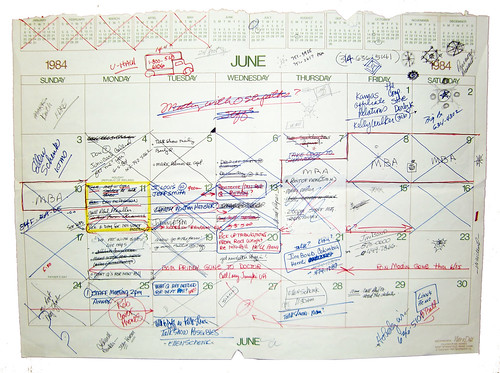
Time capsule: October 9, 1984
Oversold again. Expressed my fears and concerns to Clyde. He feels it is a mistake to turn down business. I say there has to be a “good programming” limit. The newscasts just aren’t good quality programming with two minutes of spots.
Another charming little nugget from my 1984 (first year at Learfield) journal. I believe our newscasts were 5 minutes long in ’84. Four minutes of news content, one minute of network commecial inventory. When we sold out, we “double-spotted” (3 and 2) and got away with it. Not sure if we could today. Note the total absence of irony in my “mistake to turn down business” reference. Was I precious, or what?
Who will own the podcasting rights?
From an article by Dan Migala in the Sports Business Journal (subscription required):
“The NHL’s Blackhawks have launched Hawk-Cast, which is the first podcast created by an NHL team. A new edition of Hawk- Cast, which is a 10- or 15-minute show, is available two to three times a week. The show is hosted and produced by Blackhawks Web producer Adam Kempenaar using only a computer with audio recording capability and Internet access. The HawkCast features updates from practices and interviews with players, coaches and team management. Postgame news conferences and player interviews are also available as podcasts at www.chicagoblackhawks.com.”
As an employee of a company that pays millions of dollars every year for the media rights to some of the top college teams in the country, this next little item caught my attention:
“Another plus for the Blackhawks is that, because the content is original and produced in-house, there are no conflicts with radio rights holders. The team is free to sell advertising and sponsorships for each podcast or program segment. Kempenaar said the club has not sold advertising yet, but plans to do so.”
I remember the first time we saw a reference to streaming rights in a college bid spec. You can bet we’ll be seeing references to podcasting rights in future rights deals.
5,655,320 pieces of digital crap
Phil posted our spam/virus stats for September. 95% of our inbound email is spam. And I’d say that percentage holds true for the crap that hits my USPS mail box. A bunch of shit I didn’t ask for and don’t want. As we used to sing back in the 60’s… deep in my heart, I do believe… there will be a day when we only see/hear messages that we want to hear. It’s closer all the time. So spam on you annoying turds. Make it while you can.
The challenges of getting big
I’ve always blogged with an awareness that the people I work with (and for) might be reading what I write. In fact, I know that some of them do pop in from time to time. Hi, guys.
While I post with some frequency on radio, media, blogging, journalism, podcasting and such… I rarely write about our company specifically. For lots of reasons. Today we’ll get close to the line and try not to step over.
Our company has gotten big. Not General Motors big or Microsoft big, but a lot bigger than when we started, 30 years ago. Back then, it was Clyde and Derry (and a few others) making it up as they went along, breaking all the rules, trying and doing all kinds of things that Big Companies said you couldn’t or shouldn’t do.
And, as the name suggests, the company has always beeen about communications. First as a wired (telco lines) network delivering farm news and markets to a handful of radio stations. Very few people were doing that back then because it was damned expensive and nobody really saw the need or the opportunity. Clyde and Derry did.
In the early 80’s, Clyde figured out having his own satellite uplink would allow him to reduce costs and control a powerful distribution channel. We could ‘communicate’ programming (content) to listeners (via the radio stations) in a way that others could not. More on the satellite/distribution thing in a minute.
So we have our own satellite uplink and channels and things start to take off. We build/acquire lots of radio networks. We’re scaling nicely and the company is growing. And it continues to grow. We still feel like and –in many ways– operate like a much smaller company. Handful of smart guys running the company from the top of a very flat org chart. But we’ve gotten big. And we have some big cash cows that we love very much.
You see where I’m headed with this, right? How do you get big (which has lots of advantages) without losing the Small Company “bag of rice and an AK47” flexibility and attitude? Because if the next Clyde and Derry are out there in the bushes (and you know they are), they have The Mother of All Networks at their fingertips and it doesn’t cost them the millions our Clyde paid for his first uplink. It’s virtually (get it?) free. And far more poweful because it’s global and two-way and blah, blah, blah, blah. You’ve heard it all.
Big is good. The Queen Mary is a very comfortable ride. And as long as we don’t have to make any sudden turns, we’ll be fine.
Office make-over
They’re painting all of the offices along our hallway so I’m homeless for a couple of days and the webcam is offline. The office make-over is taking forever and god only knows the price-tag when it’s over but Learfield will be one very nice place to work when everything is complete. I can’t imagine working in nicer surroundings. And today the company had a cookout, just for the hell of it. Someone invited the the guys doing the work on our building so we were all sitting around drinking beer and eating ice cream and feeling fortunate.
Rick & Ryan’s All Geek Marching Band
I’m hanging out in our new sports operations center and hear the haunting sounds of someone playing the mouth trumpet. I was surprised and delighted to discover our own Ryan Kormann riffing away. About this time, Rick Kennedy steps out of his studio to join in with Musical Hands. He insisted that he wasn’t warmed up and was a little nervous, but his musical gift was obvious. [watch on YouTube]