
New camera promises to capture your whole life (2007)

From article at NewScientist.com:

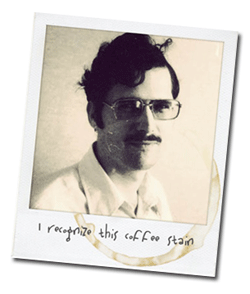
lifelogger-camera“Worn on a cord around the neck, the camera takes pictures automatically as often as once every 30 seconds. It also uses an accelerometer and light sensors to snap an image when a person enters a new environment, and an infrared sensor to take one when it detects the body heat of a person in front of the wearer. It can fit 30,000 images onto its 1-gigabyte memory.

The ViconRevue was originally developed for researchers studying Alzheimer’s and other dementias. Studies showed that reviewing the events of the day using SenseCam photos could help some people improve long-term recall.

Vicon’s version will retail for about $820 and will also be marketed to researchers at first; it will go on sale in the next few months. A consumer version should be released in 2010. So far, only 500 have been made, most for use by researchers.

For consumers, the gadget will provide an easy way to become a “lifelogger” – someone who attempts to electronically record as much of their life as possible. Microsoft researcher Gordon Bell has made his life an experiment in lifelogging, recording everything from phone calls to TV viewing, and uses a SenseCam wherever he goes.”
Continue reading →

Better tool for journalists, iPhone or BlackBerry?

Etan Horowitz, posting on E-Media Tidbits, attempts (and succeeds, in my opinion) to answer the question: Which is better tool for journalists, BlackBerry or iPhone? I’ll just share his conclusions here and you can read the full post:

“In the days when producing content mainly happened from a laptop or the office, the BlackBerry made a lot of sense. It is a perfect tool for communicating quickly by e-mail or text and looking up information online. But now that many journalists are expected to post stories, blog posts, photos and videos from the field, the iPhone is a better option.

As a profession, journalism is still struggling to find its footing in the digital age. Since most of the innovative mobile applications are being developed for the iPhone, using an iPhone will help journalists stay current with technology and get them excited about its potential for news.

Don’t believe me? Just give an iPhone to one of the old-school types in your newsroom and see how they react after a few days of use. They’re likely to tell you the device changed their life. You won’t get the same response by giving someone a BlackBerry.

But that doesn’t mean the iPhone is best for all journalists. Editors, Web producers and others who don’t report from the field but frequently communicate with a team will probably be better served by a BlackBerry. And the fact that BlackBerrys cost less, run on multiple carriers and have removable batteries and memory cards are also valid considerations.” [Thanks, Aaron for the link]

Rollip turns digital pix into Polaroids

rollipI loved Polaroids for the same reason I love small digital cameras. I got to see and share the photo immediately. No waiting for processing. And there was a space on the front of the photo to write name/date/place.

Rollip is a website that turns your digital photo into a faux Polaroid. I can probably do this faster in Photoshop but if you like this effect, Rollip is fun, easy and free.

Tag cloud

We (yes, there IS a mouse in my pocket) migrated one of our websites over to WordPress this week. As near as we can determine, more than 46,000 stories were imported. My role in this has been modest but I did spend a good bit of time working with the categories, keywords, tags and other meta data used to organize all of those news and sports stories.

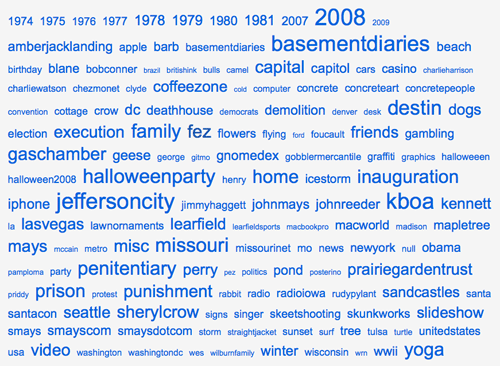
There are less than 5,000 posts to this blog but it would be impossible (okay, very difficult) to find anything without a good tagging scheme. One of the more common approaches to displaying those tags is the “tag cloud.” I have one on the right side of this page, near the bottom. And here’s the tag cloud for my flickr account.

tag-cloud-flickr

My friend Scott doesn’t like how tag clouds use different size text to indicate the most and least common topics. He thinks it looks “sloppy.” I find the visual cue very intuitive and easy to use. (I can see I have some clean-up to do)

Strangely, tagging is a bit like curling your tongue. Some people can do it and some just can’t. I’m getting better at it.

TwitBlock.org ranks your followers for “spamminess.”

I think I mentioned trying TwitBlock.org, a website that scans your Twitter followers and ranks them for “spamminess.” Higher the score, more likely to be spam. Looks at things like how many people you foll0w, how many times you’ve tweeted, and so forth. It’s not perfect but it’s better than nothing. And my rule of thumb is, “When in doubt… block.”

I’ve heard from one acquaintance who wanted to know why I blocked him. I unblocked and the pot’s right now. But there are sure to be more. Just ping me.