Team Human

Excerpts from Team Human by Douglas Rushkoff.

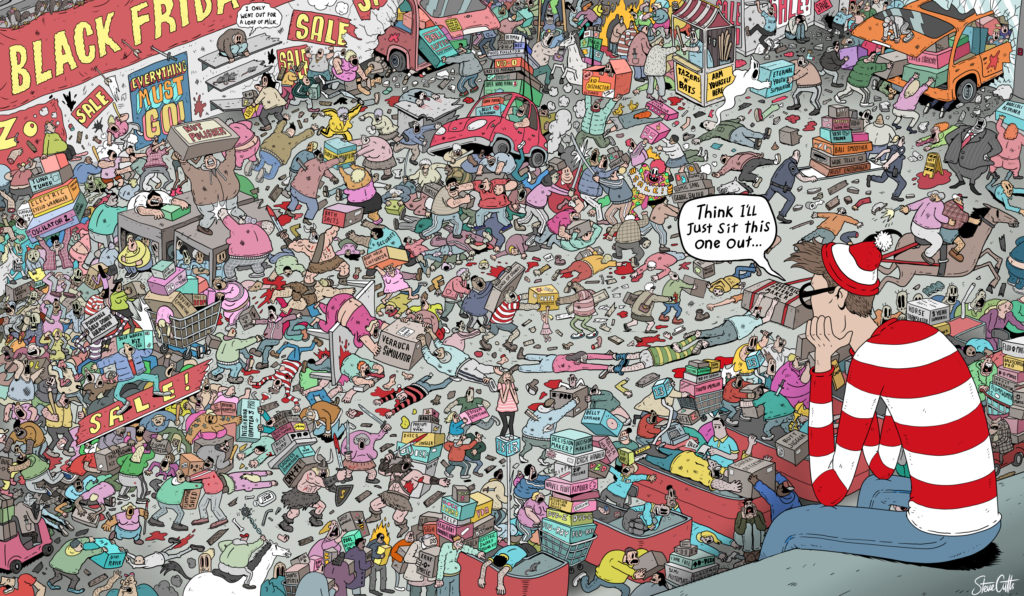
There’s a reason for our current predicament: an anti-human agenda embedded in our technology, our markets, and our major cultural institutions, from education and religion to civics and media.

Thinking, feeling, connected people undermine the institutions that would control them. […] Our institutions and technologies aren’t designed to extend our human nature, but to mitigate and repress it.

It doesn’t take much to tilt a healthy social landscape toward an individualist or repressive one. A scarcity of resources, a hostile neighboring tribe, a warlord looking for power, and elite seeking to maintain its authority, or a corporation pursuing a monopoly all foster antisocial environments and behaviors. Continue reading

One in 11 Americans pays an average of $91.14 per month to use self-storage

“According to SpareFoot, a company that tracks the self-storage industry, the United States boasts more than 50,000 facilities and roughly 2.311 billion square feet of rentable space. In other words, the volume of self-storage units in the country could fill the Hoover Dam with old clothing, skis, and keepsakes more than 26 times. […] The self-storage industry made $32.7 billion in 2016, according to Bloomberg, nearly three times Hollywood’s box office gross.”

“High-end self-storage sites can command two or three times the rent per square foot than commercial or residential uses, and in many major metros, these warehouses are 90 percent occupied.”

I resisted renting a storage unit for many years and broke down this year because I need a place to store the Land Rover’s hardtop when I switch to the soft top this spring.

More »

Why Microsoft Word must die

“Microsoft Word is a tyrant of the imagination, a petty, unimaginative, inconsistent dictator that is ill-suited to any creative writer’s use. Worse: it is a near-monopolist, dominating the word processing field. Its pervasive near-monopoly status has brainwashed software developers to such an extent that few can imagine a word processing tool that exists as anything other than as a shallow imitation of the Redmond Behemoth. But what exactly is wrong with it?”

Full post by Charlie Stross

Truth in Advertising

Written by David Chiavegato and its director, Tim Hamilton, Truth In Advertising is a genuinely funny comedy that was nominated for a Palm d’Or in 2001. Colin Mochrie, best known as a regular on Whose Line Is It Anyway? in the US and UK, is the boss in an advertising agency where everybody tells the embarrassing truth about…advertising.

Nanoinfluencers

“Nanos” for short. From the NYT story:

“People who have as few as 1,000 followers and are willing to advertise products on social media. Their lack of fame is one of the qualities that make them approachable. When they recommend a shampoo or a lotion or a furniture brand, their word seems as genuine as advice from a friend. In exchange for free products or a small commission, nanos typically say whatever companies tell them to.”

AI Superpowers

“In his book “AI Superpowers: China, Silicon Valley, and the New World Order,” Kai-Fu Lee, a well-known artificial-intelligence expert, venture capitalist and former president of Google China, argues that China and Silicon Valley will lead the world in AI. But his highly readable book covers a lot of other ground as well, and among the most interesting insights are his descriptions of the differences between Chinese and Silicon Valley tech culture.” (Washington Post review) Not quite finished but here are some excerpts:

If artificial intelligence is the new electricity, Chinese entrepreneurs will be the tycoons and tinkerers who electrify everything from household appliances to homeowners’ insurance. […] Ambitious mayors across China are scrambling to turn their cities into showcases for new AI applications. They’re plotting driverless trucking routes, installing facial recognition systems on public transportation, and hooking traffic grids into “city brains” that optimize flows.

China’s startup culture is the yin to Silicon Valley’s yang: instead of being mission-driven, Chinese companies are first and foremost market-driven. Their ultimate goal is to make money, and they’re willing to create any product, adopt any model, or go into any business that will accomplish that objective. […] The core motivation for China’s market-driven entrepreneurs is not fame, glory, or changing the world. Those things are all nice side benefits, but the grand prize is getting rich, and it doesn’t matter how you get there.

Adoption of mobile payments happened at lightning speed. By the end of 2016, it was hard to find a shop in a major (Chinese) city that did not accept mobile payments. […] By the end of 2017, 65 percent of China’s over 753 million smartphone users had enabled mobile payments. […] It got to the point where beggars on the streets of Chinese cities began hanging pieces of paper around their necks with printouts of two QR codes, one for Alipay and one for WeChat. […]

For 2017, total transactions on China’s mobile payment platforms reportedly surpassed $ 17 trillion—greater than China’s GDP. […] Data from mobile payments is currently generating the richest maps of consumer activity the world has ever known, far exceeding the data from traditional credit-card purchases or online activity captured by e-commerce players like Amazon or platforms like Google and Yelp. […] Recent estimates have Chinese companies outstripping U.S. competitors ten to one in quantity of food deliveries and fifty to one in spending on mobile payments. China’s e-commerce purchases are roughly double the U.S. totals, and the gap is only growing.

U.S. federal funding for math and computer science research amounts to less than half of Google’s own R& D budget.

Between 2007 and 2017, China went from having zero high-speed rail lines to having more miles of high-speed rail operational than the rest of the world combined.

It no longer makes sense to think of oneself as “going online.” When you order a full meal just by speaking a sentence from your couch, are you online or offline? When your refrigerator at home tells your shopping cart at the store that you’re out of milk, are you moving through a physical world or a digital one?In the United States we build self-driving cars to adapt to our existing roads because we assume the roads can’t change. In China, there’s a sense that everything can change—including current roads. Indeed, local officials are already modifying existing highways, reorganizing freight patterns, and building cities that will be tailor-made for driverless cars.

Much of today’s white-collar workforce is paid to take in and process information, and then make a decision or recommendation based on that information—which is precisely what AI algorithms do best.

Fixing Flickr

Flickr, the photo sharing site, launched in February, 2004. I created my account in May, 2005, and have been a user ever since. I have more than 1,800 photos in my account which isn’t a large number. That’s because I don’t upload every photo I take. I’ve never used Flickr as a “warehouse” for storing photos. I put stuff on Flickr that I want to share, although I tend to use my blog for that these days. My photos have been viewed more than a million times (collectively) but I doubt that’s a big number, comparatively speaking.

For most of its existence, Flickr has been owned by Yahoo! who fucked it up in ways too numerous to mention. Earlier this year Flickr was sold to SmugMug, a paid image sharing, image hosting service, and online video platform. The new owners are making changes and a bunch of the 800,000 Flickr users are freaking out. They’ve been getting unlimited storage for free and in a couple of months that ends. The new limit is 1,000 photos or upgrade to a Pro account for $50 a year. (Which I did back in 2005)

The vast majority of Flickr users are not using the service as a “photo sharing” platform. They’re taking advantage of the free terabyte of storage to warehouse and back-up all of their photos. Fun while it lasted but guess what? Internet companies make changes like this all the time. I think this is a logical move will keep Flickr financially healthy. Others think it will kill the service. Time will tell.

What my Pro account give me under this new plan?

  • One of the many dumb things Yahoo! did was make Flickr subscribers get a Yahoo! account and use that to log into their Flicker account. Cluster. Fuck. That ends soon and we can use any email account to log in.
  • Unlimited storage
  • Ad-free browsing. I would HATE having ads on my Flickr pages
  • Better stats to see which of photos are most viewed. Admittedly not a big deal to me.
  • Better support when I need it.
  • Longer (10 min) videos. Up from 3 minutes.

Free is not a business model. And if a dollar a week is too pricey for you… sorry, Charlie. I’m happy to pay for services I like. For those who aren’t, there are free services like Google Photos.

What Apple knows about its customers

A week ago Apple started allowing U.S. users to download all of their data from the company, following a GDPR-mandated feature for EU citizens that launched in May. A friend and long-time Apple user took them up on the offer and after almost a week he got it.

They have a lot of info on me.  Every item I purchased from Apple since 2003.  Every time I called Support.  Every time I had something repaired.  Every survey I replied to and how I answered.  Every app or song I downloaded and the IP address I downloaded it from.  Every time they sent me marketing email and if I opened it and what device I looked at it on.

Honestly, I’m not sure I want to know. Same for Amazon.

25 Dying Professions

The most satisfying and fulfilling job I ever had was that of small town radio announcer. About a dozen years from the early 70s to the early 80s. We still played vinyl 45s and LPs on turntables. We recorded on magnetic tape. Nobody much cared (within limits) what we said. Looking back, I can see that I was fortunate to catch the tail end of radio’s best years. From Work+Money:

One in 10 of the nation’s 33,202 radio and television announcers are expected to see their jobs disappear by 2026. Consolidation in the industry, as well as increased use of syndicated content, is fueling the decline. There’s also the explosion of streaming music services. More and more listeners prefer that over their local, drive-time disc jockey.

Party DJs however, are seeing an uptick in business with demand for their services projected to grow about six percent by 2026. And they earn about the same – $32,000 – as their on-air counterparts.

I thought radio was a dying profession twenty years ago. The Bureau of Labor Statistics has some interesting data on the profession but, like the article above, they combine radio and TV announcers. I’d like to know how many of each.