“Sorry, There’s No Way To Save The TV Business”

A thought-provoking column by Henry Blodget in the Silicon Alley Insider. Here’s his nutshell:

“As with print-based media, Internet-based distribution generates only a tiny fraction of the revenue and profit that today’s incumbent cable, broadcast, and satellite distribution models do.  As Internet-based distribution gains steam, therefore, most TV industry incumbents will no longer be able to support their existing cost structures.”

According to Blodget, the TV business models for the past 50 years have been based on:

  • Not much else to do at home that’s as simple and fun as TV
  • No way to get video content other than via TV
  • No options other than TV for advertisers who want to tell video stories
  • No options other than cable–and, more recently, satellite–to get TV
  • Tight choke-points in each market through which all video content has to flow (cable company, airwaves), which creates enormous value for the owners of those gates.

No more creating mass through scarcity

So you’ve got a TV station or radio station or newspaper with all this good “content.” The cost of producing it is already sunk so you put it on your website and sell some banner ads. Ch-ching. But it just isn’t working for a lot of “legacy media” and Terry Heaton explains why:

“The assumptions of any content play are that its value is so great that expensive, adjacent advertising will support it and that the mass attractive to advertisers can be created through scarcity. Neither of these assumptions is viable online, and the real problem is that both must be present for significant revenue to be realized.”

So what do we do?

“We should nurture our legacy products as best we can, but we simply must separate our ability to make money from our dependence on the content we create. The key to that is in defining, understanding and developing the Local Web.”

I added the bold in hopes that would help me understand what he’s saying. I think he’s referring to the content we are already creating. We have a story in the paper, we put it on the web. We have a good radio morning show, we stream it. And so on.

We can’t just “re-purpose” our existing content and expect to attract an audience that will be attractive to an advertiser. I think he’s right.

Listenomics and why things are different this time

I remember reading Bob Garfield’s The Chaos Scenario as an article in Advertising Age but I’m not sure I listened to the interview Mark Ramsey (Hear 2.0) posted to his website back in March. More on that in a moment. I don’t think the book is out yet but here’s a blurb from the web page:

“What happens when the old world order collapses and the Brave New World is unprepared to replace it…as an ad medium, as a news source, as a political soapbox, as a channel for new episodes of “Lost?” That is The Chaos Scenario.

In this fascinating, terrifying, instructive and often wildly entertaining book, Garfield is not content to chronicle the ruinous disintegration of traditional media and marketing. No, having established the problem, he travels to five continents for solutions.

What he discovers is the answer for all institutions who wish to survive – and thrive – in a digitally connected, Post-Media Age. He calls this the art and science of Listenomics.”

Mr. Garfield is Advertising Age editor-at-large and co-host of NPR’s On the Media. Looking forward to the book. If you spot it before I do, let me know.

Radio Rapture

Jerry Del Colliano (Inside Music Media) on yesterday’s firing of 590 people by Clear Channel Communications and why radio “consolidation” turned into such a bad thing:

“I’m sorry that these virtual monopolies didn’t work, but the reason they failed is because their arrogant CEOs ran up the debt to buy stations at prices that were, frankly, never really worth what sellers pumped them up to. Now they can’t service that debt and even though they could probably survive an economic downturn (radio always used to in past recessions), the debt they ran up during the consolidation years is killing them.”

I think I might have run out of anything more to say about the challenges facing radio.

In my radio fantasy, everyone working in radio today is raptured up to heaven, leaving thousands of empty stations with the transmitters still on and records “chick” “chick” “chick’ing” on the still spinning-turntables. (Okay, I know they don’t use turntables anymore but it’s my fantasy.)

Listeners tip toe down deserted hallways, peeking into empty studios, wondering where Rush went.

Eventually, someone sits down at the microphone and figures out how to turn it on. What do they say? What would radio become? Would they hastily call a sales meeting and begin selling ads? Would they assemble a focus group and put together a tight playlist?

I have no idea. Maybe they’d just stick their ear buds in slip out quietly, locking the door behind them.

Local newspaper subscription drive

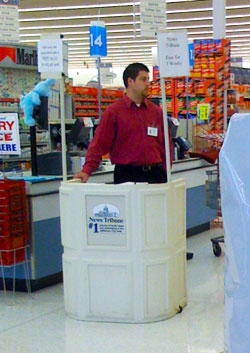
I almost didn’t post this because I don’t want to read anything into the photo. But this young man is soliciting subscribers to the local newspaper. This might be part of an on-going effort. I don’t know and was uncomfortable asking the young man. He did say he had picked up “a few new ones.”

The signs offer a $10 Hy-vee gift card with every new subscription. Or you can just try the paper for free for three weeks.

This reminds me a story old radio “time salesmen” used to tell. They’d give a car dealer a little break on their ad buys if the dealer would tune all the radios on the lot to their station. Sweet!

If I had been given this assignment, I like to think I would have dressed in my best Mickey Rooney outfit, grabbed a HUGE stack of papers, and started shouting (as loudly as store management would allow)… EXTRA! EXTRA! READ ALL ABOUT IT IN THE NEWS TRIBUNE! EXTRA! EXTRA!

When they came over (okay, IF they came over) I’d make my pitch.

PS for the paper webmaster: Dude. This is THE slowest loading page I’ve come across in a while. GOT to get that fixed.

Where do former newspaper reporters go?

Rebekah Denn has posted links to blogs “and other online works” from other staff members from the former Seattle Post-Intelligencer newspaper. The list included a number of photographers but the thing that caught my attention was the variety of “beats.”

  • Reporter, food writer, former restaurant critic
  • Features writer, children’s book reviewer
  • Art critic
  • Restaurant critic
  • Freelance classical music writer
  • Reporter, specializing in neighborhood sustainability
  • Lifestyles editor, former sports columnist and TV critic
  • Environmental reporter
  • Copy editor
  • Business reporter
  • Investigative reporter
  • Researcher and editor
  • Pop music critic
  • Photo Assignment Editor
  • Illustration, graphic artist
  • Aerospace reporter

And that’s probably not a complete list of the positions that went away when the paper folded. My guess is, these folks really knew their stuff. And are good reporters and writers. I hope they find good jobs.

Knowing absolutely nothing about the newspaper business, it’s difficult for me to imagine how any paper could afford have all these. Did the restaurant critic write one story/column a day? How can you make that math work? Is it heresy to suggest the “food writer” also be the “restaurant critic?”  Why do you need a “pop music critic” AND a “freelance classical music writer?” “Environmental reporter” and “neighborhood sustainability” reporter?

And I DO understand the same sort of analysis could be done of our business. Or any media business.

I suspect they had all of these niche positions because they could. When the ad dollars were flowing in, why not. Let’s cover everything. But those days are gone.

One final thought. Rebekah’s blog is “Eat All About It: Food, journalism and recipes from the great Northwest.” It’s okay but I’m not sure it’s any better than this one by a former co-worker of mine, Lane McConnell. I suppose Lane is technically an amateur since she doesn’t get paid. And there must be thousands of of these. Probably hundreds in Seattle alone.

When such a wealth of information is just a Google search away, how does a newspaper make the case, “We have the best food stories, read us.”

I think it only worked when they could say, “We are one of only two sources of stories about food in Seattle.”

Good use of Web 2.0 tools by non-profit

One of the clients we work with is Missouri Children’s Trust Fund. It’s a non-profit that works with “partners” throughout the state to try to prevent child abuse and neglect.

When we started working with them a couple of years ago, they had an awful website that took days or weeks to update. They trusted us enough to scrap it and move to a blog (a scary word back then). Since then they’ve become master of their digital domain.

Their annual conference is underway and Kirk Schreiber –the executive director– has been posting updates to Twitter and –with a little help– posting photos from his iPhone.

Yesterday he whipped out a tiny digital recorder and did an interview with one of the keynote speakers for an upcoming podcast.

CTF and Missouri KidsFirst –a companion organization– have very small staffs but they’ve tapped into these web tools to tell their stories and they’re doing it themselves, for little or no cost.

Google lets me target ads at myself. No more old people ads?

“Not only will Google now target ads at you based on your interest, but it will also let you target yourself. Anyone can go to Google’s Ad Preferences Manager and see exactly how Google is categorizing their interests. Now, here’s the really smart part: Google lets you add or remove any interest. In effect, it is inviting you to declare what kind of ads you want to see. You can also opt out of the program completely.”– TechCrunch

It took me less than 3 minutes to update my interests for Google. And I’m sure I’ll go back from time to time to tweak them.