
“The BBC has released a brief teaser for its upcoming adaptation of Philip Pullman’s classic fantasy trilogy, His Dark Materials, giving us a first look at the series and its characters. The BBC greenlit the show for an eight-episode season back in 2015, and ordered a second season last fall. The series is set in an alternate world in which people are accompanied by manifestations of their souls, shapeshifting animals called daemons. In the first novel, The Golden Compass, a girl named Lyra Belacqua (played by Logan star Dafne Keen) travels to the arctic to search for a friend who has been kidnapped. There, she discovers that a major church has been studying a phenomenon called Dust, an elementary particle that imparts consciousness in humans, something that the organization deems heretical.”
Category Archives: Books
The franchise virus
“The franchise and the virus work on the same principle: what thrives in one place will thrive in another. You just have to find a sufficiently virulent business plan, condense it into a three-ring binder — its DNA — xerox it, and embed it in the fertile lining of a well-traveled highway, preferably one with a left-turn lane. Then the growth will expand until it runs up against its property lines.”
— Snow Crash
I’ve lost count of how many times I’ve read this book but discover something new each time I pick it up. I like Stephenson’s female characters. Always smart and strong. Y.T. the skateboard courier in Snow Crash; Eliza in The Baroque Cycle; and Zula in REAMDE.
Same goes for William Gibson: Molly Millions (Neuromancer and Mona Lisa Overdrive); Angie Mitchell (Count Zero); Chevette Washington (Virtual Light and All Tomorrow’s Parties); Cayce Pollard (Pattern Recognition); Hollis Henry (Spook Country and Zero History); and Flynne Fisher (The Peripheral).
Sit Down and Shut Up
 Punk Rock Commentaries on Buddha, God, Truth, Sex, Death, & Dogen’s Treasury of the Right Dharma Eye
Amazon: “In Sit Down and Shut Up, Brad Warner tackles one of the great works of Zen literature, the Shobogenzo by 13th-century Zen master Dogen. Illuminating Dogenâs enigmatic teachings in plain language, Warner intertwines sharp philosophical musings on sex, evil, anger, meditation, enlightenment, death, God, sin, and happiness with an exploration of the power and pain of the punk rock ethos.”
This book got a lot of my highlighter. A few examples below:
“There are two basic kinds of thought. There are thoughts that pop up unannounced and uninvited. These are just the results of previous thoughts and experiences that have left their traces in the neural pathways of our brains. The other kind of thought is when we grab on to one of these streams of energy and start playing with it.”
“Effort is far more important than so-called success because effort is a real thing.”
“Thoughts are nothing more than electrical activity, changes in the organic chemistry of the brain.”
“Words cannot capture what your life really is. […] All humankind’s problems today stem solely from our inability to see that words are just words.”
“Everything you ever do is always, always, always a once-in-a-lifetime experience.”
Digital Minimalism: Choosing a Focused Life in a Noisy World by Cal Newport
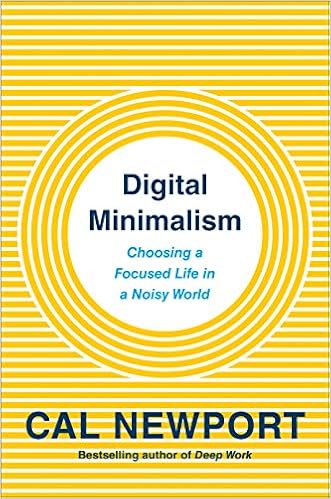 “Minimalism is the art of knowing how much is just enough. Digital minimalism applies this idea to our personal technology. It’s the key to living a focused life in an increasingly noisy world.” (Amazon)
I’ve been creeping in this direction for a while. Never on FB; deleted my Twitter account back in 2016; and said goodbye to Google+ last year. But my world is still noisier than I’d like and I got some good ideas from this book. Here’s a few excerpts:
“Philip Morris just wanted your lungs. The App Store wants your soul.”
“Checking your “likes” is the new smoking.” — Bill Maher
“(Smart phones are) slot machines in our pockets.”
“What’s the single biggest factor shaping our lives today?” (Our screens)
“We didn’t sign up for the digital lives we now lead. They were instead, to a large extent, crafted in boardrooms to serve the interests of a select group of technology investors.”
“The iPod provided for the first time the ability to be continuously distracted from your own mind.”
“You cannot expect an app dreamed up in a dorm room, or among the Ping-Pong tables of a Silicon Valley incubator, to successfully replace the types of rich interactions to which we’ve painstakingly adapted over millennia. Our sociality is simply too complex to be outsourced to a social network or reduced to instant messages and emojis.”
“A life well lived requires activities that serve no other purpose than the satisfaction that the activity itself generates.”
“Assuming that you use Facebook, list the most important things it provides you—the particular activities that you would really miss if you were forced to stop using the service altogether. Now imagine that Facebook started charging you by the minute. How much time would you really need to spend in the typical week to keep up with your list of important Facebook activities?”
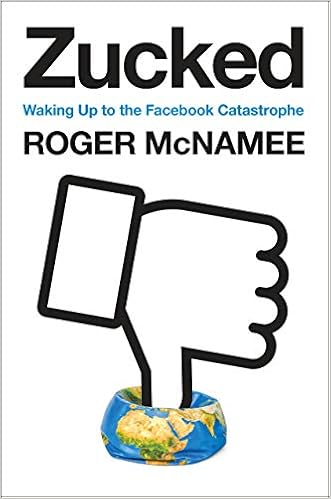
Zucked: Waking Up to the Facebook Catastrophe
Excerpts from Zucked: Waking Up to the Facebook Catastrophe by Roger McNamee.
Imagine a stew of unregulated capitalism, addictive technology, and authoritarian values, combined with Silicon Valley’s relentlessness and hubris, unleashed on billions of unsuspecting users.
The most likely case is that the technology and business model of Facebook and others will continue to undermine democracy, public health, privacy, and innovation until a countervailing power, in the form of government intervention or user protest, forces change.
Surveillance, the sharing of user data, and behavioral modification are the foundation of Facebook’s success.
When users are riled up, they consume and share more content. Dispassionate users have relatively little value to Facebook.
Facebook is the fourth most valuable company in America, despite being only fifteen years old, and its value stems from its mastery of surveillance and behavioral modification.
It turns out that connecting 2.2 billion people on a single network does not naturally produce happiness for all. It puts pressure on users, first to present a desirable image, then to command attention in the form of Likes or shares from others. In such an environment, the loudest voices dominate, which can be intimidating. As a result, we follow the human instinct to organize ourselves into clusters or tribes.
The competition for attention across the media and technology spectrum rewards the worst social behavior. Extreme views attract more attention, so platforms recommend them.
Research suggests that people who accept one conspiracy theory have a high likelihood of accepting a second one.
Belonging is stronger than facts.
The Russians might have invented a new kind of warfare, one perfectly suited to a fading economic power looking to regain superpower status.
Technology tends to reflect the values of the people who create them.
When a company grows from nothing to 2.2 billion active users and forty billion dollars in revenues in only fourteen years, you can be sure of three things: First, the original idea was brilliant. Second, execution of the business plan had to be nearly flawless. And third, at some point along the way, the people who manage the company will lose perspective. If everything your company touches turns into gold for years on end, your executives will start to believe the good things people say about them. They will view their mission as exalted. They will reject criticism. They will ask, “If the critics are so smart, why aren’t they so successful and rich as we are?”
On Facebook, information and disinformation look the same; the only difference is that disinformation generates more revenue, so it gets much better treatment.
Huge amounts of data are available. Campaigns can buy a list of two hundred million voting-age Americans with fifteen hundred data points per person from a legitimate data broker for seventy-five thousand dollars.
Where Orwell worried about the burning of books, Huxley argued that the greater risk would be citizen no longer wanting to read.
Facebook is a threat to democracy.