The Queen’s Gambit

The-Queens-GambitThis is a thriller about tournament chess. The tournaments aren’t just background for a more exciting plot, the chess games are the action. Piece-by-piece. Don’t play chess? (I don’t) Doesn’t matter, I was on the edge of my seat. (Wikipedia)

As with the only other novel I’ve ready by Walter Tevis (Mockingbird), I felt a sense of impending doom on every page of this story. I was exhausted by the end. I didn’t read closely enough to learn if Tevis was a chess player. Hard to image writing this story if he wasn’t.

If there was a false note, for me it was the main character’s struggle with alcohol and pills. According to Wikipedia, the author had the same struggle. This element just seemed “tacked on” to me.

[I was reminded of the drinking binges (and hang-overs) of Matthew Scudder, the alcoholic detective created by Lawrence Block. It was hard to read those without a cold cloth on the back of your neck.]

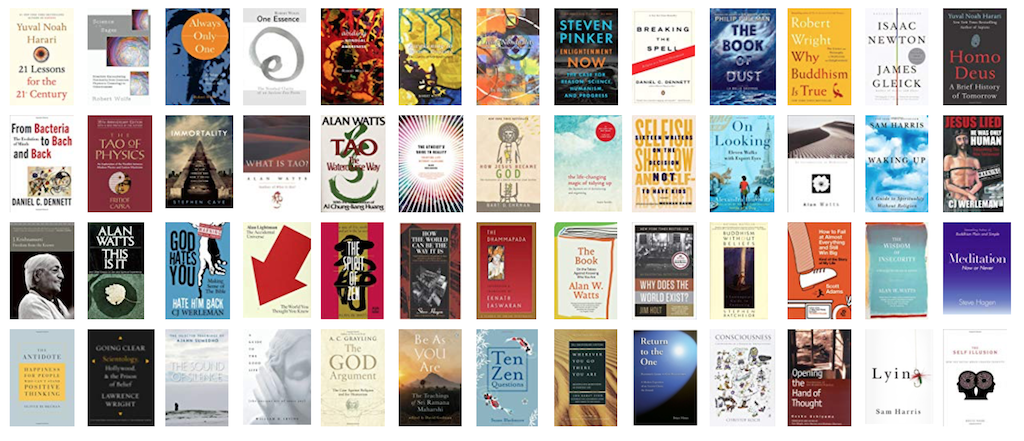
The God Argument

the-god-argumentThe God Argument (The Case Against Religion and for Humanism) by A. C. Grayling was a bit of a slow read for me, compared to a few other books I’ve read on this topic. This was, I believe, my first brush with secular humanism and it’s nice to have a basic definition of the concepts.

“Secularism is the principle of maintaining a separation between religious interests and bodies, on the one hand, and the state, on the other hand, on the premise that religion has no greater claim than any other self-interest outlook in debates about matters of government and public policy.”

“The basis of humanism is that we are to answer the most fundamental of all questions, the question of how to live, by reflection on the facts of human experience in the real world, and not on the basis of religion. […] As a broad ethical outlook, humanism involves no sectarian divisions or strife, no supernaturalism, no taboos, no food and dress codes, no restrictive sexual morality other than what is implicit in the demand to treat others with respect, consideration and kindness.”

Humanism’s two fundamental premises: 1) “there are no supernatural agencies in the universe,” 2) “our ethics must be drawn from, and responsive to, the nature and circumstances of human experience.”

“A key requirement (of humanism) is that individuals should think for themselves about what they are and how they should live. […] It imposes no obligations on people other than to think for themselves.”

Same for stoicism which, at first glances, seems to share some ideas with Buddhism.

“Stoicism’s main doctrine was that one should cultivate two capacities: ‘indifference’, and self-control. They used the term ‘indifference’ in the strict sense of this term to men neutrality, detachment, as in not taking sides on a question, or being disengaged from a quarrel.”

A few more ideas that got some highlighter »
Continue reading

William Gibson, NY Public Library

William Gibson is the author of ten books, including, most recently, the New York Times-bestselling trilogy Zero History, Spook Country and Pattern Recognition. Gibson’s 1984 debut novel, Neuromancer, was the first novel to win the three top science fiction prizes—the Hugo Award, the Nebula Award, and the Philip K. Dick Memorial Award. Gibson is credited with coining the term “cyberspace” in his short story “Burning Chrome,” and with popularizing the concept of the Internet while it was still largely unknown. He is also a co-author of the novel The Difference Engine, written with Bruce Sterling.

Present Shock: When Everything Happens Now

present-shock“We tend to exist in a distracted present, where forces on the periphery are magnified and those immediately before us are ignored.”

“The minute the ‘now’ is apprehended it has already passed. […] The more forcefully we attempt to stop the passage of time the less available we are to the very moment we seek to preserve.”

“Which ‘now’ is important: the now I just lived or the now I’m in right now?”

“Digiphrenia – the way our media and technologies encourage us to be in more than one place at the same time.”

“Not only have our devices outpaced us, they don’t even reflect a here and now that may constitute any legitimate sort of present tense. They are reports from the periphery, of things that happened moments ago. […] By dividing our attention between our digital extensions, we sacrifice our connection to the truer present in which we are living.”

“Humans once lived without any concept of time at all. In this early, hunter-gatherer existence, information was exchanged physically, either orally or with gestures, in person. People lived in an eternal present, without any notion of before or after, much less history or progress. Things just were. […] While they had to worry about where their next meal was coming from, they felt no pressure to succeed or to progress, to achieve or to improve. They had nowhere to go, since the very notion of a future hadn’t yet been invented. This stasis lasted several thousand years.”

“Like a digital file, a spelled word is the same everywhere it goes and does not decay.”

“Where calendars led people to think in terms of history, clocks led people to think in terms of productivity. Only after the proliferation of the clock did the word ‘speed’ (spelled spede) enter the English vocabulary.”

“Digital technology is more like a still-life picture. A sample. It is frozen in time. Sound, on the other hand, is audible only over time. We hear sound as it decays. […] The digital universe is a visual one: people staring silently at screens, where the only sounds in the room are the keys and mouse clicks.”

“While there is tremendous value in group thinking, shared platforms, and networked collaboration, there is also value in a single mind contemplating a problem.”

“We must retrain ourselves to see the reward in the amount of time we get to spend in the reverie of solo contemplation or live engagement with another human being. Whatever is vibrating on the iPhone just isn’t as valuable as the eye contact you are making right now.”

“In the space of one childhood, we can learn what it took humanity many centuries to figure out.”

“Catching up with Twitter is like staying up all night to catch up on live streaming stock quotes from yesterday. The value was in the now — which at this point is really just a then.”

“When everything is rendered instantly accessible via Google and iTunes, the entirety of culture becomes a single layer deep. The journey disappears, and all knowledge is brought into the present tense.”

“Our recorded past competes with our experienced present for dominance over the moment. […] What isn’t coming at us from the past is crashing in at us from the future.”

“Big data companies collect seemingly innocuous data on everyone, such as the frequency of our text messages, the books we’ve bought, the number of rings it takes us co pick up the phone, the number of doors on our cars, the terms we use in our Web searches, in order to create a giant profile. They then compare this profile against those of everyone else. For reasons no one understands, the data may show that people who have two-door cars, answer the phone in three or more rings, and own cats are extremely likely to respond favorably to ads for soup. So these people will Ье shown lots of soup advertisements. The market researchers don’t care about the data points themselves or the logic connecting one behavior to another. They only care care about predicting what a person is statistically likely to do.”

“For the first time, people engaged with products completely divorced from the people who actually made them. Technologies masked not just the labor, but also the time that went into an item’s production. […] This new way of interacting with things defined a new human identity for the very first time — that of the consumer.”

“Consumption makes up about half of all economic activity in America.”

“In a digitally enhanced consumer reality, we not only work to keep up with the latest products and service options, we purchase products and services that serve no purpose other than to help us better keep up. Our iPads and Adroids are nothing like the productivity-computing tools on which they may once have been based but are instead purchasing platforms designed to increase the ease and speed with which we consume.”

“We are so good at making stuff and providing services that we no longer require all of us to do it.”

“It is now usually cheaper to just try something than to sit around and try to figure out whether to try something.” — Joichi Ito

“The individual is flow, and the community is storage. Only the individual can take actions. Only the community can absorb their impact over time.”

“Fractalnoia – Relating one thing to another, even when the relationship is forced or imagined.”

“Ideas don’t generally emerge from individuals, but from groups (liquid networks).” – Social critic Steven Johnson

“In a networked ideascape, the ownership of an idea becomes as quaint and indefensible a notion as copyright or patents. Since ideas are built on the logic of others, there is no way to trace their independent origins. It’s all just access to shared consciousness. Everything is everything.”

“Consumers don’t want to speak with companies through social media; we want to speak with one another. We don’t even think of ourselves as consumers anymore, but as people.”

“As long as people didn’t engage with one another and were instead kept happily competing with one another, their actions, votes, and emotions remained fairly predictable.”

“The human body is a space suit for something that could be stored quite differently.”

“I find myself unable to let go of the sense that human beings are somehow special, and that moment-to-moment human experience contains a certain unquantifiable essence. I still suspect there is something to quirky, too paradoxical, or too interpersonal to be imitated or re-created by machine life.”

Amazon

Ten Zen Questions by Susan Blackmore

tenSusan Blackmore describes her fascinating book as “my own attempt to combine science and personal practice in the investigation of consciousness.”


“Learning to meditate means nothing more than learning to sit still and pay attention, staying relaxed and alert, without getting tangled up in trains of thoughts, emotions or inner conversations.”

“Now I understood the need for a calm mind. We were told that calming the mind is the starting point of all meditation, but that it can also take you all the way. We were told even scarier things; that what you are searching for is here right now, that there is really nothing to strive for and that once you arrive you will realise there was nowhere to go in the first płace; that however hard you work, and you must work hard, in the end you will know that there is nothing to be done.”

“Being in the present moment […] meant that I was not to think about the next moment, not to dwell on what I had just done, not to think about what I might have said instead, not to imagine a conversaton that I might have later, not to look forward to lunch, not to look forward to weekends, or holidays or… anything.”

“The present moment is always all right. All my troubles lay in the thoughts I was letting go of. […] The body seemed to keep on doing relevant and sensible things, apparently without all the agonising I had assumed was essential.”

“Idealism: The idea that there is no separate physical world, and everything in the universe is made up of thoughts, or ideas or consciousness.”

“Materialism: The idea that there is no separate mental world, and everything in the universe is mad of matter.”

“Actions exist, and also their consequences, but the person that acts does not. — Buddhist saying

“Am I conscious now? It troubles me that I seem so often to be unconscious. I wonder what this unconsciousness is. I cannot believe I spend most of my life in a kind of darkness. Surely that cannot be so. Yet every time I ask the question it feels as though I am waking up, or that a light is switching on.”

“How can I look into the darkness, when looking makes it light?”

“The words aren’t really necessary anymore. Rather, there just seems to be a questioning attitude, an openness of mind. Am I conscious now? Yes, I am, keep on that way, and now, and now, and gently now. […] Awareness does become more continuous with practice — it can just take a very long time.”

“I can grab a now. I can grasp out with my attention. This and this. They happened at once, didn’t they. It was a now, I am sure, even though it was gone by the time I can have that certanty. […] I cannot work out what it would mean for there to be no now. And yet there does not seem to be a now. […] When I sit quietly, doing nothing, there is no obvious choice of what is now. Stuff just happens.”

“I was looking for the me that was looking and I found only the world. I am, it seems, the world I see.”

“There is not a separate me as well as the experience. It is hard to accept that I am all those people walking down the street.”

“I see and hear and feel but name nothing. […] It is something like paying attention equally to everything.”

“How can I tell the clouds have moved? Because from one moment to the next I can remember what came before.”

“There are multiple brain processes going on, some of which take up more of the brain’s capacity than others, but there is no me who experiences them, and no time at which they become conscious.”

“The world we think we see or hear — is always a memory. and what is a memory?”

“Do past and future look different? […] They’re all just the same stuff — memory stuff; imagination stuff. Past and future can be held in mind as equivalent.”

“Mindfullness is being fully here in the present moment. But now I know that there is no such moment. So what is mindfullness?” [What I understand as ‘now’ is really just a memory of just-past moment]

“What was I conscious of a moment ago? I found whole streams of experience that seemed to have already been going on, for someone, before I noticed them.”

“There is no thinker other than the thoughts. […] I’ve always treated thoughts as a problem, or something to be dealt with. Now, instead of either fighting them or watching them, I am simply to be them.”

“The universe seems to be causlly closed. That is, everything that happens is caused by something else. Nothing happens by magical forces intervening from outside the web of causes and effects, for everything is interconnected with everything else. […] Yet I feel as though I can act freely. Indeed this magical view is probably how most people in most cultures have always thought about themselves, imagining a non-physical mental entity that has wishes and desires, can think and plan, and carry out those plans by acting on the world.”

“Decision are made because of countless interacting events, and afterwards a little voice inside says, ‘I did that’, ‘I decided to do that.’ […] I am not separate from the perceptions, thoughts and actions that make up my world. And if I am what seems to be the world, the we are in this together. Me and the world, world/me are doing all these actions that now just seem to act of their own accord.”

“The world had summed up the options, chose one, carried it out, and moved on. This action was a result of everything I had learned and done before. […] Could I just trust the world and this body to woirk all by itself without me doing anything?”

“I am not a continuous conscious being at all. What seems to be me just arises along with whatever is being experienced. […] Every time some experience comes along, the me is allowed to go, along with the ending of the experience, as though experience and experiencer arise and then snuff out together. […] There never was a continuous I. […] The ‘same me’ was never recreated. […] Will I be snuffed out like a candle? Yes, just as I have been a thousand, million times before.” #

“Consciousness is an illusion; an enticing and convincing illusion that lures us into believing that our minds are separate from our bodies.”

“(My selves) arise along with the sensations, perceptions and thoughts that they seem to be having, and die along with them. With every new ‘this’ there is a new ‘me’ who was looking into it.”

There is nothing it is like to be me.
I am not a persisting conscious entity.
I do not consciously cause sthe actions of my body.
Consciousness is not a stream of experiences.
Seeing entails no vivid mental pictures or movie in the brain.
There is no unity of consciousness either in a given moment or through time.
Brain activity is neither conscious no unconscious.
There are no contents of consciousness.
There is no now.

“At any time in a human brain there are multiple parallel processes going on, conjuring up perceptions, thoughts, opinions, sensations and volitions. None of these is either in or out of consciousness for there is no such place. Most of the time there is no observer: if consciousness is involved at all it is an attribudon made later, on the basis of remembering events and assuming that someone must have been experiencing them in the past, when in fact no one was.”

Brave New War

Here’s my over-simplification of John Robb’s thesis in Brave New War: A few, dedicated “Global Guerrillas” can defeat the army of a nation state by disrupting critical systems. I thought he made a pretty good case. Not sure about his timing, however. The book, written in 2007, suggests a dire sceneria for 2016:

“Security will become a function of where you live and whom you work for, much as health care is allocated already. Wealthy individuals and multinational corporations will be the first to bail out of our collective system, opting instead to hire private military companies, such as Blackwater and Triple Canopy, to protect their homes and facilities and to establish a protective perimeter around daily life. Parallel transportation networks—evolving out of the time-share aircraft companies such as Warren Buffett’s Netjets—will cater to this group, leapfrogging its members from one secure, well-appointed lily pad to the next. Members of the middle class will follow, taking matters into their own hands by forming suburban collectives to share the costs of security—as they do now with education—and shore up delivery of critical services. These “armored suburbs” will deploy and maintain backup generators and communications links; they will be patrolled civilian police auxiliaries that have received corporate training and boast their own state-of-the-art emergency response systems. As for those without the means to build their own defense, they will have to make do with the remains of the national system. They will gravitate to the cities, where they will be subject to ubiquitous surveillance and marginal or nonexistent services. For the poor, there will be no other refuge.”

I kept looking for “the good news” but this was the best he offered:

“The strikes of the future will be strategic, pinpointing the systems we rely on, and they will leave entire sections of the country without energy and communications for protracted periods. But the frustration and economic pain that result will have a curious side effect: they will spur development of an entirely new, decentralized security system, one that devolves power and responsibility to a mix of local governments, private companies, and individuals.”

Brave New War was only a couple hundred pages and well worth the read for those that share my sneaking suspicion a) our governments don’t tell us the truth, and b) we are not winning The War on Terror because it can’t be won.

Wherever You Go There You Are by Jon Kabat-Zinn

Mindfulness Meditation in Everyday Life by Jon Kabat-Zinn (Amazon)

Screen Shot 2013-02-22 at Fri, Feb 22, 12.01.09 PM


What happens now, in this moment, influences what happens next.

We tend to be particularly unaware that we are thinking virtually all the time. […] Meditation means learning how to get out of this current.

Meditation is the only intentional, systematic human activity which at the bottom is about not trying to improve yourself or get anywhere else, but simply to realize where you already are.

Let go of wanting something else to happen in this moment.

Is it possible for you to contemplate that this may actually be the best season, the best moment of your life?

Look at other people and ask yourself if you are really seeing them or just your thoughts about them. Sometimes our thoughts act like “dream glasses.”

If you do decide to start meditation, there’s no need to tell other people about it, or talk about why you are doing it or what it’s doing for you. […] Just look at (this) as more thinking.

Meditation is neither shutting things out nor off. It is seeing things clear4ly, and deliberately positioning yourself differently in relationship to them.

Meditation is not about feeling a certain way. It’s about feeling the way you feel. It’s not about making the mind empty or still. […] Meditation is about letting the mind be as it is.

Even our leisure tends to be busy and mindless. The joy of non-doing is that nothing else needs to happen for this moment to be complete.

“To affect the quality of the day, that is the highest of arts.” — Thoreau

(We meditate to realize) “…that things are already perfect.”

We tend to see things through tinted glasses: through the lens of whether something is good for me or bad for me, or whether or not it conforms to my beliefs or philosophy.

At the deepest level, there is no giver, no gift, and no recipient… only the universe rearranging itself.

Voluntary Simplicity: “…intentionally doing only one thing at a time and making sure I am here for it.

If mindfulness is deeply important to you, then every moment is an opporunity to practice.

Meditation is more rightly thought of as “Way” than as a technique.

Awareness is not the same as thought. It lies beyond thinking. […] Awareness is more like a vessel which can hold and contain our thinking.

Meditation involves watching thought itself.

The posture itself is the meditation. The posture speaks of not looking for anything more, but simply digesting what is.

Mindfullness: Allowing one moment to unfold intot he next without analyzing, discoursing, judging, condemning, or doubting; simply observing, embracing, opening, letting be, accepting. Right now. Only this step. Only this moment.

We often see our thoughts, or someone else’s, instead of seeing what is right in front of us or inside of us.

When we perceive our intrinsic wholeness, there is truly no place to go and nothing to do.

What we call “the self” is really a construct of our own mind.

Stop trying so hard to be “somebody” and instead just experience being. […] You are only you in relationship to all other forces and events in the world.

You are who you already are. But who you are is not your name, your age, your childhood, your beliefes, your fears. They are part of it, but not the whole.

The self is impermanent. […] It is constantly changing, decaying, and being reconstructed again, always slightly differently, depending on the circumstances of the moment. […] It never repeats itself. Whenever you look, it is slightly different.

Mockingbird (Walter Tevis)

Plot summary from Wikipedia: “The novel begins hundreds of years in the future in Manhattan, where most of the buildings have been razed and its population, as with the world’s, is largely depleted. The surviving people are illiterate, and are drugged with pills that makes them apathetic and infertile. That has caused human life on the planet to gradually decline to the point of near-extinction. The surviving humans are survived by android robots, of which Spofforth is the most powerful and sophisticated. No humans have been born in many years and there are no children. Suicide by immolation is rampant, as people have nothing to live for.”


Mockingbird(1stEd)“In the vast and cluttered factory room where he was brought into awareness his dark eyes looked around him with excitement and life. He was on a stretcher when he first experienced the power of consciousness enveloping his nascent being like a wave, becoming his being. His constricted throat gagged and then cried out at the force of it — at the force of being in the world.”

“Spofforth had been designed to live forever, and he had been designed to forget nothing. Those who made the design had not paused to consider what a life like that might be like.”

“The idea of the sequence of events and circumstances — that things had not always been the same — was one of the strange and striking things that had occurred to me as I had become aware of what I can only call the past. […] I feel that I understand a good many things since I have begun to memorize my life. You get the sense that one thing comes after another and that there is change.”

“Then he removed my handcuffs, with a surprisingly gentle touch, and had me place my right hand in the Truth Hole that sat directly in front of me. He said quietly, “For each lie you tell, a finger will be severed. Answer the judge with care.”

“And they read, hearing the voices of the living and the dead speaking to them in eloquent silence, in toucnh with a babble of human talk that must have filled the mind in a manner that said: I am human, I talk and I listen and I read.”

“Sadness. Sadness. But I will embrace the sadness, and make it a part of this life I am memorizing.”

“When the drugs and the television were perfected by the computers that made and distributed them, the cars were no longer necessary.”

“I would like to know, before I die, what it was like to be the human being I have tried to be all my life.”

“I think now that they expected something miraculous to happen when they started to hear the words from the Bible read aloud, opening up that mystery to them—the message of an inscrutable book they had learned to revere. But no miracle occurred, and they soon lost any real interest. I think that to know what those words said required an attention and a devotion that none of them possessed. They were willing to accept their stringent piety, and silence, and sexual restraints, all unthinkingly, along with a few platitudes about Jesus and Moses and Noah; they were overwhelmed, however, at the effort it would require to understand the literature that was the real source of their religion.”

“I no longer wanted to keep my mind silent, or use it as a vehicle for disconnected pleasure; I wanted to read, and think and talk.”

“My mind racing with the realization that all my notions of decency were something programmed into my mind and my behavior by computers and by robots who themselves had been programmed by some long-dead social engineers or tyrants or fools.”

“Whatever may happen to me, thank God I can read, that I have truly touched the minds of other men.”

“All of those books — even the dull and nearly incomprehensible ones — have made me understand more clearly what it means to be a human being.”

“It (the Empire State Building) is only a marker, a mute testimoney to the human ability to make things that are too big.”

Wikipedia

Consciousness

Conscious book cover“The idea that humans are special, that they are singled out by the gift of consciousness above all other creatures, stems from the deeply held Judeo-Christian belief that we occupy a privileged place in the order of things, a belief with a biblical but no empirical basis. We are not special. We are just one species among uncountable others.”

“Imagine a construction set of a thousand different types of LEGO bricks of distinct colors, shapes, and sizes. The human cerebral cortex has sixteen billion bricks chosen from these types, assembled according to fantastically elaborate rules, such as a red 2×4 brick is linked to a blue 2×4 but only if it is near a yellow 2×2 roof tile and a green 2×6 piece. From this is born the vast interconnectedness of the brain.”

“It is not the nature of the stuff that the brain is made out of that matters for mind, it is rather the organization of that stuff – the way the parts of the system are hooked up , their causal interactions.”

Consciousness by Christof Koch

Name the Beatles (Carl Hiaasen – Skin Tight)

One of my favorite bits of dialogue in Carl Hiaasen’s Skin Tight:

“But I don’t want to many you,” she said. “I promise. Even if you ask me afterwards, I’ll say no—no matter how great it was. Besides, I’m not a waitress. You said all the others were waitresses.”
He groaned and said, “Tina, I’m sorry. It just won’t work.”
“How do you know it won’t work?” she said to Stranahan
“I’m too old.”
“Bullshit.”
“And you’re too young.”
”Double bullshit.”
“Okay,” he said. “Then name the Beatles.”
“What?” Tina forced a caustic laugh. “Are you serious?”
“Dead serious” Stranahan said, addressing her from the edge of the roof. “If you can name all the Beatles, I’ll make love to you right now. ”
“I don’t believe this,” Tina said. “The fucking Beatles.”
Stranahan had done the math in his head: She was nineteen, which meant she had been born the same year the band broke up.
‘Well, there’s Paul,” Tina said.
“Last name? Come on! Let’s hear it.”
“McCartney, okay? I don’t believe this.”
Stranahan said, “Go on, you’re doing fine.”
“Ringo,” Tina said. “Ringo Starr. The drummer with the nose.”
“Good.”
“And then there’s the guy who died. Lennon.”
“First name?”
“I know his son is Julian.”
“His son doesn’t count.”
Tina said, “Yeah, well, you’re an asshole. It’s John. John Lennon.”
Stranahan nodded appreciatively. “Three down, one to go. You’re doing great.”
Tina folded her arms and tried to think of the last Beatle. Her lips were pursed in a most appealing way, but Stranahan stayed on the roof. “I’ll give you a hint,” he said to Tina. “Lead guitar.”
She looked up at him, triumph shining in her gray eyes. “Harrison,” she declared. ”Keith Harrison!