
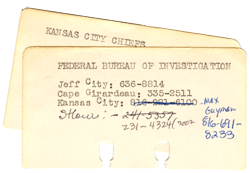
You’re in my Rolodex

One of the reporters in one of our newsrooms has a Rolodex that goes back 30+ years. The cards are worn from handling and yellowed by the years. I have no idea if he also maintains some kind of computer file as well. Doubtful.

A well-maintained Rolodex was once the most valuable thing on a reporter’s (or salesman’s) desk and the one thing to take with you when the time came.

It’s from a time when the telephone was the sole means of instant communication but not yet smart enough to remember more than a half-dozen numbers (“I’ve got you on speed dial”).

I wonder how many fewer calls are made in our email world. Has Outlook become the new Rolodex? Or has our mobile phones absorbed that function? Losing your phone is only a big deal because it might mean losing all of the numbers of friends and contacts.

Which brings us to social networks.

Will being able to communicate with you –by calling or emailing– become less valuable than having you “friend” me on Facebook or “follow” me on Twitter. The difference is me seeking your attention versus you deciding to give me your attention.

Let’s say you’re a salesman for a paper products company. Let’s call you Stanley. You have the phone number and email addresses of your 20 largest customers. With a little time and patience, you can get them on the phone; get a reply to an email; and even get an appointment.

But suppose those customers elected to follow your Twitter feed because that’s where you posted links to information that they found valuable enough to give their attention. I submit it is a different –more valuable– kind of attention than you get when you punch through with a call or email.

One last example. I can call or email the senior management of our company. Most of them are in the same building, so I can walk down the hall and usually get some face time. But a couple of them read my blog and –in time– will follow my Twitter feed. And the only reason they would invest even a minute or two from incredibly busy days, is they perceive some value (information or entertainment).

Being in someone’s network is far more valuable than being on their call-back list. Or in their Roladex.

Pill to erase bad memories

I first wondered about this back in 2004. A couple of years later, 60 Minutes did a segment on one such drug. Now Dutch researchers claim to have erased bad memories by using ‘beta-blocker’ drugs, which are usually prescribed to patients with heart disease.

“The astonishing treatment could help sufferers of post-traumatic stress disorder and those whose lives are plagued by hurtful recurrent memories. But British experts said the breakthrough raises disturbing ethical questions about what makes us human. They also warned it could have damaging psychological consequences, preventing those who take it from learning from their mistakes.”

Would I take such a pill? I think I might. I haven’t experienced more than my share of pain or trauma but if I’m a better person for it, I’m hard pressed to say how.

“But you are YOU because of the sum of your experiences, smays.com,” one might argue.

Yes, and I’d just be a different person if I took the pill and erased the memories. In fact, maybe I did take the pill. I wouldn’t remember, would I?

And before we leave this topic… how is this different from taking pills that alter our perception of this moment (Valuium, anti-anxiety meds, etc)?

“Democratization of information”

Last month I –like many others– made note of Janis Krums being among the first to report (on his Twitter feed) that an airliner had crash landed in the Hudson River. Will Leitch was in the SF offices of Twitter, working on an article for New York Magazine, as the story was breaking.

“In the midst of chaos—a plane just crashed right in front of him!—Krums’s first instinct was to take a picture and load it to the web. There was nothing capitalistic or altruistic about it. Something amazing happened, and without thinking, he sent it out to the world. And let’s say he hadn’t. Let’s say he took this incredible photo—a photo any journalist would send to the Pulitzer board—and decided to sell it, said he was hanging onto it for the highest bidder. He would have been vilified by bloggers and Twitterers alike. His is a culture of sharing information. This is the culture Twitter is counting on. Whatever your thoughts on its ability to exist outside the collapsing economy or its inability (so far) to put a price tag on its services, that’s a real thing. That’s the instinct Stone was talking about. If the nation has tens of millions of people like Krums, that’s a phenomenon. That’s what Twitter is waiting for.”

I’ve given up trying to explain the phenomenon that Twitter has become but can’t help take note of the examples that pop up almost every day.

@angelawilson does freelance work for us and works from her home. Today she had The Price is Right on (“just for background”) and one of the ladies picked to be a contestant was part of a group of women wearing shirts with their Twitter names on the front (mine is @smaysdotcom). Host Drew Cary had to explain to the studio and viewing audience what Twitter was. I hope that shows up on YouTube because I’d really like to see it.

And then this afternoon I learned (from the Twitter feed of St. Louis Post-Dispatch Reporter Tony Messenger) that some kind of big “nuke hearing” was getting ready to start in the Senate. And that there was so much interest the hearing room was so packed they had to set up closed circuit TV monitors in a room on the third floor.

I followed Tony’s Twitter feed for a bit, where I learned that one of the senators (Jolie Justus) on the committee holding the hearing, was also using Twitter to let her “followers” know what was going on. You can check out her “tweets” (you should pardon the expression) at http://twitter.com/joliejustus. Where she assured us she’d tell us more about the four hour hearing tomorrow on her blog, Fresh Meat (she’s a freshman senator?).

What does all of this mean? I’m not sure I know. Does it mean something? Yeah, I’m pretty sure it does. As Twitter co-founder Ev Williams says in the NY mag piece:

“It’s another step toward the democratization of information. I’ve come to really believe that if you make it easier for people to share information, more good things happen.”

Me too.

UPDATE: Sen. Justus started her blog as a Freshman Senator two years ago. [Thanks, JW]

50s and 60s new prime?

Major U.S. companies are retaining workers over 55 even as younger workers get the ax. That’s the gist of an article in Feb edition of BUSINESSWEEK:

“Figures from the Bureau of Labor Statistics tell the tale: The number of people aged 55 and up with jobs actually rose nearly 900,000 from the start of the recession, in December 2007, through last year. By comparison, people aged 25 to 54 lost nearly 2.9 million jobs. The share of older Americans who have jobs has risen during the recession, while the share of younger Americans with jobs has plunged.”

And a “mature” dude such as myself, who is comfortable on the Internets… let’s get us some of them!

Job interviews

Lots of folks looking for jobs and many more will be. I’ve been trying to remember the last time I interviewed for a job. I blush to recall that Clyde recruited me 25 years ago and “insisted” I accept his offer.

In 1972 I got a job at the radio station where my father worked so there was nothing that resembled an interview. If I was willing to work 10p-6a, the job was mine.

The short-lived gig as a postal inspector was more of a pass the test, fill out the form kind of thing. Another instance of me “falling into” the job.

I can only recall a couple of job interviews: one for the Memphis TN police department; another with a community theater in Kansas City. I wasn’t qualified for either and was damned lucky I didn’t get hired.

During my Management days, I interviewed lots of people for jobs but don’t think I ever got very good at it. And I wouldn’t be very good at applying for a job now.

I wish the very best to those now “on the bricks.”