
Missouri Senator Claire McCaskill on Twitter

Missouri Senator Claire McCaskill has been getting a lot of interest in her use of Twitter (microblog, social networking tool, blah blah blah) to keep her constituents informed about what she’s doing. Politico recently named her to their list of the ten most influential Twitterers in DC (right behind Karl Rove).

Missourinet (network owned by Learfield, the company that pays me) reporter Steve Walsh brought up Twitter in a recent interview and the senator spoke wistfully about a day when she can “speak directly to everyone in Missouri,” describing it as “Nirvana.”

It was telling that my friend (and co-worker) Steve set his question up as “nothing at all to do with anything serious.”

Hmm. Should the day come that every elected official can speak directly to every one of the people they represent, without talking to a reporter, things could get serious (for the news media). Don’t get me wrong, we need good reporters like Steve, who can call bullshit on the politicians when necessary. They will always have a role. But it seems to be changing.

And this just in… anyone with access to the Internet can hear directly from Senator McCaskill.
KBOA voice of SE Missouri during/after ice storm

In the early days of the big ice storm that knocked out power to so many in southern Missouri, I kept hearing from friends in Kennett, Missouri (where Barb and I grew up) what a great job the local radio station (KBOA-AM) was doing. It was the only source for information and just a few announcers were keeping the station on the air with a generator and broadcasting non-stop with nothing but a phone and a microphone.

Steve Tyler, News Director Charles Isbell and Operations Manager Monte Lyons are all veteran radio guys (“with more than 100 years of experience between us”) who remember a time before computers and automation and syndicated talk shows. I figured they had some good stories to tell about the recent disaster. It runs about 20 minutes and –since they were on a speaker phone– you might have to listen closely.

AUDIO: Interview 20 min MP3

A tip of the hat to William Pollack, President of Pollack Broadcasting, the owner of the station(s), for deferring to his local staff and letting them make the call on how best to serve the community.

With cable and phone lines down, the Internet wasn’t much help for all those people sitting in the cold and dark, wondering when the power would come back on. But radio was there. Literally the voice of a community. Or communities.

I can’t foresee the future of small market radio but have to believe it will involve this kind of service and involvement. But that’s going to take people. People who know their neighbors and local business because they live there.

Will finding and hiring and training these men and women be easy. Doubt it. Will such staffing cut into profit margins. Probably. But if broadcasters don’t find a way to be truly local and relevant… their stations are almost certain to be cold and dark.

—–

For those that missed these earlier posts, Matthew Howard and Charles Jolliff share some photos of the ice damage… and friend and fellow-blogger Dr. Everett Mobley shares the journal he kept for the two weeks his family was without power. This is a terrific account.

Google Juice: Example #32

I do these from time to time, in spite of how self-serving they seem. That’s never my intention, given the modest traffic through this little alley of the Internet. I’m talking about Google ranking and how well blogs do in this most important metric.

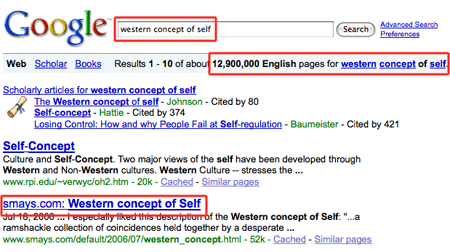
In July of 2006, I posted passage from John Burdett’s second novel, Bangkok Tattoo. The subject –and title of the post– was “Western Concept of Self.”

Today, I happened across the post and decided to Google “western concept of self” (minus the quotation marks). Those are pretty common terms and Goggle returned almost 13 million pages with one or more of them. My little post was number two on that list.


So when clients ask me, how can they get their website to show up on the first page of Google search results, I always tell them the same thing: Start by making your site a blog and update it every day.

“Isn’t there some meta-thingy you can hide on the page that will force my site to the top of the rankings?”

Yeah, maybe. But I’m not your guy for that. I love that Google almost always helps me find what I’m looking for and I’m not keen on helping someone game the system. Even for money. (God, I hope I don’t get hammered by all the SEO experts. Can I just stipulate that you guys are right and I’m wrong?)

One final point and it has to do with blogs vs. newsletters. I’ve posted on this in the past. It came up again recently. The “village elders” of a local organization were unhappy with the blog one of their members maintains for them. They didn’t like having frequent, short items and wanted to go back to their “newsletter” format. Save up any news and post it all, once a month, at the same time.

Nothing wrong with that approach if you’re only interested in reaching the people who are already in the organization and know to go check the website once a month. But if you’re trying to reach more and new people, you want that Google juice. Blogs deliver. Newsletters… not so much.

Jeff Jarvis: What Would Google Do

Jeff Jarvis’ new book, What Would Google Do looks like it might be a two highlighter read. I’ll be posting some of my favorite passages here but encourage you to buy and read the book.

“In retail, media, education, government, and health –everything– the link drives specialization, quality, and collaboration, and it changes old roles and creates new ones. The link changes the fundamental architecture of societies and industries the way steel girders and rails changed how cities and nations were built and how they operated. Google makes links work. Google is the U.S. Steel of our age.” – pg 27, What Would Google Do (Jeff Jarvis)

The Onion: Another Dark Ages?

From remarks by Scott Dikkers, Editor of The Onion. Freedom from Religion Foundation

“We live in an age now that could easily turn into another dark ages. It’s a time when irrational beliefs that run counter to established science are accepted not just by a large percentage of the population but also by our elected leaders.

The religious like to say they’re “saved.” But after eight years of their pick for president, it’s the rest of us who need to be saved.

And the people who voted for this leadership are ready to do it again, because they are ideologues, who are incapable of learning–they reject any factual information that contradicts their beliefs.”