Stories we told ourselves

“History in the older sense was narrative, stories we told ourselves about where we’d come from and what it had been like, and those narratives were revised by each new generation, and indeed always had been. History was plastic, was a matter of interpretation. The digital had not so much changed that as made it too obvious to ignore. History was stored data, subject to manipulation and interpretation.”

— All Tomorrow’s Parties by William Gibson

Online influence

Interesting article in the Sunday Review section of the New York Times (I think I used the last of my 20 free accesses for the month). It’s about the growing importance (?) of online influence.

“If you have a Facebook, Twitter or LinkedIn account, you are already being judged — or will be soon. Companies with names like Klout, PeerIndex and Twitter Grader are in the process of scoring millions, eventually billions, of people on their level of influence — or in the lingo, rating “influencers.” Yet the companies are not simply looking at the number of followers or friends you’ve amassed. Rather, they are beginning to measure influence in more nuanced ways, and posting their judgments — in the form of a score — online.”

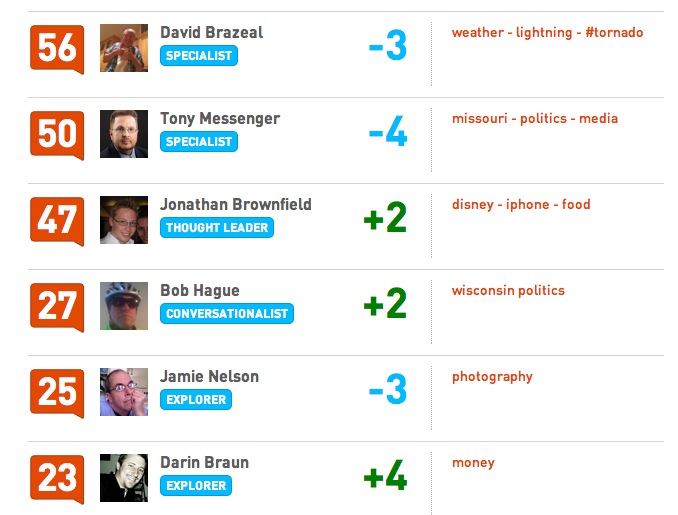
Yes, I check my Klout score from time to time but it’s never gotten above 40. 39 as of a few minutes ago. But 40 suggests “a strong, but niche, following.” Niche being the operative word. And the average Klout score is in the high teens, so…

“After analyzing 22 million tweets last year, researchers at Hewlett-Packard found that it’s not enough to attract Twitter followers — you must inspire those followers to take action. In other words, influence is about engagement and motivation, not just racking up legions of followers.”

Is there any sort of analogue to this in the world of traditional advertising? Do we even care about the influence of someone hearing our radio ad?

“Industry professionals say it’s also important to focus your digital presence on one or two areas of interest. Don’t be a generalist. Most importantly: be passionate, knowledgeable and trustworthy.”

Half the fun of checking your Klout score is comparing your score to your friends and acquaintances.

My pal David Brazeal is off on his own now and needs as much Klout as he can get. He’s something of an expert on “weather, lightening & tornados.” Jonathan Brownfield should be higher given his access to beautiful, large-breasted young women.

My plan is to stand outside Hooters and wait for a bad storm.

Moving from ownership to access

“Who owns this data? Who owns your friendships? There’s another party involved. Who owns your genes? 99.9% are shared by other humans. Who owns your location? The knowledge that you’re in a public space is hard to own. Your reputation or history? Your conversations? The real issue is that we’re moving away from ownership altogether to access. The benefits of accessing are eclipsing the benefits of (owning) it – consumers may eventually not own anything at all. Netflix means you can stop owning movies – if you have access to all movies anytime, why would you buy movies? This may be leaking from the virtual to the material world, particularly once we have personal fabrication. It may eventually play out into data, because access is often better than ownership.”

From Kevin Kelly’s remarks at the Quantified Self conference in May this year. More of Kelley’s speech.

Incognito – The Secret Lives of the Brain by David Eagleman

It’s easy to think of “me” has “having” a brain, but this book left me thinking my brain has me. If there is a me apart from my brain, I fear it’s mostly along for the ride. Here are some ideas that brought out my highlighter.

The brain generally does not need to know most things; it merely knows how to go out and retrieve the data. It computes on a need-to-know basis. pg 28

You’re not perceiving what’s out there. You’re perceiving whatever your brain tells you. pg 33

We have no access to the rapid and automatic machinery that gathers and estimates the statistics of the world. pg 34

Your brain is in the dark but your mind constructs light. pg 40

The difference between being awake and being asleep is merely that the data coming in from the eyes anchors the perception. Asleep vision (dreaming) is perception that is not tied down to anything in the real world; waking perception is something like dreaming with a little more commitment to what’s in front of you. pg 45

It’s easy to spot a hallucination only when it’s bizarre. For all we know, we hallucinate all the time. pg 46

Our expectations influence what we see. There has to be a match between your expectations and the incoming data for you to “see” anything. Awareness of your surroundings occurs only when sensory inputs violate expectations. pg 48, 50

The brain refines its model of the world by paying attention to its mistakes. pg 49

The brain tries to see the world only as well as it needs to. We are not conscious of most things until we ask ourselves questions about them. What we perceive in the outside world is generated by parts of the brain to which we do not have access. pg 54

Instead of reality being passively recorded by the brain, it is actively constructed by it. pg 82

There are thoughts you cannot think. pg 82

Evolution has carefully carved your eyes, internal organs,sexual organs, and so on — and also the character of your thoughts and beliefs. pg 82

“In general, we’re least aware of what our minds do best.” — Marvin Minsky, The Society of Mind

We are not able to see the instincts that are the very engines of our behavior. These programs are inaccessible to us not because they are unimportant, but because they’re critical. Conscious meddling would do nothing to improve them. pg88

Briefly glimpsed people are more beautiful. pg 92

We come to know our own attitudes and emotions, at least partially, by inferring them from observations of our own behavior. pg 134

David Eagleman is neuroscientist at Baylor College of Medicine, where he directs the Laboratory for Perception and Action.