
Everything you need to know about Kennett, MO
Author Archives: Steve Mays
“Why humans cling to stories”
I prompted Perplexity to look for themes or trends in the 70+ posts (going back to 2004) in the Religion category.
1. Religion as human-made stories and systems
You treat religion less as revelation and more as a **human** technology: something people invent, edit, and use to organize behavior, power, and meaning. You’re drawn to writers like Harari, Adams, Hines, Watts, Harris, and Ehrman who frame gods, money, nations, and ideologies as “shared fictions” or “maps” that work pragmatically rather than metaphysically. Your own comments echo that: religion is one example of a larger human habit of myth‑making to hold fragile social orders together.
2. Skepticism of certainty, affection for “I don’t know”
Many posts poke at people who are utterly sure they’ve found the “one true faith” out of thousands of incompatible options. You highlight quotes and essays that argue the only honest stance is some version of “I don’t know, and neither do you,” and you clearly resonate with that. The tone is rarely angry; it’s closer to amused disbelief at how confident people can be in claims they can’t possibly verify.
3. Religion, ego, and performance
You repeatedly connect religiosity to **ego**: chosen peoples, special relationships with God, and the need to feel correct or favored. Posts about appearing religious (Machiavelli, “appearing to be religious”), evangelical branding, and “religion and ego” all treat belief as something performed for social and psychological payoff as much as for doctrine. You’re especially interested in the gap between what people say they believe and how they actually behave or legislate.
4. Power, politics, and “weaponized” faith
Another through‑line is religion as a power tool: surveillance, social control, justification for violence, or political branding (evangelicals and the GOP, Christian Right decline, cults, “The Family”). You focus less on abstract theology and more on who gets to define “God’s will” and what that does in the real world. Organized religion, in your posts, is often less about God than about those who act in his name.
5. Spirituality without dogma
Alongside the critique, there’s a consistent interest in non‑dogmatic spirituality: Zen, Buddhism, meditation, Sam Harris’s “spirituality without religion,” Alan Watts on stillness and consciousness. You repeatedly highlight ideas about awareness, present‑moment experience, the illusory self, and consciousness as primary, often contrasting that with inherited belief systems and scriptures “cobbled together during the Iron Age.” You seem much more attracted to practices that clarify experience than to creeds that explain it.
6. Religion, technology, and future “gods”
In more recent posts you connect religion to AI, Silicon Valley, and new ideologies: AI‑written scriptures, Silicon Valley as a birthplace of future religions, money and the economy as a kind of religion, liberalism/communism/nationalism as modern creeds. A recurring question is what happens to “religions of text” when the texts start talking, or when algorithms and biotech become the new sources of superhuman authority.
7. Your overall stance
Putting it all together, your “religion posts” read less like attacks on believers and more like a long, curious investigation into why humans cling to stories and what those stories do to us. You tend to trust awareness over belief, experience over doctrine, and are wary whenever any story—religious or secular—claims unquestionable authority.
Goodbye old friend
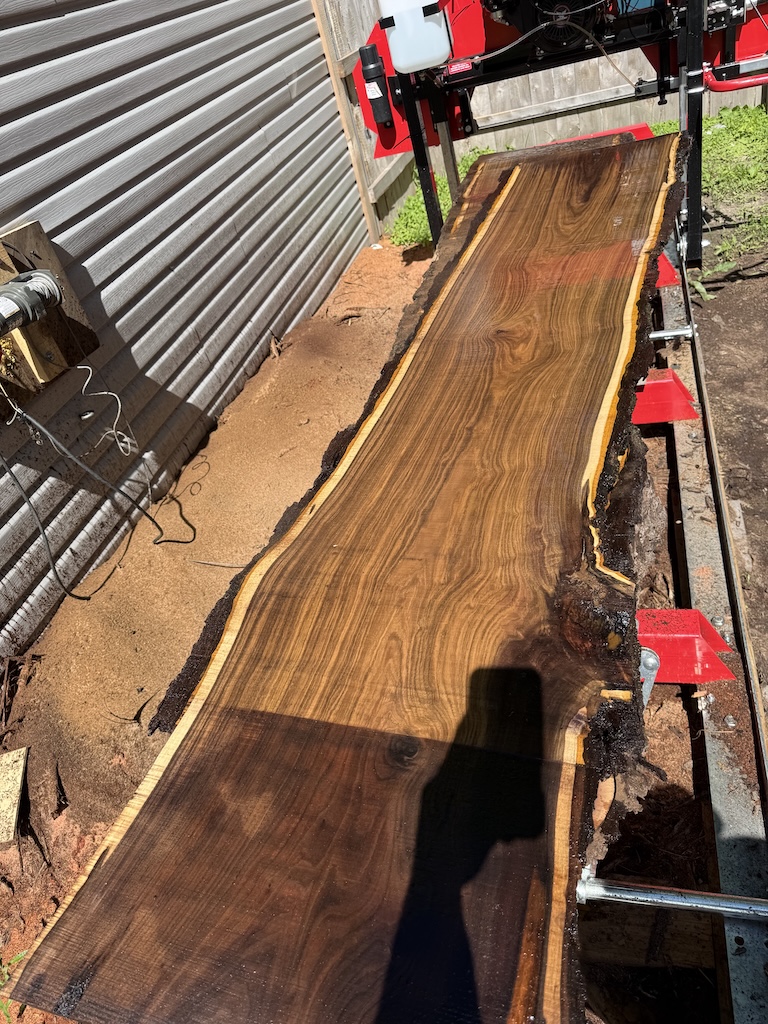
The local electric co-op crew insisted on cutting the few remaining live limbs on our old Walnut tree and it wasn’t going to survive. So today we said goodbye.
Based on several metrics, the tree was between 80 and 100 years old.
The equipment in the video is a knuckleboom loader (specifically a forestry/trash crane) mounted on a grapple truck. This specific configuration is commonly used by tree service companies (like “Korte Tree Care” seen on the door) to load heavy logs and brush into the truck for transport without requiring a separate loader or manual lifting. A complete grapple truck like the one in the video typically costs between $150,000 and $350,000 when purchased new.
UPDATE: The young man using this amazing piece of equipment is Josh. He took a big part of the trunk home where he milled it into planks and boards. Barb is buying one for her nephew Wes who might turn it into a coffee table.
Basement Diaries slide show
And oldie-but-goody from 2013.
My reading gestalt
I uploaded 495 blog posts from my BOOKS category to Perplexity and prompted it look for any themes, trends, connections, etc. This is another of those tasks that I’m not sure could have completed. And certainly not as well. This is my reading gestalt. (At the bottom of the page is a link to what Gemini came up with)