iTunes adds Major League Baseball video highlights

On Friday, Apple announced they’ll be offering Major League Baseball video highlights for the 2007 season on the iTunes Store. MLB video on iTunes will include a daily 25 minute MLB.com Daily Rewind highlight show and two weekly Games of the Week, featuring full versions of the best games from the National and American Leagues.

Customers will be able to download individual episodes of MLB.com Daily Rewind and each Game of the Week for $1.99, or purchase a Multi-Pass for a month of Daily Rewind shows for $7.99 or a Season Pass for every Game of the Week at just $19.99. [Podcasting News]

I’m not a baseball fan but I do love highlights (of almost any sport). And I’ll probably invest $1.99 just to see how these look on the Apple TV. (“I just don’t know what you’d watch on that Apple TV thing.”)

Regular readers know the company I work for has the multi-media marketing rights for 32 college athletic programs. I sure hope somebody is working on something similar for our schools.

Blog lemonade

VirginaThe “West Virginia” printed on the shirts players wore after winning the NIT title with a 78-73 victory over Clemson on Thursday night is missing the last “i” in “Virginia.” WVU sports information director Shelly Poe said the NIT printed the shirts.

Embarrassing? Maybe a little for the NIT. But certainly not for West Virginia. Their accomplishment is in no way diminished. But it will get a little ink for a day or two.

If I were the Resident Blogger for West Virginia Athletics, I would be having some fun with this.

  • Invite fans to send in videos of themselves wearing the T-shirt and explaining the misspelling.
  • Post an explanation loaded with typos.
  • Have a fake professor (with British accent) explain how the spelling on the shirt is –in fact– the original, “correct” spelling of “Virgina”

Blogging lemonade.

Disclosure: The company I work for handles multi-media marketing for Clemson.

“Citizens” against satellite radio; Who’s got HD?

Mark Ramsey (Hear 2.0): “C3SR – the consumer group that was created to oppose the merger between XM and Sirius – is in fact supported by the NAB.”

Also at Hear 2.0: “…the average consumer is more likely to die by accidental drug overdose or by hanging, strangulating, or suffocating themselves than they are to own an HD radio.”

I’d love to hear from any smays.com readers who have HD radios. How’s it sound? What are you listening to? Use Comment link below.

iPods help doctors recognize heart problems

Doctors can greatly improve their stethoscope skills and therefore their ability to diagnose heart problems by listening repeatedly to heartbeats on their iPods. Previous research has shown that the average rate of correct heart sound identification by physicians is 40 percent.

In a new study, 149 general internists listened 400 times to five common heart murmurs during a 90-minute session with iPods. After the session, the average score improved to 80 percent.

Apple TV: The price of simplicity

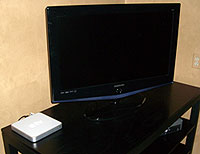
Apple TVI spent part of the weekend playing with Apple TV. George came over Saturday and we had the thing up and running within 15-20 minutes. I won’t try to “review” this device because a) I don’t have the technical chops, b) I’m not a videophile or power user by any stretch and c) lots of websites and blogs have provided professional reviews.

And just for the record: Windows Media Center is light years ahead of Apple TV. Superior in every way. A different league. Cheaper, better, faster, taller… you name it. I have no experience with Media Center but happily stipulate to the above.

George described Apple TV as “your iPod on steroids.” A pretty good description. I liked this from a review in PC World:

“The basic rule of Apple TV content seems to be: If you can play something in iTunes, you can play it on Apple TV. That puts some limitations on users, but then, that’s the price of simplicity.”

The price of simplicity. Yes, I will pay that price. Gladly. And Apple TV does everything I wanted to do. And just those things. And does them beautifully.

When we turned it on, all of my photos and all of my songs and podcasts immediately transferred (wirelessly) to the Apple TV.

So I can now play my music through the TV speakers or the sound system speakers.

I created a couple of slide shows in iPhoto (with music from iTunes) and shoved ’em over to Apple TV. So easy that I’ll do this a lot more now.

Probably as much fun as anything was to put the music on shuffle and let Apple TV shuffle images from iPhoto. And, as you might expect, Apple does this in a very cool and visually interesting way. You’d have to see it.

Navigating the Apple TV menu is as easy and intuitive as… well, the iPod. No learning curve. Which also describes the Apple remote [far right in photo below].
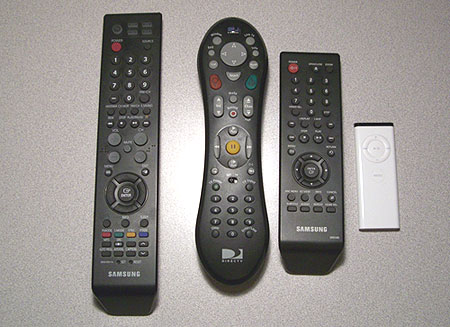
Apple Remote

Bottom line for me: I will do a lot more with my music and my photos than I have in the past. Just as the iPod changed the way I listen to music (and podcasts)… Apple TV is going to change how I use my TV. Like the box says, “Now there’s always something good on TV.”


HealthCareFineArt.com

Henry says I first mentioned blogging to him in 2003. He let the idea percolate for a while and emailed me last weekend to say he was ready to start blogging (he’s a thoughtful guy). I stopped by his office a couple of days later for my Are You Ready to Blog lecture. By the time I left, Henry had lost his blog virginity and had a couple of posts up at HealthCareFineArt.com.

Along with his medical practice, Henry has built a very successful business creating digital images for the health care industry.

Where was I? I remember. While Henry has a beautiful website, he had concluded a blog would be a valuable addition. People he knows and trusts warned him “this blog thing” might be a distraction. And he came to Dr. Steve for a second opinion.

Aside: Have I mentioned smays’ theory that the first 48 hours are critical in the life of a new blog? At the end of two days you’ll wind up with one, sad little “toe in the water” post… or a dozen or so posts.

I’m proud to report Dr. D. comes down solidly in Column B. He is off…and..running. And, like all good blogs, he has focus. He’s writing for and about the health care fine art space (the oxygen is thin up there).

Like all natural bloggers, he didn’t need much help. He came armed with passion, creativity and something to say. And he hasn’t stopped saying it. He is… empowered!

(Throw up the Prediction graphic)

A year from now, a Google search for “health care fine art” will take you to Henry’s blog. Comments are open, so if I’m wrong… I want to hear about it.

If any smays.com readers with blog want to give Henry a little link love, he’ll appreciate it and so will I.

Dave Winer: “Reform journalism school”

“It’s too late to be training new journalists in the classic mode. Instead, journalism should become a required course, one or two semesters for every graduate. Why? Because journalism like everything else that used to be centralized is in the process of being distributed. In the future, every educated person will be a journalist, as today we are all travel agents and stock brokers. The reporters have been acting as middlemen, connecting sources with readers, who in many cases are sources themselves. As with all middlemen, something is lost in translation, an inefficiency is added. So what we’re doing now, in journalism, as with all other intermediated professions, is decentralizing. So it pays to make an investment now and teach the educated people of the future the basic principles of journalism.”

Patient’s webcam sends shockwaves through hospitals

“A nurse’s discovery of a Webcam hooked up by parents in their child’s Boston hospital room has stunned the patient’s doctor, raised a mound of privacy issues and potentially left medical staff looking over their shoulders. The unidentified parents set up the camera so the child’s favorite relative could see what was going on during the long hospital stay.”

“Dr. Deborah Peel of the Patient Privacy Rights Foundation said as long as a patient isn’t recording other patients, she doesn’t see violations of the federal Health Insurance Portability and Accountability Act, or HIPAA, which protects patient privacy.”

“Many people are very concerned that the quality of care in hospitals has decreased so much. I could understand the family wanting a Webcam to prove what care their family did or didn’t get,” she said.” — Boston Herald

That’s the money quote in this story.

Create all the policies you want… hire good lawyers (like Barb)… but as long as families question the quality of the care their loved ones are getting (rightly or wrongly), they’re going to be taking pictures and video. If you wind up in court, you might prevent it from being introduced as evidence, but you’ll have a hard time keeping it off YouTube.

Who’s privacy is the hospital really trying to protect?

If I was having a broken arm set and wanted Barb to video the procedure, on what grounds should the hospital prevent this? Is it okay if she watches the procedure and then opens up her laptop and blogs what she just saw?

The elephant in the room is the appearance of something to hide on the part of the facility and the staff.

Why wouldn’t you train your staff to: “take care of every patient as though what you are doing is being recorded”?

Because, like it or not, it will be.

Google Audio looking better to radio groups

“Google is finding some friends. There are plenty of critics of Google’s foray into radio — but we’re slowly seeing some group heads come out and say there may be a place for the Internet giant in radio sales. Regent tested the service in two markets and CEO Bill Stakelin says they sold “a tremendous amount of inventory” and the results “far exceeded our expectations.” He says the issue that remains to be worked out is pricing.

While Emmis CEO Jeff Smulyan says “if Google has the advertiser that we’re never going to call on at rates that make sense … then it’s business that we want to take.” Smulyan says Google’s efforts are especially welcome in “transactional” markets like New York and L.A. where radio has done a “marginal job” at attracting new advertisers.

Meanwhile — Border Media Partners CEO Tom Castro says many folks are focusing on HD and streaming. But the real technological breakthrough will come on the sales side. Castro says “it’s not very sexy — but it’s where we are going to make a lot of money in the future.” — INSIDE RADIO report from the Kagan Radio-TV Summit: