

Back to land lines?

UplinkIn 1981 our company began distributing our (news and ag) programs to radio stations via satellite. It was a big deal at the time because we were the first of the smaller, regional networks to “go satellite.” Uplink hardware was damned expensive. Downlink hardware at the radio stations was pretty pricey, too. But much cheaper (in the long run) than all of those point-to-point land lines.

For many years, having a satellite distribution system was a competitive edge. You had to have some way of getting the programming to the radio stations (and their listeners). No FedEx in those days.

In a few weeks, football season will get underway and we’ll be distributing play-by-play audio to affiliates of 35 collegiate sports radio networks around the country. Most of those via satellite. But for the first time, we’ll use live web streaming to deliver audio to the affiliates of two of our networks (Maine and Montana State).

This is possible because of increased bandwidth; better audio encoding; and a growing acceptance of audio (and video) online. If all goes according to plan, listeners won’t even be aware of how the audio gets from the stadium to their radios (or computers).

We could sort of see this coming but it was/is difficult to imagine a time when satellite distribution of audio and video could be replaced by the Internet (or even some Super Internet of the future). But it’s getting easier.

So what’s it all mean? It seems unlikely your “competitive edge” will be distribution. That’s probably been true for some time now. Having the good content will always be important. But if you are not the only source for the content… or the best source for the content… (to be continued).
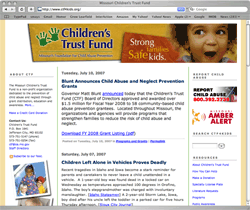
Children’s Trust Fund relaunches website on Typepad

ctf4kids.orgChildren’s Trust Fund of Missouri is one of our clients and, for the last few months, I’ve been helping them with a make-over of their website.

Their previous site was classic Web 1.0. It was designed by a company in St. Louis and any changes or updates had to be emailed to the developer who would, in time, make the change. Most of the “current” content was PDF news releases that weren’t very “new. The site was hosted on state servers. The CTF guys just were not happy with their site.

I persuaded them to try Typepad and incorporate a blog as their primary content element.

They took the site public at the first of the month and, although still tweaking some of the content, it looks and works great. And the best part… they are now in control. Paula and Alicia know how to add pages, maintain links, and manage the site top to bottom.

Kirk, the executive director, is finding his blogging feet and posting regularly. From his fingers…to the world. Boom.

We’ve shown them how to use Flickr, Google Calendar and YouTube. And all of this for a fraction of what they paid for their previous site, which simply wasn’t meeting their needs.

Helping folks like Kirk, Paula and Alicia tell their story is extremely gratifying. If Web 1.0 was selling fish, Web 2.0 is using great new tools for helping people learn how to fish.

iPhone Confessions: George Kopp (Week One)

George is a serious Techno Boy. He has a geek job with the state for his day job (all Windows) and moonlights on Macs (and some PC’s) for love (and a little money).

George knew he’d eventually own an iPhone but thought he could wait awhile. He made the mistake of stopping by the AT&T store (Day Two) for a look-see and wound up springing for the 8 gig model.

George’s love-of-all-things-Mac is tempered by his no-bullshit-geek-o-rocity. By that I mean, he expects much from his techno-toys. But once he got the iPhone in his sweaty little hands, it was prom night. I got caught up in that as we talked and had to edit our chat more than I intended. Sorry, George.

Listen/Download: 5:30 MP3

Creators, Critics, Collectors, Joiners, Spectators and Inactives

A new Forrester report divides the U.S. online population into six groups according to their social participation on the Web.

More than one-fifth of those classified as Creators—those who blog, publish Web sites, upload videos, or participate in other content creation activities—own Macs, while only 12 percent own Dell computers.

The majority of Spectators (they read blogs, watch videos, and listen to podcasts) own Macs while the majority of Inactives (they don’t participate online) own Dells.

Scott Adams on Hypnosis

“…the best super power that hypnosis gives you is a different world view. Nothing in this life makes sense if you assume people are rational most of the time. Hypnosis teaches you how easily people’s memories and impressions can be altered. And it’s not just the gullible people, it’s all of us. It’s humbling. And it’s the most useful skill I’ve ever learned.” [Full post]

iPhone Confessions: Dave Morris (Week One)

Dave MorrisDave Morris is the voice of great radio stations and television stations, film studios, syndicated shows and more. World wide. I know this because it says so on his website. He’s also a blogger (a good one). And a gadget junkie.

He was one of those crazies standing in line the day the iPhone went on sale, so we called him up for a report on Week One.

Unlike some of the others we’ve chatted with for this series, Dave is not a Mac guy. Windows all the way. But he’s only slightly less “gushy” about Apple’s latest creation.

Download/Listen: 12 min MP3

DVD: Not Just the Best of Larry Sanders

Larry SandersThe Larry Sanders Show was a satirical television sitcom that aired from 1992 to 1998 on HBO, starring stand-up comedian Garry Shandling as vain, neurotic talk show host Larry Sanders. The series was partly inspired by Shandling’s stint as a guest host on The Tonight Show.

The Larry Sanders Show is easily one of the best five TV shows of all time (I’m sorry, this is not open for debate). And now I own a DVD with 23 of “the best episodes” of the series as well as eight hours of new stuff. I’m going to try to hoard this like the last baggie of ganja but suspect I’ll burn through these in a week or so. This is just one more reason why it’s better to be me than you.

Radio’s “discarded audience”

“First the standards vanished from radio, as stations that played lots of Frank Sinatra, Peggy Lee and Ella Fitzgerald went dark. Then over the past couple of years, the oldies format collapsed, and suddenly the sounds of Motown, Elvis and the Beach Boys were hard to find on the radio. Now, even classic rock stations are starting to feel the pressure, as commercial radio strains to find ways to connect with younger listeners who find most of their music online.”

AARP is happy to address the frustration that there’s “not enough choices on the radio.” The organization is finding that its 39 million members are eager for programming they can tap into through the latest technologies. AARP is podcasting, Web streaming and even offering a branded version of Pandora.com. AARP’s next wave of audio programming will be “user-created media a la YouTube.”

— WashingtonPost.com – Thanks, Kay

NYT: The Road Home

“It is frighteningly clear that Mr. Bush’s plan is to stay the course as long as he is president and dump the mess on his successor. Whatever his cause was, it is lost.

President Bush and Vice President Dick Cheney have used demagoguery and fear to quell Americans’ demands for an end to this war. They say withdrawing will create bloodshed and chaos and encourage terrorists. Actually, all of that has already happened — the result of this unnecessary invasion and the incompetent management of this war.

This country faces a choice. We can go on allowing Mr. Bush to drag out this war without end or purpose. Or we can insist that American troops are withdrawn as quickly and safely as we can manage — with as much effort as possible to stop the chaos from spreading.” — New York Times editorial