The secret to Farmville’s popularity

“The secret to Farmville’s popularity is neither gameplay nor aesthetics. Farmville is popular because in entangles users in a web of social obligations. When users log into Facebook, they are reminded that their neighbors have sent them gifts, posted bonuses on their walls, and helped with each others’ farms. In turn, they are obligated to return the courtesies. As the French sociologist Marcel Mauss tells us, gifts are never free: they bind the giver and receiver in a loop of reciprocity. It is rude to refuse a gift, and ruder still to not return the kindness.[11] We playFarmville, then, because we are trying to be good to one another. We play Farmville because we are polite, cultivated people.” — From an essay by y A. J. Patrick Liszkiewicz

I’ve never played Farmville. Or any other Facebook game. I don’t have a Facebook account anymore and find myself unable to explain why I do not. So it’s hardly fair to use this thoughtful essay as an explanation. But the very essence of Facebook seems to be social obligation. I hate obligations and avoid them wherever possible.

Facebook/Farmville fans can tell me where Mr. Liszkiewicz misses the mark with his essay.

Why radio news guys don’t do social

Papper: Radio News Does not Make Use of Social Media from Poynter Institute on Vimeo.

From Mashable: “Although Facebook and Twitter are popular with TV stations, only 27% of radio newsrooms use Twitter and 1% have a Facebook page. The survey’s conductor, Robert Papper of Hofstra University, said the contrast in usage is due to staff size. “If you had a staff of three or more, you were involved in a number of social networking things. If you did not hit that magic number you were not involved.” He explains why radio stations do not participate more in social media in the video clip above.”

Why Twitter is worth the time

I can’t believe I’m still having to make this case. But I can throw a rock and hit half a dozen people in our company who –at the mention of Twitter– will huff, “I don’t care about what some stranger had for lunch!”

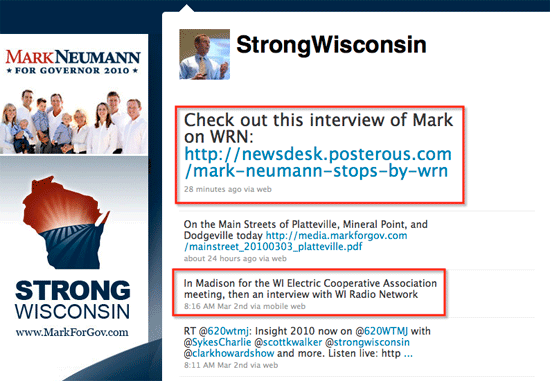
I think most of them know that something more important is going on but they don’t want to admit they might be wrong on the topic. And because they are NOT part of “the conversation,” they don’t see tweets like these on the Twitter page of Mark Neumann, a candidate for governor in Wisconsin, where our company operates a news network.

Neuman has almost 3,600 followers and some of them –who might not otherwise– might hit the link to our site to hear the interview with their guy.

PS: This is the kind of blindness that brings out the smart ass in me.

“Digital-age monks illuminating manuscripts”

From an op-ed piece on NYTimes.com, by Sheelah Kolhatkar:

“You can tell when a print journalist has lost his full-time job because of the digital markings that suddenly appear, like the tail of a fading comet. First, he joins Facebook. A Gmail address is promptly obtained. The Twitter account comes next, followed by the inevitable blog. Throw in a LinkedIn profile for good measure. This online coming-out is the first step in a daunting, and economically discouraging, transformation: from a member of a large institution to a would-be Internet “brand.”

“While most people are worried about getting paid for their work, I’m more concerned that journalists might be the digital-age equivalent of monks illuminating manuscripts, a group whose skills will soon disappear.”

I feel bad for anyone that has lost a job, but can’t help wondering why the reporter in this piece didn’t already have the online presence. It’s like going camping without a flashlight.

A “teaching moment” or Big Brother?

YouDiligence.com is the brain-child of Kevin Long. According to a blog post on ESPNB’s Jock-O-Sphere, the service works like this:

“…for a small fee — $1,250 a year for 50 athletes or less, or $5,000 a year for 500-750 athletes (described as pennies a day for each athlete) — schools are essentially given a broad-scale monitoring system for their athletes’ Twitter, MySpace and Facebook pages. Enter in the keywords you’d prefer not to show up in your student-athletes’ stream — these can range from curse words to alcohol and drug references to just about anything; it’s entirely customizable — and the instant any of these buzz words are posted to a student-athletes’ social media stream, administrators can be alerted via e-mail and a detailed account of the instance is added to a spreadsheet log … instead of online a few hours later on a blog or newspaper’s Web site, which could be potentially damaging to the program.”

This is a really interesting post (by Ryan Corazza, a freelance writer and Web designer based in Chicago), whether you’re in the world of college athletics or not. Would you (would I) be okay with your company monitoring what you post on social sites? Are you sure they are not? Would it make a difference in what you post?

Disclosure: At least one of the schools mentioned in the post is a “university partner” of the company I work for, Learfield.

For the record, I don’t see anything wrong with schools keeping an eye on what their student athelets are saying/writing. I mean, it’s out there. You should assume everyone is reading every word you post.

If you feel that your school is censoring your freedom of speech, then it’s decision time.

Google Buzz

I’ve been noodling around with Google Buzz a bit and my early impression if very positive. Now, I’m not going to even try to explain Google Buzz. You can watch the video below if you’re interested. And I’m not going to encourage you to “follow” me on Buzz. Or try to sell you on social media, or anything else. This is one of my “for the record” posts.

I will say that more and more of what I find interesting is going to my social media streams, which will now mostly show up on my Buzz profile page. If you have a Gmail account you have (or soon will have) Buzz.

RTNDA Guidelines for Social Media and Blogging

Several Learfield (the company I work for) employee are members of the Radio and Television News Directors Association, so I was pleased to come across their recently published guidelines for social meida and blogging. A few snippits:

“Social media and blogs are important elements of journalism. They narrow the distance between journalists and the public. They encourage lively, immediate and spirited discussion. They can be vital news-gathering and news-delivery tools. As a journalist you should uphold the same professional and ethical standards of fairness, accuracy, truthfulness, transparency and independence when using social media as you do on air and on all digital news platforms. “

Ahem. This is where it would be tempting to remind some of my colleagues how ferociously they fought the very concept of blogging.

On Accountability and Transparency:

“You should not write anonymously or use an avatar or username that cloaks your real identity on newsroom or personal websites. You are responsible for everything you say. Commenting or blogging anonymously compromises this core principle.” [Emphasis mine]

“Be especially careful when you are writing, Tweeting or blogging about a topic that you or your newsroom covers. Editorializing about a topic or person can reveal your personal feelings. Biased comments could be used in a court of law to demonstrate a predisposition, or even malicious intent, in a libel action against the news organization, even for an unrelated story.” [Emphasis mine]

Reporters who forget that second point could face dire consequences.

Image and Reputation

“Remember that what’s posted online is open to the public (even if you consider it to be private). Personal and professional lives merge online. Newsroom employees should recognize that even though their comments may seem to be in their “private space,” their words become direct extensions of their news organizations. Search engines and social mapping sites can locate their posts and link the writers’ names to their employers.”

“Avoid posting photos or any other content on any website, blog, social network or video/photo sharing website that might embarrass you or undermine your journalistic credibility. Keep this in mind, even if you are posting on what you believe to be a “private” or password-protected site. Consider this when allowing others to take pictures of you at social gatherings. When you work for a journalism organization, you represent that organization on and off the clock. The same standards apply for journalists who work on air or off air.”

I don’t belong to RTNDA (or any association, if you don’t count the Order of the Fez) but I like these guidelines. Sort of, “Everything You Need to Know About Social Media You Learned in Kindergarten.”

The art of the tweet

From a thoughtful –and useful– post by Tammy Erickson (@tammyerickson) on how to make Twitter fun for your followers:

  1. Don’t report banal details. Unless you’re observing a true breaking news event (and note: this term does not include what you or your child ate for lunch), skip it.
  2. Do interpret your experiences. How do they make you feel? What do they mean to you?
  3. Do share the oddities you observe. Look for things that seem unusual, out-of-place, surprising.
  4. Do share things you love – quotes, phrases, descriptions of events that brought joy to your day.

Her conclusion:

“Slow down, enjoy. Listen to the world’s music. Share the best of your experiences, but remember, 140 characters is a unique format — more like poetry or Haiku than news reporting.”

One in five radio execs social networking

How many US radio industry executives (from the 50 largest companiues) are on Facebook or Linkedin? Here’s what the folks at McVay New Media discovered:

“Out of 116 radio executives, running the fifty largest USA radio companies, 14 of them had Facebook accounts and 19 of them had LinkedIn accounts. The most common member of the executive team to have a presence on either website was the Chief Operating Officer.”

While less than scientific –some executives are online under different names– the results raise the question:

“How can we embrace the digital direction of the industry if our leaders are not even participants themselves? Think of it this way. If it were exposed that less than one in five of radio’s C-level executives owned radios, we would significantly doubt their confidence and personal investment in the radio industry.”

“If today’s radio companies are to evolve into the digital media world, wouldn’t it first make sense for radio’s leaders to evolve into the digital media world? Clearly, many leaders in the media industry are still learning the language of digital. Yet, the fastest way to learn a new language is immersion.”

“Tools like Facebook, LinkedIn, and Twitter can offer any C-level executive a simple and efficient direct forum with employees, shareholders, and customers. In fact, a strong executive could use social networking to improve their company’s image, foster positive communication, and directly confront market feedback.”

Is our (Learfield) industry “headed in a digital direction?” I believe it is. Are our leaders participating themselves? Only a few and in very limited ways. I might rephrase the question:

If only 1-in-5 of our senior managers regularly attended college sporting events, would we “doubt their confidence and personal investment” in collegiate sports marketing?

flickr interestingness

UPDATE 5/27/19: Looks like these features are no longer available.

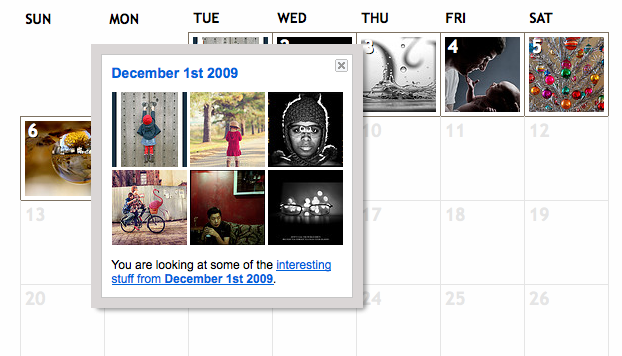
Flickr has something called “interestingness.” I don’t know if this is new or I just never noticed. A photo gets included based on “where the click-throughs are coming from; who comments on it and when; who marks it as a favorite; its tags” and other stuff. You can spend hours on interestingness so don’t go unless you have some time.

Not sure why, but there’s a calendar view in case you wanted to see interesting photos from June, 2008, for example.

Screen shot 2009-12-07 at Mon, Dec 7, 7.39.16 AM