Online influence

Interesting article in the Sunday Review section of the New York Times (I think I used the last of my 20 free accesses for the month). It’s about the growing importance (?) of online influence.

“If you have a Facebook, Twitter or LinkedIn account, you are already being judged — or will be soon. Companies with names like Klout, PeerIndex and Twitter Grader are in the process of scoring millions, eventually billions, of people on their level of influence — or in the lingo, rating “influencers.” Yet the companies are not simply looking at the number of followers or friends you’ve amassed. Rather, they are beginning to measure influence in more nuanced ways, and posting their judgments — in the form of a score — online.”

Yes, I check my Klout score from time to time but it’s never gotten above 40. 39 as of a few minutes ago. But 40 suggests “a strong, but niche, following.” Niche being the operative word. And the average Klout score is in the high teens, so…

“After analyzing 22 million tweets last year, researchers at Hewlett-Packard found that it’s not enough to attract Twitter followers — you must inspire those followers to take action. In other words, influence is about engagement and motivation, not just racking up legions of followers.”

Is there any sort of analogue to this in the world of traditional advertising? Do we even care about the influence of someone hearing our radio ad?

“Industry professionals say it’s also important to focus your digital presence on one or two areas of interest. Don’t be a generalist. Most importantly: be passionate, knowledgeable and trustworthy.”

Half the fun of checking your Klout score is comparing your score to your friends and acquaintances.
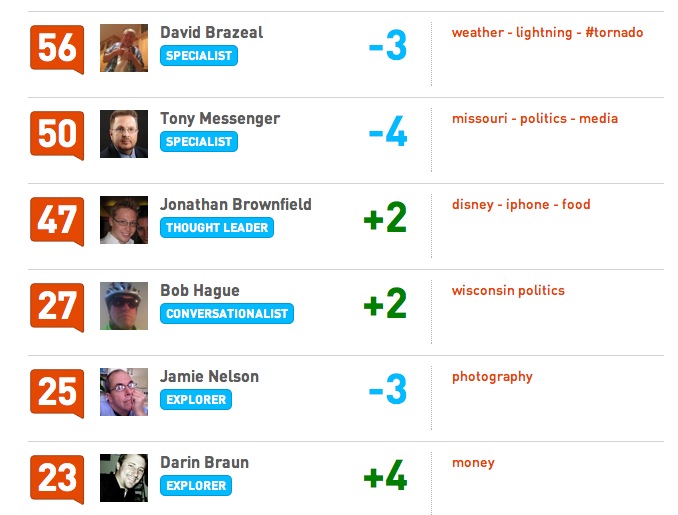
My pal David Brazeal is off on his own now and needs as much Klout as he can get. He’s something of an expert on “weather, lightening & tornados.” Jonathan Brownfield should be higher given his access to beautiful, large-breasted young women.

My plan is to stand outside Hooters and wait for a bad storm.

Instagram

Every time I peek at Instagram, I find remarkable new images. This one by someone calling themselves purposofenvy. You can see more of his/her photos here.
Not sure why I find instagram so appealing. I think it’s that the photo is the extent of the communication. You can intuit (?) a lot about someone without a bunch of words. The photo is the story.

Instagram

I started playing with Instagram about 6 months ago but never got around to writing about it here because I couldn’t think of how to describe it (“Fast beautiful photo sharing for your iPhone”).

From the website: “Snap a photo with your iPhone, choose a filter to transform the look and feel, send to Facebook, Twitter or Flickr – it’s all as easy as pie. It’s photo sharing, reinvented.”

I have about 3,000 photos on my MacBook and a couple of thousand on flickr. I post photos here at smays.com and a few on Twitter so, there’s no shortage of places to share photos. And it’s really no more trouble to post a photo to flickr or Twitter than Instagram.

So how to explain the popularity of this little app (4.5 million users)? I can’t.

Today I came across a website called Inkstagram that brings Instagram pics to your web browser.  So I can introduce you to the gritty images of tonydetroit; and komeda whose photos almost feature one or two people against a beautiful but lonely backdrop; and today I discovered travisjensen who sends instagrams from San Francisco.

I don’t know these people and will probably never interact with them, short of liking or briefly commenting on one of their photos. But I like to think the images they share tell me something about them. Something, perhaps, they don’t know about themselves.

Ah. Just came across this interview with the founder of Instagram.

“The Cultural Imperative For A Social Business”


That’s the title of a blog post by Maria Ogneva that has been stuck in my head for a week or so. It’s about how businesses and organizations communicate and share information. A topic of discussion in our company recently. Here are a few of my take-away’s from Maria’s post:

“Transparency and openness require the braveness of “opening up the kimono”, not when convenient, but all the time. It involves letting people know what’s happening and why, with advance notice, providing a channel to share feedback, and closing the feedback loop – in the open.”

I give us a B- on that one. We’d like to be there but aren’t quite.

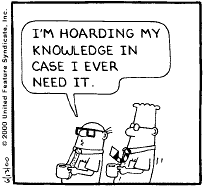
“Knowledge hoarding is replaced by sharing. Traditionally, our educational systems have emphasized becoming a specialist. We have hoarded our knowledge in fear that if we shared what we knew, we will become more replaceable.”

Ouch. Been guilty of that myself. I suspect we still have pockets but by the very nature of hoarding, it’s difficult to know.

“Command and control mindset: Traditionally, corporations have been structured with tightly managed controls at the top, which were passed down through levels of management, down to the people who actually performed the work. Tasks to be done, as well as the processes by which these tasks had to be done, were mandated from the top.”

The C&C manager often has an “I-know-best-that’s-why-I’m-the-manager” mindset. Takes a lot of self-confidence to break free of this approach. But the command and control style of management be less and less effective in any event:

“Rigid hierarchies: Scarcity of information pre-Internet, combined with specialization, has contributed to knowledge hoarding. At times, this asymmetry of information, and not the right leadership skills, allowed people to rise up the corporate ladder. Hierarchies were developed to preserve this status quo. However, things are changing rapidly, and democratization of information is definitely putting the emphasis back on leadership style, and not access to information, as a competitive advantage.”

This is why I’m all in on the Network and shared information. It’s breaking down these 20th century approaches to business, communication and everything else.

If you manage a company or work at a company, you should take a few minutes to read this insightful post. I’ll let you know how things come out at our company.

Unpoked and unlinked

I “deactivated” the Facebook account. Again. I didn’t even bother trying to delete the account this time. I’m pretty sure that’s not possible. I’m like one of those people who get a dog because they like the idea of having a dog but wind up leaving it chained up in the back yard all day.


Wait, it gets worse. I fired up the LinkedIn account again, just to see what new features the’d added. I immediately got some “invites” from nice folks I once knew or worked with. It occurred to me all I have in common with most of these folks is (was) we both have LinkedIn accounts. So I deactivated the account.

Techies and Taciturns

Olivar Marks blogs about collaboration for ZDNet. He brings up an issue that I’ve been dealing with as I push for an enterprise social networking platform (Yammer) at our company.

“There seems to be a personality type that has a huge appetite for learning and using ever more frequent waves of new technology developments that is independent of any particular demographic, and who are eager to participate in group activities online or off.”

“These folks are often called “early adopters” and “techies” in companies and are leveraged in pilot try outs of new technologies. Their opposite –I call them the Taciturns (habitually reserved and uncommunicative)– are those who have limited interest (or competence and confidence) in collaborating, preferring instead to work solo and communicate on their own terms.”

Okay, I’m squarely in the first group. To the point of being annoying.

“Obviously some of the people who have created the workflows and body of knowledge inside a company through years of service resent the trivialization of their old fashioned ways of working, and some have been led to believe that they need to buck up their ideas and get with it on Twitter, micro/macro blogging, Facebook-in-the-enterprise and other forms of social engagement with their cohorts.”

…and I helped create some of those workflows and bodies of knowledge during the last quarter century but it’s time for some of them to go!

“The Taciturns of all ages generally speaking are laughing inwardly at all the teenage leadership stuff they hear being bandied about, and have often already decided they won’t be participating in any of that.”

What most managers -in my experience- really want is for every employee to immediately open, read and act on every email “from the top.” The notion of a social networking platform is less appealing because they now have to compete for attention with stuff (they consider) less important than theirs (usually everything).


Bruce Sterling on mobile phones and revolution

“… we’re in the midst of a massive global reinvention. Not just a shift from analog to digital, but a shift from centralized control to distributed systems. From isolated single user experiences to a global social fabric. These mobile devices are the of Gutenberg presses of our generation. This is not a bubble, this is a revolution.” – Blog post

“The Viral Me”

In The Viral Me (GQ), Devin Friedman heads to Silicon Valley for a closer look at social networking. Don’t let the length of this piece scare you off, it’s worth the read. A few of my favorite ideas:

“Your smartphone is now, or will be, your basic interface with the world.”

“I think old people like me (I’m 38) often do this stuff (social media) to feel like the world hasn’t yet left them behind, but we don’t have any natural hunger for it. It’s kind of like androids having sex: We know we’re supposed to do it, but we’re not really sure why. Meanwhile, and infuriatingly, we know that humans just like to bone.”

“(Silicon Valley) might be the last place in America where people are this optimistic. The last place in America where people aren’t longing for a vague past when we were the shit.”

“Flood the social layer with information you want out there about yourself.”

“If you’re confused by the term social layer, think of the word layer as meaning “lens.” The social layer is one lens you can look through to see the content of the Internet. Who you’re connected to, what they’re connected to, what they like and don’t like.”

“More and more people are going to have careers where they move from one thing to another fairly publicly. And what people are really investing in is your track record. Your brand. What you do and what you say and what you think are just as important as your skills.”

“An open society isn’t one where people have access to the real you. It is simply providing access to the identity you very carefully construct for human consumption.”

“I believe that more people are going to work for themselves, and more people are going to do what they’re passionate about. … What we’re talking about is monetizing passion. Monetizing authority.”

I can’t wait for people my age to get the fuck out of the way. Die, retire, whatever. Admit that you don’t get it and probably won’t get and make room for the bright young men and women who live the ideas expressed in this article.

When the technology disappears

“One of the things I love about the iPad, for instance, is when you’re using the iPad, the iPad disappears, it goes away. You’re reading a book. You’re viewing a website, you’re touching a web site. That’s amazing and that’s what SMS is for me. The technology goes away and with Twitter the technology goes away. It’s so easy to follow anything you’re interested in. It’s so easy to tweet from wherever you are.”

— Twitter founder Jack Dorsey on Charlie Rose