
The unbundled media world

I’ve been doing some work on the website of one of our networks and came across a story about what appears to be a big music festival. I exchanged some emails with the news director about linking and adding content from other sources (Google, flickr, YouTube, blogs, Twitter, etc). She expressed some concerns about this.

She, like some many veteran reporters I know, seemed to be coming from that place where you write your story (with audio/video/stills) and it goes into whatever distribution channel your company happens to own: paper, magazine, radio/TV station. That’s where her “audience” finds the story.

And it worked just fine for a long time. But then the web comes along and most of us clapped our hands because we saw it as just one more way to reach “our” audience. A one-way pipe from which they would “consume our content.”

From a recent post (“The Web’s Widening Stream”) by Terry Heaton:

“The “Browse” phase of the Web was its first, and it’s where the name of the desktop application known as the browser originated. The Web was seen as a series of roads leading to destinations, We hopped from site to site — or in the case of AOL, destinations within the site — and everybody was happy. “Visitors” to sites were welcomed through a front door, which became the most valuable online real estate in terms of advertising.

“Search” disrupted the paradigm by allowing people to access documents within a site without going through that front door. We were still visiting sites, though, because that’s “where” the content resided. Search destroyed the value of the home page, and also allowed for advertising adjacent to search results — a way of monetizing content that existed only in link form on the pages of the search. If you wanted to buy ads next to football content, you didn’t need to buy football pages, for example. You could simply buy ads on search results for football.

“Subscribe” blew everything apart, because users no longer had to even visit websites, assuming publishers were willing to make their content available in RSS form. Most major publishers refused to play the game, so media company RSS feeds have generally contained only a sentence or two, thereby forcing users back to the site of origin, where publishers can monetize pages. This irritating practice has kept publishers from exploring revenue possibilities in a truly subscriber-based environment, and it’s the key thing holding back the development of RSS.

But a new paradigm is threatening all of the others and will eventually force all publishers into the unbundled media world. The staggering popularity of social media messaging via Facebook and MySpace “status updates” and, of course, Twitter is creating an information ecosystem that is a series of real-time streams. These streams come in short bursts, but when added to the RSS of Microsoft’s “subscribe” phase of the Web, they form powerful, relevant and meaningful sources of knowledge and information for an increasingly networked world.

Mr. Heaton quotes (and links to) VC John Borthwick who views “streams” as the new metaphor for the web:

In the initial design of the web reading and writing (editing) were given equal consideration – yet for fifteen years the primary metaphor of the web has been pages and reading. The metaphors we used to circumscribe this possibility set were mostly drawn from books and architecture (pages, browser, sites etc.). Most of these metaphors were static and one way. The steam metaphor is fundamentally different. It’s dynamic, it doesn’t live very well within a page and still very much evolving.

A stream. A real time, flowing, dynamic stream of information — that we as users and participants can dip in and out of and whether we participate in them or simply observe are a part of this flow.

And then there is the advertiser:

“Advertising will be another fundamental part of the stream, but the rub for media companies is that advertisers can enter the stream themselves, without the assistance of being attached to media content. This is the inevitable end of a truly unbundled media world.”

If I started this post with a point in mind, I lost it along the way. I think it had something to do with the notion that a reporter –any reporter– could write/produce a story and expect others to find it and read it (and comment on it?) without being connected to them in some synchronous manner.

Or perhaps: All of us can tell the story better than any of us.

Whatever. Read Mr. Heaton’s piece.
“creativity thrives on constraints”

The always insightful Amy Gahran poses a little thought experiment that I believe I’ve posted on a few times:

“What if social media (Twitter, Facebook, Delicious, Google Earth, etc.) were the only tool you could use to deliver the benefits of journalism to your community? You could still gather information however you choose (through in-person interviews, phone, Web, archive research, etc. — even social media), but you could only deliver your work via social media. How would you do it?”

I suspect this experiment is already out of the lab and we’ll see more and more examples. And I especially like the notion that “creativity thrives on constraints.” 140 characters. 30 sec of video. Boiling a story down to its essence.

Twitter coverage of execution

Missourinet (a Learfield network) News Director Bob Priddy covered last night’s execution of Dennis Skillicorn. Reporters and witnesses can’t take cell phones past a certain point, but Bob was planning to use Twitter to file updates before and after the execution (he was a witness).

The wifi he expected wasn’t available so he took notes and posted to @missourinet when he got back on line (at the motel, I assume).

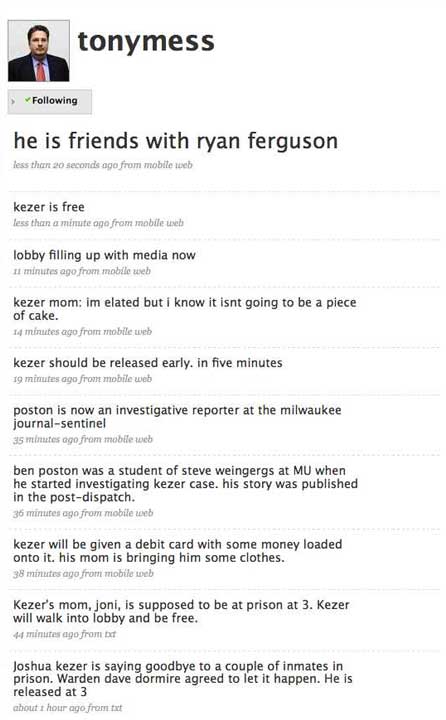
As I expected, Twitter was a very effective tool in the hands of good and experienced reporters. Here’s a screen shot from early this morning.


Had reporters been allowed to keep their Blackberrys and iPhones, this is probably as close to live coverage of an execution as we’re likely to get.

And in the hands of someone as responsible as Bob Priddy, I think this might be a good idea. As I understand it, the rationale behind having witnesses is to insure the people of Missouri “see” this ultimate punishment. Twitter might be the least sensational way to accomplish this on a mass scale.

I’ll make a prediciton here: If not in Missouri, some state will allow or provide this coverage.

TweetSpin: “set it and forget it”

TweetSpin, a new Twitter application designed by a radio programmer named Rico Garcia. Among other info, TweetSpin can post "now playing" data from a station's website.

Here's a couple of snippets from a review in R&R, a radio trade publication:

From KHOP PD MoJo Roberts: "TweetSpin allows us to constantly have 'what's playing now' on our status and set appointment tweets to go out so we can set it and forget it."

In addition the "now playing" feature, Garcia is more excited about built-in scheduling that allows stations to set up hourly, daily or weekly messages to encourage listening appointments.

Hardly surprising that an industry in the process of automating itself out of existence would look for a way to automate social media, too. Of course, if there's really no one at the station…

Choosing what we don’t want to see

“For the first time in our lives we were being exposed to more information than we could consume. In the age of newspapers we had to choose what we wanted to see. But in 2004 we had to choose what we didn’t want to see. This had a devastating effect on the traditional forms of information. In the past, you could get people’s attention simply by making something. People wanted more choices, so you simply had to give them another choice. But in 2004 this changed. People started to have enough, and now you actually had to make something better. It was not enough that it was different.”

From Thomas Baekdal’s Where Is Everyone? A brief tour of the history of information.

“To follow or not to follow? How do you decide?”

Here's how Phil Johnson, writing in Advertising Age, decides:

"When somebody new crosses my path, I take a look at their last 10 tweets and ask myself three sets of questions:

  1. Can I learn something from this person? Does he connect me with information that I would never find on my own?
  2. Is she original? Does she have a distinct voice and make interesting observations about the world and business?
  3. If I'm not getting a clear answer, I ask the ultimate question, "Would I drink with him?"

If I know the person, there's a good chance I'll follow them. If I don't, I'll look at their profile and check out a website if they provide a link. If they're "following" hundreds of people, I figure they're just trying to pump up their numbers and I block them.

When I hear someone sneer, "I don't care about what someone had for breakfast," as a way of dismissing something about which they are clearly ignorant… I immediately think: I don't remember the last time I saw a tweet like that. Why would I follow someone with so little to say? No, this is just an easy rationale for learning something new.

Everybody is on Facebook

“For a long while—from about the late ’80s to the late-middle ’90s, Wall Street to Jerry Maguire—carrying a mobile phone seemed like a haughty affectation. But as more people got phones, they became more useful for everyone—and then one day enough people had cell phones that everyone began to assume that you did, too. Your friends stopped prearranging where they would meet up on Saturday night because it was assumed that everyone would call from wherever they were to find out what was going on. From that moment on, it became an affectation not to carry a mobile phone; they’d grown so deeply entwined with modern life that the only reason to be without one was to make a statement by abstaining. Facebook is now at that same point—whether or not you intend it, you’re saying something by staying away.”

Slate

http://twitter.com/inauguration

A week or so ago I got a ping that @inauguration was following my Twitter feed. I assume they just searched all Twitter feeds for “inauguration” and found me. As I always do, I checked the profile page and found:

“Get tips and helpful scoop as you plan for the Presidential Inauguration on January 20, 2009 when Barack Obama takes the oath of office.”

There was a link to a website but I didn’t click it.

@inauguration has been a great source for news about the upcoming event. With links to lots of news sources.

I finally checked the url on the Twitter page and learned that the feed belongs to WUSA-TV in D.C. Thinking back, a lot of the tweets have taken me to pages on the WSUA website.

We’re they being sneaky by not clearly identifying the TV station? Doesn’t feel that way since I now know they pointed me to a variety of sources for relevant news about the inauguration.

My point here is WSUA didn’t just feed the latest news from the station website. They didn’t just promote their coverage. Someone was smart enough to understand how Twitter really works and use it. Cost: zero.

This will be the norm for any big event. And it won’t always be news organizations doing it. It will often be the event organizers. And should be since they will have the most information and have it first.

Yes, I could have set up a Google Alert for “inauguration” but adding @inauguration to my feed was just one-click.

Seasoned Twitter users will remind me there’s a hash tag (#inauguration) that aggregates tweets from ALL Twitter users, not just one source. True, but there’s a lot of noise in that stream. Takes too long to separate the wheat from the chaff.

And to bring it down to the individual level, I could set up a Twitter page just for my tweets from the event, so that my “followers” aren’t drowned in my tweets from DC. Probably won’t be posting enough for that to be a problem, however.

In conclusion… I quickly determined that the @inauguration Twitter feed had useful and interesting information. I didn’t notice or care who was behind the feed.

I am not that smays

I was trying out the new People Search feature on Twitter and discovered another “smays.” And he is also “Steve Mays.” There should be no confusion, however, because he appears to be very smart and successful.

“Steve Mays, Chief Technical Officer — Steve has over 15 years experience in senior technology development positions. His former roles include Director of Infrastructure Services and IT Security Analyst for Semaphore Partners, Chief Information Officer for Xamplify, Inc., Director of Technology and Founder of Gloss.com and Manager of Online Operations for Vivendi Universal. Steve holds a BS in Business Management and an MBA in Global Business Management from University of Phoenix.”

Couldn’t find an email but maybe he’ll see this. We could drive up to Seattle and have a beer with the other Steve Mays West

“a stats geek behind the scenes tweeting interesting stuff”

I’ve been beating the Twitter drum ever since that digital light bulb came on for me. I did my best to offer some practical applications for our various businesses. But none were as spot-on as StatTweets. From the StatTweet website:

“Most sports-related media outlets that have a Twitter account simply blast everything through a single account. I don’t know about you, but I don’t find this very useful. I prefer Twitter updates targeted at just the teams I’m interested in. And I’m not talking about just a news feed. It needs to be as if each sports team had a twitter account and a stats geek behind the scenes tweeting interesting stuff.

That’s exactly what the StatTweets accounts are intended to do (but it is all automated). Not only can you follow just the teams you are interested in, but you can interact with each account to retrieve team and player stats dynamically.”