KCI making good use of Twitter

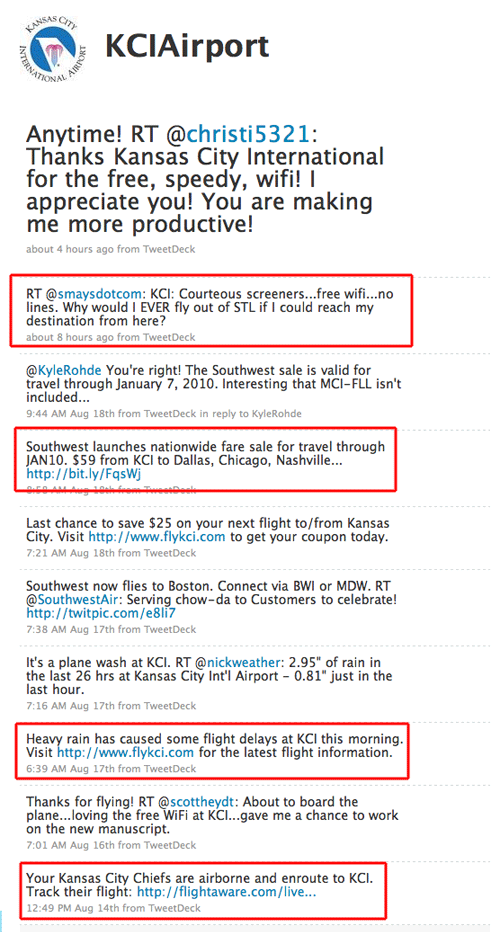
I twittered a few nice words about the Kansas City International Airport this morning and someone at KCI was watching or searching. Either way, they were listening and retweeted my praise. A quick check of their Twitter stream provides such useful nuggets as special prices by airlines; news that the Chiefs are homeward bound; update on the weather; links the twitter feeds of airlines serving KCI.  All good stuff.

Sure, they only have a couple hundred followers but that grow. And the cost? A few minutes by someone with a clue. If you fly regularly from KC, why wouldn’t you tap this resource? Well done @KCIairport

KCI-twitter

Blogs never went away

Yes, I am easily seduced. I admit it. I’m like a pillow, I keep the impression of the last person who sat on me. Twitter, Posterous… I love new stuff and tend to get carried away. I’ve posted her less frequently since I began dallying with these new tools. But, as Dave Winer reminds us (in a post to Robert Scoble regarding sale of FriendFeed to MySpace Facebook), I can always come home to momma.

“Our blogs are still there, as is the web and the Internet. They never went away just because we foolishly flirted with something fast and easy and seductive. Our blogs never went away, they’re still ready to share our ideas and connect us with others. We’ll go back to basics now, take what we learned from this round of innovation, and build it for real this time.”

I never got the FriendFeed bug but I can’t believe MySpace Facebook owning it is good news for users. But hey, if MS bought Yahoo! they’d probably screw up flickr, so…

The point is, my blog is mine. Nobody can buy it or mess with it. It’s my place to “write things down.”

Everything you need to know about Twitter, you learned in kindergarten

I learned from @chadlivengood that the Missouri State Teachers Association is now on Twitter (@MSTA). I seem to recall them advertising on one of our radio networks a few years ago. I’ve been thinking about what they were getting for their money. Basically, distribution of their message to radio stations affiliated with our network. If someone was listening to one of these stations when an MSTA announcement aired, mission accomplished.

So what does the MSTA do with Twitter. In theory, everyone in the state could see their tweets. But only if they choose to “follow” @MSTA. The association must persuade people to pay attention to their Twitter feed? Most advertisers spend a lot of time or money or both on the messages they air on radio and TV. But even if the message is weak, someone hears it.

With Twitter, nobody sees the message unless it’s good (i.e. relevant, interesting). And being limited to 140 characters forces one to boil the message down to the essence. Distribution is free, but worthless unless you have something to say.

During my radio days I wrote and produced commercials and entered what I considered my best in competitions each year. I wonder if there are competitions for the best commercial tweet? I doubt it. Nobody wants to hear “commercials,” no matter how short they are.

From a traditional advertising perspective, Twitter’s only up side is it’s free. It can take a long time to grow the number of people who follow you. And more importantly, they have all the power, all the control. If a company is successful, it has something far more valuable than advertising. Something that money –literally– cannot buy.

Given enough time and money, even a bad product or service can see returns from advertising. Not so with social media. I’m not sure it’s possible to teach a company how to be open, honest, authentic and caring. They were supposed to have learned that in kindergarten.

The siren call of Posterous

http://ihnatko.posterous.com/damn-i-really-like-posterous-now-what
The siren call of Posterous
I continue to be enamored with Posterous, the bare-bones blog service to which you post via email. So much so, I’m moving one of my Typepad blogs over.
My friend Taisir doesn’t have time (on inclination) to post to a traditional blog. With Posterous and his iPhone, he can update the blog with minimal effort. And Posterous did a pretty good job importing the the 160+ posts I had on Typepad.
Like tech columnist Andy Ihnatko, I’m boiling down my online life to my WordPress blog, Twitter and –now– Posterous.

I continue to be enamored with of Posterous, the bare-bones blog service to which you post via email. So much so, I’m moving one of my Typepad blogs over.

My friend Taisir doesn’t have time (on inclination) to post to a traditional blog. With Posterous and his iPhone, he can update the blog with minimal effort. And Posterous did a pretty good job importing the the 160+ posts I had on Typepad.

Like tech columnist Andy Ihnatko, I’m boiling down my online life to my WordPress blog, Twitter and –now– Posterous.

Shop Talk: SEC Digital Network

The Southeastern Conference is getting ready to launch the SEC Digital Network. They’re working with a company called XOS Digital and are touting: “…nearly 10,000 hours of original and exclusive SEC content anytime, anywhere through online video syndication, digital downloads, and exclusive live-streaming and on-demand video content.”

If I understand this correctly, this does NOT include live streaming of actual game broadcasts. Those are protected by the rights holders. Companies like ours. So what content will be available?

  • Highlights
  • Complete game replays
  • Breaking SEC news in real-time
  • Post-game interviews
  • Tailgate events
  • Behind-the-scenes pep talks
  • Press conferences

The company I work for is associated with some SEC schools: Alabama, Mississippi State and South Carolina.

Remember that saying about the farmer’s pig? We eat everything but the oink? Well, companies like ours pay lots and lots of money for the marketing rights to this big schools and we have to sell everything but the oink to recover that investment.

But you can only put so many commercials in a radio or TV broadcast; only so many logos on a big scoreboard; only so many ads in a program (as you can see, I don’t really know everything we sell).

And if God isn’t making any more land, she’s not making any more avails in a football broadcast. So everyone is looking for ways to generate more programming, more content, to support additional advertising. The SEC Digital Network would seem to be doing this.

And the fans have a nearly insatiable appetite for anything related to their team. And if the SEC does this right, with lots of fan engagement and interaction, and fully mobile… they’ll have a winner.

Bambi358 is following you

I just did a little Twitter house cleaning, blocking about 60 followers who looked … suspect. My criteria for blocking is very scientific and includes –but is not limited to– the following:

  • Anyone who follows 500+
  • Anyone with a number in their name
  • Anyone trying to be anonymous
  • Overly cute names
  • Just about any business (unless I know you)
  • Anyone who uses the terms “SEO” or “social” in their profile bio
  • Glam shot photo icon

If I blocked you and you’d like for me to reconsider… you’re way too needy. But email me and we’ll talk.

[10 hours later] The Twitter spam is coming way too fast. I’ve blocked almost 100. Giving serious thought to protecting my account.

Radio stops with the listener

What do you do when someone sends you a good video, a photo, or a link to an interesting news item? You share it. Maybe with a link on Facebook or Twitter; a blog if that’s your thing; or you simply email it to everyone in your address book. And some of them will do the same. It seems quite natural after 15 years of life on the net.

Now, what do you do when you hear something interesting, amusing or important on the radio? Assuming you’re not recording, your options are limited. You could call a friend, but by the time you reach them the song/interview/comedy bit is likely to be over.

All the good stuff you hear on the radio (or TV) pretty much stops when it reaches the listener. That never bothered me before because… well, where else _could_ it go after reaching me? There WAS no practical way to share it.

The web changed all that. Even the dumbest cat photo goes on and on and on.

Before hitting the record button or opening the mic, we should ask ourselves, “Can anyone link to what I am about to create?”

Exploiting expertise

Mindy McAdams (Teaching Online Journalism) points us to a speech by David Schlesinger, editor-in-chief for Reuters News, to the Intl. Olympics Committee Press Commission (June 23, 2009).

“We in the traditional media … must concentrate our efforts on defining and developing that which really adds value.

That means understanding what really can be exclusive and what really is insightful. It means truly exploiting real expertise.

It means, to my earlier point, using all the multimedia tools available and all the smart multimedia journalists to provide a package so much stronger than any one individual strand.

It means working with the mobile phone and digital camera and social media-enabled public and not against them. Working against them would be crazy.”

The last few days playing with the iPhone, Twitter, Posterous and YouTube make his last point really hop off the page.

I think the long-term success of our news networks –of everyone’s news networks– will depend on understanding and implementing these ideas. Okay, maybe the short-term success.

TED Talk: Clay Shirky: How cellphones, Twitter, Facebook can make history

From the TED Blog: “NYU professor Clay Shirky gave a fantastic talk on new media during our TED@State event earlier this month. He revealed how cellphones, the web, Facebook and Twitter had changed the rules of the game, allowing ordinary citizens extraordinary new powers to impact real-world events.” [via @greatdismal]