The Internet in 1993

1993 is often marked as the year the Internet “went mainstream.” The Mosaic web browser (released by NCSA in January) [link] was the first to make the World Wide Web accessible to ordinary people—images inline with text, point-and-click navigation, bookmarks. It spread like wildfire. Tim Berners-Lee’s protocols (HTTP, HTML) had been around for a couple of years, but Mosaic lit the match.

Until then, the Internet was largely academic and government-funded. Companies like AOL, CompuServe, and Prodigy were still running their own walled gardens, but suddenly the “open” Internet looked much more attractive.

1993 saw the launch of the first graphical web magazines (e.g. Wired’s early web presence, the Internet Underground Music Archive). Newsgroups (Usenet) were still the beating heart of online culture: technical forums, fandoms, flame wars, and the infamous “Eternal September” (AOL unleashing new users onto Usenet).

Fewer than 100 websites existed at the start of 1993. By year’s end, there were over 600—an exponential curve was beginning. Internet users worldwide numbered around 14 million. Compare that to billions today. In hindsight, 1993 feels like the “hinge year.”

Before: academics, researchers, and a few hackers exchanging text. After: browsers, commercialization, and the first glimpse of the Internet as a global medium for culture, business, and daily life.

In 1993 I had been working for Learfield Communications for eight years. The company operated regional radio networks throughout the midwest and there wasn’t much interest in what most of my co-workers referred to as “that Internet thing.” I, however, was smitten and quickly became very annoying on the topic. Over the course of the next five years I pissed away a lot of company resources (money and man-hours).

After retiring in 2012 I made some notes on that period. A half-assed history, if you will. This morning I uploaded those notes to ChatGPT and it came back with a timeline.
Continue reading

How to Surf the Web in 2025

Editor’s Note: I’m sharing so much of this post because it’s all good and I don’t have the skill to adequately summarize. I encourage you to “surf” to the full post.


“Just as it’s still possible (though seldom necessary) to ride a horse, it is still possible to surf the internet. It’s a thrill not yet lost to time.

By “surfing the internet” I don’t just mean going online. I mean exploring the internet solely by following hyperlinks from page to page, with no clear destination except for that one wonderful, as-yet-unknown website that will amaze and enthrall you when you find it, the one that will seem like it’s been waiting for you your whole life and which you can’t get enough of.

To surf, you must begin on a normal website with outbound links, and avoid all the algorithm-driven thoroughfares (Reddit, YouTube, X, any “apps”) that direct most of today’s internet traffic. You also have to be on a real computer, not a phone. If you end up on social media, you’re no longer surfing.

Younger readers may not even know that the internet used to be made entirely of websites, created by human beings, connected only by hyperlinks. Hyperlinks served as signposts, hand-placed by other humans, to point fellow travelers to unique locations they would not otherwise have known about. There were no corporate-owned thoroughfares, just many pathways shooting off from each clearing, marked by these handmade signs, beckoning you onward to some other place in the wilderness.

This internet, of the late 90s to early 2000s, offered a completely different sensory and emotional experience than today’s. To switch metaphors slightly, the old web felt like an endless city of conjoined, wildly decorated apartments, to be traversed by climbing through little chutes and portals in their walls. Each one sent you straight to some other eccentric space, built by some other eccentric character, each with its own array of chutes radiating out from there.

Surfing through this structure was characterized feelings of wonder and abundance. Just beyond that next portal was possibly something you’ve never seen. You were zipping around the universe, discovering things you didn’t know were even a thing, and the universe was expanding.

This era ended when we weren’t looking. In 2018, I came across an article that gave me a lump in my throat. It was titled I Don’t Know How to Waste Time on the Internet Anymore by Dan Nosowitz. He described a moment in which he was bored at work, tried to surf the internet, and realized he didn’t know how to do that anymore.

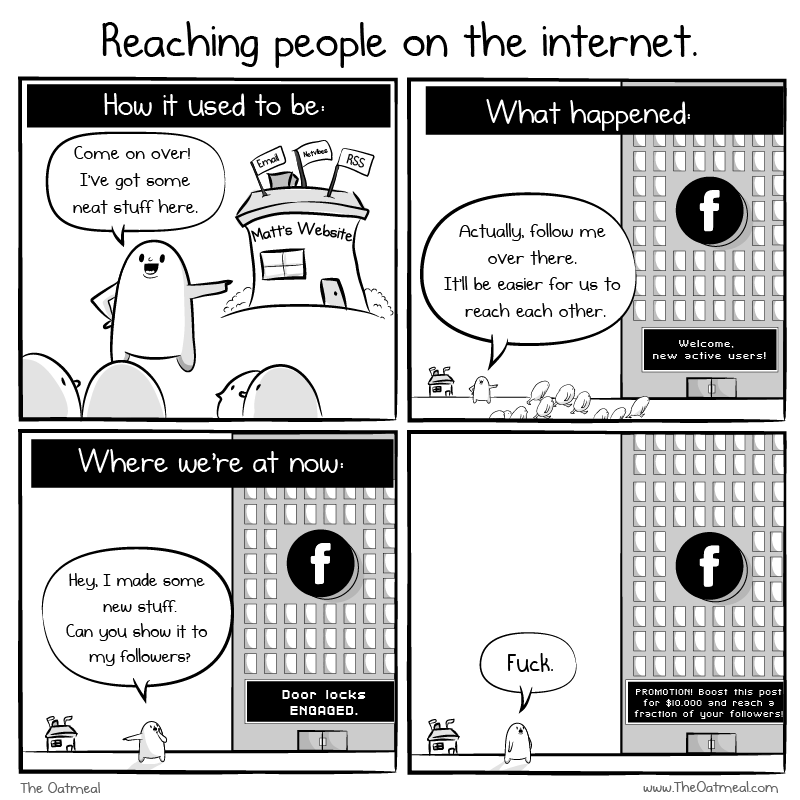
I realized then that I didn’t either, and hadn’t for a long time. Our online behavior, by that point, had been captured by big platforms that initially served as portals into that endless ramshackle apartment complex, but had at some point became the entire visible landscape. To “go online”, instead of typing in your favorite websites (fark.com, Digg, LiveJournal) and leapfrogging from there, people started going to their “home” on Facebook or Reddit and ended up wherever they were pointed to, which was usually another place inside Facebook or Reddit. The ethos had become capture-and-retain, rather than swing-by-and-say-hi. Open-water internet navigation – surfing – quietly went away, as these platforms designed slicker and more magnetic engagement routines for us.

While it will never be a habit again for most people, you can still surf the internet. You can pick a website with a lot of outbound links (they do still exist) and follow your heart.”

Early web influencers

My blog clean-up project (ongoing) reminded me of these early-web influencers (for me). Some of these folks are still around but most are no longer the “stars” they were in the early days. Link to my posts below. (Descriptions by GPT 4o)


Visionaries, Theorists, and Futurists

  • Bruce Sterling – A science fiction writer and cyberpunk pioneer who explored the social and cultural implications of digital technology.
  • Clay Shirky – An influential thinker on Internet culture, crowdsourcing, and the power of decentralized networks.
  • Douglas Coupland – Coined “Generation X” and explored the cultural impact of digital technology in novels and essays.
  • Douglas Rushkoff – A media theorist who wrote about cyberculture, the social effects of technology, and digital optimism.
  • Kevin Kelly – Founding editor of Wired and a deep thinker on how technology shapes society and the future.

Journalists and Media Analysts

  • Dan Gillmor – A pioneer in citizen journalism, advocating for the participatory nature of news in the digital era.
  • Jeff Jarvis – A media critic who has been vocal about how the Internet disrupts traditional journalism.
  • Steven Levy – A tech journalist who chronicled the history of computing and the rise of the digital age.
  • Steve Outing – An early advocate for online news, exploring how journalism adapted to the Internet.
  • Terry Heaton – A television executive who recognized the shift from traditional media to digital platforms.

Tech Pioneers and Web Innovators

  • Chris Pirillo – Founder of Lockergnome, one of the earliest online tech communities, helping people understand software and the web.
  • Dave Winer – A key figure in the development of blogging, RSS feeds, and podcasting technology.
  • David Weinberger – Co-author of The Cluetrain Manifesto, which framed how businesses should adapt to the Internet age.
  • Doc Searls – Another Cluetrain Manifesto author, emphasizing user empowerment and open-source principles.
  • Jakob Nielsen – The godfather of web usability, setting foundational principles for user-friendly web design.

Marketing and Culture Shapers

  • Halley Suitt – A prominent blogger and voice in the early blogosphere.
  • Hugh MacLeod – Known for his “gapingvoid” cartoons and commentary on creativity and business.
  • Mark Ramsey – A key voice in digital radio and podcasting strategy.
  • Scott Adams – Creator of Dilbert, which captured the absurdities of tech and office culture.
  • Seth Godin – A marketing guru who popularized permission-based marketing and how digital culture changes business.

Entrepreneurs and Digital Business Minds

  • Mark Cuban – Made his fortune selling Broadcast.com to Yahoo, later becoming a major figure in sports and media streaming.
  • Nikol Lohr – Less widely known, but active in early online DIY culture and communities.

Hyperlinks

In the early days of HTML (“WWW“) I looked for every opportunity to embed an in-line link on the websites I was responsible for. The more links, the better. It was all about the “user experience” back then and links added value.

Seems like I don’t see that many links these days and I only had to wonder for about three seconds. Why would they send me off to another page/site? Maybe we were always just “eyeballs.” I miss those links and the places they took me.

Where are they now?

You know how some insanely popular rock group has a bunch of hits and then… just disappears. At least from the media mainstream. They didn’t get less talented overnight and, sure, tastes change but this always seemed odd to me. In reviewing blog posts from the early days of the web, I see something similar. Here are some of the people most influential (for me) from that era (in no particular order): Bruce Sterling, Chris Pirillo, Clay Shirky, David Weinberger, Doc Searls, Kevin Kelley, Jeff Jarvis, Seth Goden.

On second thought, I’ll bet the folks are still around but — like everyone else — have migrated to social media, abandoning their blogs. Perhaps the web they wrote about and — in some cases — predicted, disappeared/never happened.

Goodbye DSL

I remember my excitement, all those years ago (2005), when I upgraded from dial-up internet access to “high speed” DSL. It was never great but it was the best thing available (we can’t get cable). The local phone company (CenturyLink) advertised 10mbps download (1mbps up) but we never got more than 8 and that was good enough. But for the last six months we’ve had continual problems. Good fast connection one minute… then almost nothing five minutes later. Lots of phone calls and two visits by technicians (image of large man scratching his head) and the service is still unreliable. So today is the day we cancel the service (which only costs $45/mo).

I’ve replaced it with AT&T’s wireless internet service. I’m now getting — on average — 35mbps down and 5mbps up. More than 4x faster! And almost certainly more reliable.

I’m paying $60 per month for the service and that gets me 50gb of data a month. Because we’re also DirecTV customers, they give us an additional 50gb. 100gb/mo should be enough but if we run over, we have an additional 30gb on our phones which can serve as wifi hotspots. I’ll monitor this for a few months to see what our usage looks like. DSL is ancient tech and while it has been mostly a good experience, I happy to see it go.

UPDATE 10/17/18: Or maybe not. Looks like we’ve used three quarters of our 100gb just halfway through our billing period. The overages could mount up fast. And we just don’t want to have to watch and budget. So we’re going back to DSL and will learn to live with slow speeds and unreliable service. But hey, I remember dial-up.

Rolling School Buses

“Google today announced an expansion of its Rolling Study Halls initiative to over 16 additional school districts, giving “thousands” of students access to Wi-Fi and Chromebooks on their buses. […] Google contributes mobile Wi-Fi routers, data plans, and Chromebook devices. Each Rolling Study Hall also has an “onboard educator” who’s able to provide direct assistance.”

My first BBS

I joined my first BBS (bulletin board system) on November 18, 1994. It was called Fun City and was operated by Kevin Diehl.

(Wikipedia) A bulletin board system, or BBS, is a computer server running software that allows users to connect to the system using a terminal program. Once logged in, the user can perform functions such as uploading and downloading software and data, reading news and bulletins, and exchanging messages with other users through email, public message boards, and sometimes via direct chatting. Many BBSes also offer on-line games, in which users can compete with each other, and BBSes with multiple phone lines often provide chat rooms, allowing users to interact with each other. Bulletin board systems were in many ways a precursor to the modern form of the World Wide Web, social networks and other aspects of the Internet. Low-cost, high-performance modems drove the use of online services and BBSes through the early 1990s. Infoworld estimated there were 60,000 BBSes serving 17 million users in the United States alone in 1994, a collective market much larger than major online services like CompuServe.

DSL Repair

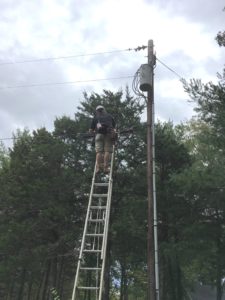
phoneguyBeen having problems with my DSL service (losing connection, slow speed) and the phone company sent a tech this morning. (Second time someone has been out in the last week or so) He could see there was a problem with the line, somewhere upstream, and — to save time — called the tech who came out previously since it was recent enough he might remember the call. He did and provide useful info.

I asked Mike (the tech who came out this morning) if he could access records from the previous call. From his reply I gathered only the barest minimum of information is recorded. Not surprising because who wants to write up a report once the problem is fixed.

But would it really be that difficult? Take out your smartphone, dictate brief summary of the call, save it as PDF and upload it to the company cloud where it can be accessed by the next service tech if needed. And by the customer.

My physician does this routinely. Within 24 hours of a visit. It’s readily available, along with my lab and test results.