
“The twisted psychology of bloggers vs. journalists”

NYU journalism professor Jay Rosen identifies five sources of stress on today’s journalists.

  1. A collapsing economic model, as print and broadcast dollars are exchanged for digital dimes.
  2. New competition (the loss of monopoly) as a disruptive technology, the Internet, does its thing.
  3. A shift in power. The tools of the modern media have been distributed to the people formerly known as the audience.
  4. A new pattern of information flow, in which “stuff” moves horizontally, peer to peer, as effectively as it moves vertically, from producer to consumer. Audience atomization overcome, I call it.
  5. The erosion of trust (which started a long time ago but accelerated after 2002) and the loss of authority.

This is an insightful look at the friction between journalists and bloggers. A must-read for either species.
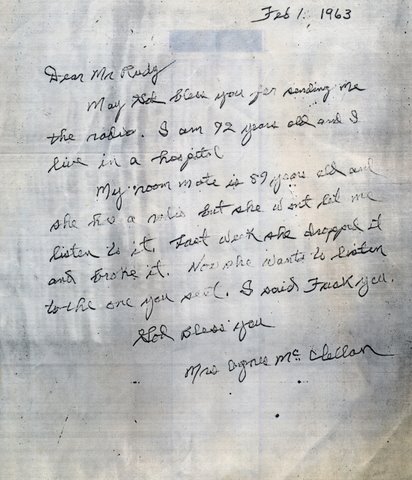
Fan letter to Mr. Rudy

I had heard this story over the years but always assumed it was apocryphal. Too good to be true. Rudy Pylant (“Mister Rudy”) was a local radio personality in my hometown. His fans were legion and he got lots of letters. Like this one his daughter recently discovered and shares.

“The Internet is over”

The Guardian sent Oliver Burkeman to SxSW where he realized the Internet is over:

“If Web 2.0 was the moment when the collaborative promise of the internet seemed finally to be realized – with ordinary users creating instead of just consuming, on sites from Flickr to Facebook to Wikipedia – Web 3.0 is the moment they forget they’re doing it. When the GPS system in your phone or iPad can relay your location to any site or device you like, when Facebook uses facial recognition on photographs posted there, when your financial transactions are tracked, and when the location of your car can influence a constantly changing, sensor-driven congestion-charging scheme, all in real time, something has qualitatively changed.”

We can probably stop saying “digital” media since all media is digital. Same for “online identity.” We only have one identity and unless you’re hunkered down in a Montana cabin, it’s online.

As long predicted, the Internet/Net/Web is woven in to all that we do. Like electricity and indoor plumbing. We don’t think about it. It has become invisible. We’ll stop saying (as I did above) “online” because we’ll never be “off line.” (Yes, I realize there are lots of people in the world for whom this is not the case. It will be.)

I wonder if I will miss the Internet when it is no longer an identifiable thing? Something I can “get on?” A place to go.

Fortress of Solitude

I spent some time cleaning up (and rearranging) my home office this weekend. One of our upstairs bedroom was turned into a “man cave” some years ago and I’m spending more and more time there (here).

With just the MacBook and wireless printer to move, it really didn’t take long. In the bad old PC days I had to label wires and cords to have any chance of getting everything hooked back up and working. I have a growing collection of power-strips that are no longer needed.

The room has a nice southern view looking out into the woods behind our house.

In the immortal words of Brian Wilson:

Now it’s dark and I’m alone
but I won’t be afraid
In my room

“The Net is the new TV & radio”

“Smartphones and other portable Net-connected devices are now the closest things we have to universal receivers and transmitters of live news. Not many of us carry radios in our pockets any more. Small portable TVs became passé decades ago. Smartphones and tablets are replacing radios and TVs in our pockets, purses and carry-bags.”

“Television has also become almost entirely an entertainment system, rather than a news one. News matters to TV networks, but it’s gravy. Mostly they’re entertainment businesses that also do news.”

“…emergencies such as wars and earthquakes demonstrate a simple and permanent fact of media life: that the Net is the new TV and the new radio, because it has subsumed both. It would be best for both TV and radio to normalize to the Net and quit protecting their old distribution systems.”

— From a post by Doc Searls, co-author of The Cluetrain Manifesto.