Podcasting is bottom-up

Rex Hammock knocks “the business of podcasting. Not the essence of podcasting” in a response to Darren Barefoot. I agree with Mr. Hammock about the content of podcasts:

The “killer-app” content will be that which has no professional alternative: A report from a Mom to her two children away in college; a recording of a Sunday School class for six people who couldn’t attend; an inspirationial chat from the regional sales manager to 15 sales people to listen to while driving between calls; an explanation of a new product by the lead engineer; a father’s play-by-play description of a Little League baseball game — all showing up automagically on the iPod or other MP3 player of the individuals who “subscribe” to it.

KBOA Trivia Bowl

KBOA (Modern Era) - 04

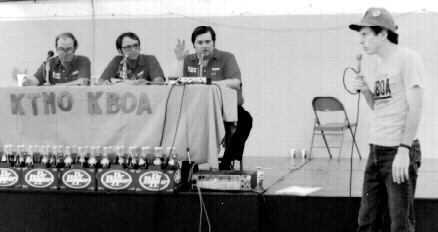
Some Canadian guys developed the concept for Trivial Pursuit in 1979 and released the board game two years later and the game’s popularity peaked in 1984. But we had been playing trivia on the air at KBOA for a number of years by then and it was about as much fun as anything I ever did on the air. While cleaning out a closet this afternoon, I found a tape of a show (first half-hour) we did in May of 1981.


[Download/listen]. Team members: John Robison, Jeff Wheeler and Tom Colvin. Good friends, then and now.

Profitable Demise

An intriguing open to a thoughtful article by Jay Rosen (PressThink). The piece (Laying the newspaper gently down to die. And keeping the spirit of journalism alive.) looks at challenges facing the newspaper business and how it is (or is not) meeting those challenges. But I believe there’s something here for all traditional media. My big take-away was a concept called “harvesting market position.” A last-resort business model for companies undermined by substitute technology.

“An industry that won’t move until it is certain of days as good as its golden past is effecively dead, from a strategic point of view. Besides, there is an alternative if you don’t have the faith or will or courage needed to accept reality and deal. The alternative is to drive the property to a profitable demise.

Drive the property to a profitable demise. You won’t see that in the company mission statement. But my favorite quote from Professor Rosen’s article came from Craig Newmark (craigslist):

“I realize I’m no news guy, not an activist; just like everyone else, tired of news that I can’t trust. My favorite irony is that Jon Stewart produces fake news that’s honest; and the White House produces allegedly honest news that’s really fake.”

“Telemarketing Wiz”

This is a true story although I have changed the names to protect the innocent and the clueless.

A couple of months ago, a friend (I’ll call him Ishmael) started a blog called “Telemarketing Wiz” and began posting all kinds of interesting stuff about telemarketing. He started hearing from others in the telemarketing business and people started linking to his blog. He got a little buzz going. Not a raging wildfire, but a little brush fire. Google “telemarketing” and his blog is #3 in the results.

One day recently, Ishmael has a meeting with someone at a publication called “Telemarketing.” (Remember, all of the names have been changed. This has nothing to do with telemarketing) The Telemarketing executive tells Ishmael they are not happy with him using the name “telemarketing” and they’d really like for him to stop. They even offered him a few worthless incentives.

Ishmael was shocked and said he’d think about it but wasn’t inclined to change the name of his blog. There were dozens of companies using the term “telemarketing”… why was the Big Publication concerned about him? Could it be that Big Publication was getting tired of hearing about Telemarketing Wiz?

Legal issues aside, this is a nice example of cluelessness on the part of MSM. I suggested to Ishmael that he change the name of his blog to “TelemarketingSucks.com,” but he’s more of a grown-up than I.

Would it have made more sense for Big Publisher to say, “We’ve noticed what you’re doing and think it’s pretty exciting. We’d like to hire you to blog for our publication.”

I’m sure that Telemarketing is a very good publication. Maybe the best. With lots of talented writers and editors and advertisers and big building with a nice lobby. A great place to read about telemarketing. But not the only place.

If Ishmael was writing a little paper newletter and mailing to a few hundred people, Big Publisher probably wouldn’t care what he called it. But the web is national. It’s global. Anybody can play. It’s no longer about who can come up with a few hundred thousand (million?)dollars to start a magazine. One guy, with a computer, and a head full of good ideas can get in the game. It’s a new day.

Air America Radio

“In early 2004, a group of investors set out to launch a liberal radio network that would challenge the dominance of America’s airwaves by conservative talk radio. The creative, financial and logistical challenges were immense, but on March 31, Air America Radio became a reality. LEFT OF THE DIAL chronicles the trials and tribulations involved in starting up – and sustaining – a nationwide radio network during a highly charged election year.”

Left of the Dial is another fascinating documentary from HBO.

Vision still 20/20

I’m just guessing here, but I figure I must own five or six hundred pair of reading glasses. And I can lay my hands on maybe a dozen of those. But the good news is they are cheap and disposable. And the better news is my vision is (still) almost 20-20. That’s the word from Dr. Wankum. I was half-way expecting to need full-time specs, but not yet. Waiting for the doctor, with all the eye exam gear surrounding you, is a fine time to think about all the beautiful things there are to see.

Saga cancels satellite-friendly syndicators.

Taking a stand against syndicators that air programs on both terrestrial and satellite radio, Saga Communications has begun methodically canceling shows where its exclusivity has been compromised. Ed Christian, president and CEO for Saga said he hopes his actions will sound a wake-up call to the industry while conveying to syndicators that they can’t have it both ways. [Story in Mediaweek]

Wire Service

In 1972, radio station KBOA had a little closet in the newsroom that housed two teletype machines. One for the Associated Press and one for the National Weather Service. These typewriter-like printers spewed out line after line of news, sports, weather… everything a radio station might ever want to pass on to its audience. They were loud and smelly and mechanical and the ground through box after box of paper and ribbons. I remember a tractor trailer pulling up to the station every few months to drop off dozens of boxes of each. It was –for all practical purposes– the radio station’s only source for news outside the local community. If someone forgot to feed the beast a new box of paper… or the paper jammed overnight… or the printer ribbon broke… no news. And if the damned thing just broke, you were probably miles from a technician that knew how to fix it.

I was reminded of those primitive days by a visit from old friend David Gerstmann, founder of WireReady. I met David at an NAB meeting in Boston back in 1991 or ’92. David had just graduated from Tufts University and was exhibiting at the show. He had written an inexpensive software program that could run on the personal computers that were coming into use. Instead of grinding through all of that paper and ribbon, his software could capture and store the information and you just printed out the stories you wanted. Not just from one wire service, but from as many as you had. An amazing idea at the time.

WireReady could also do some word processing tricks that radio news guys found handy. It was affordable, easy to use, ran on the piece-of-shit computer that trickled down to the newsroom and David gave great customer support. He sold a boat-load of WireReady systems and –over the years– introduced new features (networking, digital audio editing, etc).

For a long time, Associated Press and United Press International (UPI) were pretty much the the only sources for world and national news. Not technically a monopoly but they had broadcasters by the balls and they squeezed hard and long. It was a tightly controlled information pipeline but –thanks to the Internet– those days are gone forever. RIP.

Disclosure: The company I work for operates a sort of “poor man’s wire service” (sorry, David) called Learfield Data. It exists today, in part, because broadcasters wanted alternatives to the Big Wire Services of yore.

RadioDavidByrne.com

“A friend who relocated to California from NY said she missed hearing all the odd variety of music that was played around the office here. I miss hearing what you all are listening to,” she wrote. This “radio” is my response. It will stream for a few hours and then it will recycle. Maybe it will run longer in the future. The artists played here are respectful of one another and gunplay is forbidden.”

David Byrne explains why he started his own Internet radio station. What an interesting idea. I confess I like most of the songs I’ve heard, even though I’ve never heard of any of the artists. Other Internet radio stations to which I would listen: Radio McVey, Virettarama.