News bureau redefined

Picture_1

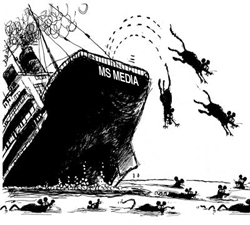
CNN announced on Tuesday that it would assign journalists to 10 cities across the United States, a move that would double the number of domestic cities where the cable news network has outposts.

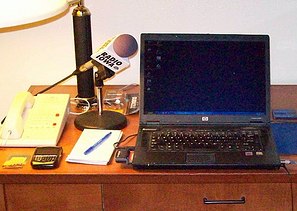
But in a reflection of the way television networks are reinventing the way they gather news, the journalists will not work from expensive bureaus — rather, they will borrow office space from local news organizations and use laptops to file articles for the Internet and TV. When news happens, they will use Internet connections and cellphone cameras to report live.

A new breed of reporter, sometimes called a “one-man band,” has become the new norm. Though the style of reporting has existed for years, it is being adopted more widely as these reporters act as their own producer, cameraman and editor, and sometimes even transmit live video.

Marcus Wilford, vice president for international digital at ABC News, recalled that when he was hired 20 years ago, the news division’s Paris bureau had three camera crews, three producers, two correspondents, drivers, and a chef in a house with a view of the Eiffel Tower. Today the ABC News presence in Paris consists of a lone staff producer.” — NYTimes.com

Keep your Blackberry under your pillow

Former Iowa Congressman Jim Leach — a Republican — endorsed Democratic presidential candidate Barack Obama on Tuesday morning. I think my friend and co-worker Kay Henderson broke the story. It got a lot of national play and her blog post generated 3,000+ page views. I’m sure we got a bunch more at RadioIowa.com. I asked Kay how she got on the story so early:

“I sleep with my blackberry. I woke up at 6 o’clock, checked the ‘berry, and went back to sleep.  As I sort of floated out of dreamland I must have heard or sensed the vibration the ‘berry makes when there’s an incoming email. I pulled the ‘berry from underneath the pillow and read the email sent at 7:14 a.m. from a source in the Obama campaign, alerting me to the fact that former Iowa Congressman Jim Leach would be endorsing Obama in a few hours, during a telephone conference call being organized by the Obama campaign.

I called the newsroom and gave Matt – our morning anchor – the details for him to include in our next newscast, then roused myself from bed and walked into my home office.  I started blogging by feel, as I hadn’t found my glasses yet.  By 7:45 a.m. I had a fairly complete blog post up about the news.  It included text from a speech Vice President Dick Cheney gave at a Leach campaign fundraiser in 2003, explaining the Leach-Cheney-Rumsfeld connection.

I kept updating the post through the day.  An addition at the top – the opening Leach quote — came from a noontime interview.  The McCain folks emailed responses, which got to my email box by 1:50 p.m.”

A couple of things in Kay’s account stand out for me. If she had waited until she got to the office to check her email, she might not have had the jump on the story. Should all reporters sleep with their Blackberry under their pillow? Well, yeah, if you expect to beat Kay on a story.

And that she blogged the story before having her Cheerios. A whole bunch of political reporters follow Kay’s blog.

And while the technology is cool, there’s no substitute for having the contact in the Obama campaign.

Public Access TV in a YouTube world

If you watch any TV or cable news, you hear references to this or that video on YouTube. It reminds me of the days when the big three networks referred something on CNN. YouTube is starting to feel like another network. NBC doesn’t want to cover my speech? No problem. I’ll just post it to YouTube.

My next thought was the similarity to public access TV. Let the record show I know almost nothing about public access TV. I think it works something like this:

The local cable company (or someone) sets aside a channel for the public to produce programming. I assume there is a local board or committee that manages the channel and decides what programming to air and when.

Putting Tivo aside for a moment, the public access channel is limited to 24 hours of programming each days. And to keep the math simple, let’s say every program is an hour long and airs once a week. That’s 168 programs a week. And many of those would “air” in the middle of the night.

I think it would be difficult to fill that much time. And what if I had something that was only 5 or 10 minutes long?

Here’s my question: Why won’t YouTube (and similar services) make public access television obsolete? [This is where I show my ignorance of PATV] If local relevance is the raison d’etra of PATV, why not just invite the people of your community (or people who visit your community) to post their videos to YouTube and tag them with the name of the city/town?

But wait, what about our live coverage of the weekly city council meeting? It runs 2 hours or longer and YouTube limits videos to 10 minutes.

Hmm. I guess I’d stream it on Ustream and then pull “highlights” and post those on YouTube.

I expect the Big Question would be, “What about all the people who don’t have computers and access to the Internet?” For the answer, see: “What About People Who Don’t Have TV Sets?”

Don’t misunderstand. I’m not suggesting for a moment that public access TV isn’t a good or necessary thing. There must be people who watch it or it wouldn’t exist. It just feels like one of those things –like classified adds– that would work better and cheaper online.

My friend Jeff knows a LOT about public access TV and I encourage him to comment and help me understand how technology is evolving in this area.

Bush declines to slap Misty May-Treanor’s bikinied butt

“Defending gold medalists Misty May-Treanor and Kerri Walsh gave (President Bush) some (volleyball) pointers. Then after a good play, in the tradition of female volleyballers, Misty May-Treanor turned, bent over slightly and offered her bikinied rear-end for the 43rd president to slap. “Mr. President,” she said, “want to?” — From LA Times Top of the Ticket blog

14 hours, 900 miles

Destinroute

That’s a lot of windshield time for smays.com. But the company was good (Barb) and the distance still within my 1,000 mile drive-rather-than-fly range. Did I mention how much I hate the hassle of flying. You know what? I can’t wait for the current batch of American carriers to go belly-up. Sooner that happens, the sooner we’ll see alternatives. I’m serious as a depressurized cabin. But hey, I’m on vacation. Happy thoughts only.

The Miltenberger Clan has gathered here in beautiful Destin for a week of sun and fun. The nearby Starbucks (sorry, Taisir) has free wifi and I have some good books I’ve been stockpiling. Gotta run, it’s time for my post-drive bottom massage.

Can Congress tweet?

“A political spat erupted in Washington, D.C., earlier this month over rules governing how members of Congress may use the Internet. House Republicans argued that proposed changes to the rules amounted to “new government censorship of the Internet,” while Democrats said the charges were exaggerated. Whichever side is right or wrong, the fact remains that current rules governing official communications prohibit members of Congress from using video-sharing or social networking sites like YouTube, Flickr, or Facebook. As a result, many House members, including Speaker Nancy Pelosi (D-CA), are currently in violation of the rules.

Rep. John Culberson (R-TX), a pioneer in using new media to communicate with constituents, sounded the alarm over the new rules via Twitter. Culberson has made a name for himself twittering from the House floor, broadcasting live video from the White House using Qik, and hosting regular “town hall” meetings using live video-streaming and chat on Ustream.

In a later statement, Culberson argued that new media should not be treated any differently than old. “When I am interviewed for a newspaper article or a television story, or have a conversation on a radio show, my interview/conversation is going to appear in the same publication/broadcast as a campaign or commercial ad,” he said. — Ars Technica