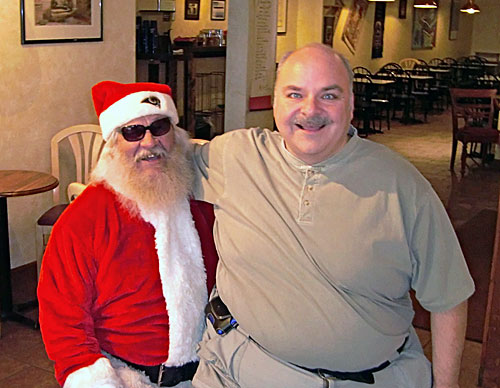
And for those that haven’t seen it in previous years, here I am desperately throw a gang sign calling for immediate help.
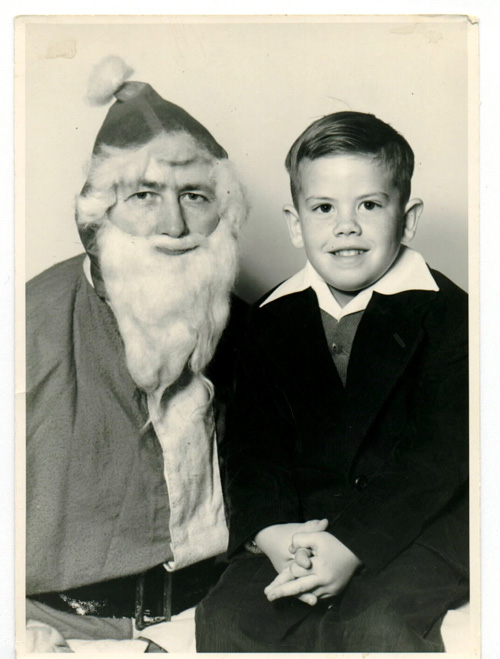

And for those that haven’t seen it in previous years, here I am desperately throw a gang sign calling for immediate help.
Local radio personality Jack Daniels broadcasting live from the Jefferson City Hy-Vee.
Until the fifteen hundreds, people knew the earth was flat. But it wasn’t. Everyone was wrong. It probably took a long time for that new reality to sink in. A life time, perhaps? Makes a boy wonder if there are things I believe —I’m talking about the most fundamental things here— that are just wrong. Like, the sun does NOT circle the earth.
How do you wrap your mind around something like that? Your senses tell you one thing, but the reality is something different. Will there be something as jolting as “the earth is round, not flat” in my lifetime? How will I deal with it? Many would —I believe— choose denial. “It’s just not so. Uh uh, no way.”
If I’m just flat out wrong about some fundamental belief, do I want to know the truth. Remember, we’re talking the-world-aint-flat kind of truth here.
I do. As painful and unsettling as it would surely be, I want to know. And then I’ll try to keep it to myself.
A few weeks back I posted a few times on the Heather Ellis trial in Kennett, MO, my home town. The trial and the incident that started the whole thing (3 years ago?) left Kennett with a black eye (so to speak). The local prosecutor recused himself and Morley Swingle –the prosecuting attorney for Cape Girardeau County– took over. In an op-ed piece (?) in today’s St. Louis Post-Dispatch, Mr. Swingle reflects on the trial and the incident that made it necessary:
“On a Saturday night in 2007 at the Wal-Mart in Kennett, Mo., Heather Ellis went into an angry tirade in the checkout line, grabbed another customer’s merchandise and pushed it away from the cash register, not just once, but four times.
When a manager told her to leave the store, she responded, “I’m not leaving and you can’t make me.” The police were called. They escorted her out of the store. Outside, she continued her angry rant. When an officer told her she would be arrested if she did not leave, she replied: “If you try to arrest me I’ll kick your [derriere].”
She was arrested. True to her word, she kicked the arresting officer and smacked another in the mouth, drawing blood.
Most people, after behaving so badly, would issue a few apologies and accept the prosecutor’s generous plea offer of probation to misdemeanor offenses. Instead, Ellis decided to claim to the national media that her arrest was based on “racism.”
 I’m reading a mind-stretching book. Biocentrism by Robert Lanza (with Bob Berman). I wouldn’t know where to begin describing what this book is about. Like John Sebastian said, “it’s like trying to tell a stranger ’bout rock and roll.”
The authors, however, are very good at explaining the most complex concepts. Here’s a little riff on Time:
“Imagine that existence is like a sound recording. Listening to an old phonograph doesn’t alter the recording itself, and depending on where the needle is placed, you hear a certain piece of music. This is what we call the present. The music, before and after the song now being heard, is what we call the past and the future. Imagine, in like manner, every moment and day enduring in nature always. The record does not go away. All nows (all the songs on the record) exist simultaneously, although we can only experience the world (or the record) piece by piece. We do not experience time in which “Stardust” often plays, because we experience time linearly.”
This book is not for everyone. If you have too much “reality” in you life to think about the possibility it’s all “in your head,” you can take a pass on Biocentrism. But it will get a spot on my nightstand as one of those books I’ll have to read again and again.
I missed the Agrarian Age and the Industrial Age but have been pretty much in the thick of the Information Age, so I was a little startled to learn that it was over. Or nearly so.
David Wienberger pointed to an essay by Joe Andrieu titled “Leaving the Information Age,” written in September of 2007. It makes a compelling case for the the idea that we’re nearing the end of the Information Age:
“As cable television and the Internet invaded our homes, we began to find that we could satisfy many of our wants and desires through Information rather than physical goods. It was liberating, intoxicating, and led to one of the most outrageous economic bubbles since the heyday of the Industrial Age triggered the Great Depression.
Similarly, the Information Age is, (surpise!), defined by MORE information. More channels. More telephones. More email. More websites. More advertising. More media.
And in a (perhaps) surprisingly short period, we now find ourselves echoing a new version of the mantra that ended the Industrial Age: “Enough! We don’t need so much Information!”
Mr. Andrieu makes the subject of “ages” much more interesting than your junior high history teacher. Well worth the read.
I just spotted (in Google Reader) an Associated Press story about Monsanto with the headline: Monsanto seed business role revealed. Here’s the first graph:
ST. LOUIS — Confidential contracts detailing Monsanto Co.’s business practices reveal how the world’s biggest seed developer is squeezing competitors, controlling smaller seed companies and protecting its dominance over the multibillion-dollar market for genetically altered crops, an Associated Press investigation has found.
I was curious what the twitterverse was saying about the story and found an endless stream of links and comments. No surprise there.
I’ve been following one of Monsanto’s Twitter feeds (@monsantoco) for a while and dropped into see how they were responding to the story and the Twitter buzz.
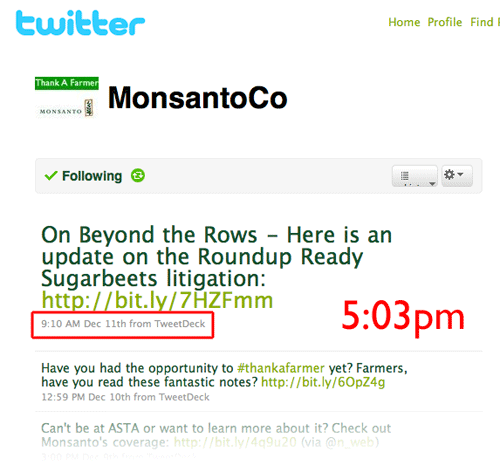
Nothing since Friday morning at 9:10. Hard to draw any conclusions without know more but with almost 3,000 followers, why wouldn’t you use Twitter to “engage in the conversation.” If not now, when? If not Twitter, how? If you’re going to use social media to tell your story, you gotta be there if/when the story gets unpleasant or be conspicuous by your absence.
Depending on the serious of the AP investigation, there are probably lots of emails and phone calls and maybe even a few meetings, to decide if/how/where to respond to the story.
If anyone on Learfield’s senior management team are reading this, take a few minutes at your next meeting to talk about how you would respond to a big, negative story about our company. I really think we could engage quickly without making our lawyers all jittery and nauseous.
Disclosure: Monsanto is an advertiser on at least one of the radio networks owned by the company I work for.
UPDATE: Monsanto did get a response up last night. And linked to it from Twitter. Probably hard for a company that large to move any faster.
“In the movies, radio is a mythic force: local, rebellious, life-changing. This hardly describes the reality at commercial radio stations today, but it does tell us something about how radio was—and about how we want it to be.
The Clear Channel consolidations of the 1990s and the streaming revolutions of the last decade have given us change and innovation, but they haven’t forged the kind of cultural radio that thrilled and united 20th-century audiences. Sure, we’ve got talkers who excel at dividing us. And we’ve got little machines that let us become our own DJs. But we haven’t replicated the “real people” kind of radio that speaks and sings to us better than we can speak and sing to ourselves. Our new broadband-powered landscape hasn’t empowered that level of talent—yet. But don’t worry. It will. Until then, see you at the movies.
I stumbled across this piece by Matthew Lasar on ars technica. It brought back many fond memories from my days at KBOA (’70s). We said pretty much anything within reason and the same went for the music we played (on turn-tables). And I loved movies about DJ’s and radio stations. I’ll be forever grateful I didn’t miss “real radio.”
“Barack Obama ran for president as a man of the people, standing up to Wall Street as the global economy melted down in that fateful fall of 2008. He pushed a tax plan to soak the rich, ripped NAFTA for hurting the middle class and tore into John McCain for supporting a bankruptcy bill that sided with wealthy bankers “at the expense of hardworking Americans.” Obama may not have run to the left of Samuel Gompers or Cesar Chavez, but it’s not like you saw him on the campaign trail flanked by bankers from Citigroup and Goldman Sachs. What inspired supporters who pushed him to his historic win was the sense that a genuine outsider was finally breaking into an exclusive club, that walls were being torn down, that things were, for lack of a better or more specific term, changing. Then he got elected.”
Oh dear. Who’s my favorite political reporter? Who’s the guy I always turn to for the hard, profane truth? That’s right, Matt Taibbi. The graf above is the lead to his latest piece in Rolling Stone. And this, sums it all up:
“What we do know is that Barack Obama pulled a bait-and-switch on us. If it were any other politician, we wouldn’t be surprised. Maybe it’s our fault, for thinking he was different.”