
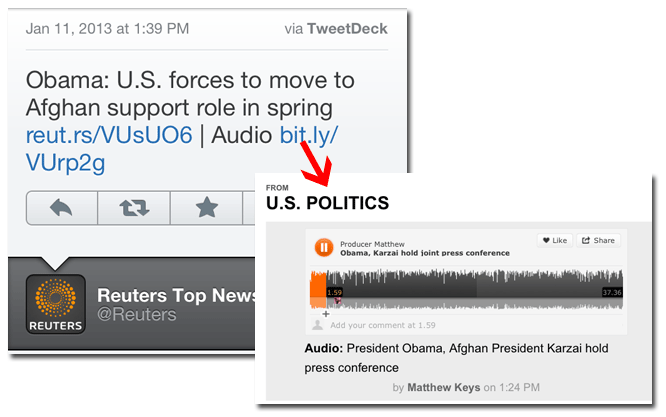
Twitter is my first source for breaking news. If anything big (that I care about) happens, it will show up first in my Twitter feed. I guess a cable news channel might come close or a good all-news radio station (do those still exist?) but my Twitter stream is non-stop in my pocket. Smart news organization (NPR and Reuters, for example) know they need to have their stories where I am, rather than try to get me to come to where they are.
Seth Godin on social networking
Keep the channel open
“There is a vitality, a life force, an energy, a quickening that is translated through you into action, and because there is only one of you in all of time, this expression is unique. And if you block it, it will never exist through any other medium and it will be lost. The world will not have it. It is not your business to determine how good it is nor how valuable nor how it compares with other expressions. It is your business to keep it yours clearly and directly, to keep the channel open. You do not even have to believe in yourself or your work. You have to keep yourself open and aware to the urges that motivate you. Keep the channel open.” — Martha Graham
Scott Adams: Robots
“I predict that someday robots will have superior rights to humans in specific areas of life because robots can be trusted (programmed) and humans cannot. … I will go so far as to predict that someday it will be illegal for a human to practice medicine because robots will be so much more reliable. In the long transition period, which has already started and will last another twenty years, humans will be in charge of what the technology does. Eventually those roles will reverse because technology will be so much more reliable than humans. Future generations will be appalled that humans were ever allowed to perform invasive surgery on other humans.”
“At some point the real cost of healthcare, energy, construction, transportation, farming, and just about every other basic expense will fall by 90% as robots get involved. It would be absurd to assume we know anything about the economy in thirty years. Nothing will look the same.”
Floating in Extraordinariness
Kevin Kelly thinks we’ve reached a point where “rather than be surrounded by ordinariness we’ll float in extraordinariness.”
“The internet is like a lens which focuses the extraordinary into a beam, and that beam has become our illumination. It compresses the unlikely into a small viewable band of everyday-ness. As long as we are online – which is almost all day many days — we are illuminated by this compressed extraordinariness. It is the new normal.”
“That light of super-ness changes us. We no longer want mere presentations, we want the best, greatest, the most extraordinary presenters alive, as in TED. We don’t want to watch people playing games, we want to watch the highlights of the highlights, the most amazing moves, catches, runs, shots, and kicks, each one more remarkable and improbable than the other.”
Still images from video
“The distinction (what was left of it) between still images and cinematic images is gone. As this technology continues to shrink and improve, eventually moving to your phone, it will change what we think of as photography.”
Day One
Feels like I’ve been “retiring” for a long time. Months. Didn’t plan it that way but it sort of dragged out. I grew weary of talking and thinking about it and assumed others did. But a few people have asked about The First Day of the Death of Your Life so here’s a brief run down.
Got to the Soldier of Fortune Command Center (Coffee Zone) around 8:00 a.m. Shot the shit with my buddy Clyde for a couple of hours until he had to go to work. He’s supposed to be retired, too, but “doing nothing” is not an option for him.
Ran some errands and then drove to nearby city to have lunch with one of my house-mates from college. Back home for some (daylight!) fetch with Lucy and Hattie (the Golden Retrievers). A little meditation then off to the gym for 45 min. Really didn’t have much trouble filling the day but there was a noticeably different tempo. Almost anticipation. Probably what dogs experience when they find themselves on the other side of the “invisible fence.” Waiting for that shock that never comes.
Stay tuned.
The Post-Productive Economy
A few paragraphs from an inspiring and thought-provoking post by the always-brilliant Kevin Kelly:
“These homes have no running water, no grid electricity, and no toilets. They don’t even have outhouses. But the farmers and their children who live in these homes all have cell phones, and they have accounts on the Chinese versions of Twitter and Facebook, and recharge via solar panels.”
“The farmers in rural China have chosen cell phones and twitter over toilets and running water. You can go to almost any African village to see this. And it is not because they are too poor to afford a toilet. As you can see from these farmers’ homes in Yunnan, they definitely could have at least built an outhouse if they found it valuable. But instead they found the intangible benefits of connection to be greater than the physical comforts of running water.”
“The 3rd Industrial Revolution is not really computers and the internet, it is the networking of everything. We have only begun to connect everything to everything and to make little network minds everywhere. It may take another 80 years for the full affect of this revolution to be revealed.”
What if you don’t want to be a manager?
From a post by Anne Kreamer at HBR.org. It’s probably just my own heightened awareness, but a bunch of really timely articles have found their way to me in recent weeks.
“Companies continue to cling to the notion that one of the only mechanisms they have to acknowledge employees’ talent is to make them managers and then to continue to promote them into ever-higher levels of management — reflecting the misguided assumption that being good at something also means being able to (and wanting to) manage others doing the same thing.”
“As corporate executive I felt like I had to pretend to be something I wasn’t — I didn’t like being a manager, but I was a manager, so I had to appear to be interested in all the stuff that went along with being a manager. This is something social scientists call “emotion labor” — what you experience when you feel obliged to act differently from your natural inclinations.”
Consciousness vs Self-Awareness
“Humans are more than just conscious; they are also self-aware. Scientists differ on how they distinguish between consciousness and self-awareness, but here is one common distinction: consciousness is awareness of your body and your environment; self-awareness is recognition of that consciousness—not only understanding that you exist but further comprehending that you are aware of your existence. Another way of considering it: to be conscious is to think; to be self-aware is to realize that you are a thinking being and to think about your thoughts.”
— Scientific American