
The sun is always setting
“The state of the world is a relative truth. It’s mostly relative to how much news you watch. If you’re a CNN junkie, you live in a more worrisome, dangerous world than I do. You can argue all day that it’s the same world, but all that matters is what world you experience, not what the world is supposed to be likeoutside your experience. So zoom in, live from here. Don’t let others tell you what the world is like, because they live in a different world.”
David Cain on sunsets and how the world works.
Living in an Internet cafe
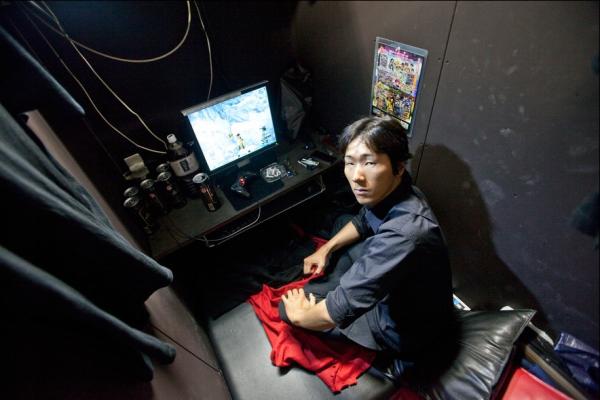
“Fumiya has learned to sleep with a blanket over his face to block out the fluorescent lights that stay on all night. Unable to afford an apartment in Tokyo, he has been living in an Internet cafe for nearly a year. At 26, he is part of Japan’s struggling working class. Temporary workers with little job security now make up more than a third of the country’s labor force, according to government statistics.”
“At a discounted monthly rate of about 1,920 yen ($21) a day, the 24-hour cafes offer private rooms with computers, reclining chairs, and an endless supply of coffee and soft drinks. Shared bathrooms and laundry service are also included.”
“According to a 2007 study from Japan’s Ministry of Health, Labor and Welfare, an average of 60,900 people spent the night in an Internet cafe on any given day. Of those, an estimated 5,400 were long-term residents.”
Steve Jobs Schools
“Some 1,000 children aged four to 12 will attend the schools, without notebooks, books or backpacks. Each of them, however, will have his or her own iPad. There will be no blackboards, chalk or classrooms, homeroom teachers, formal classes, lesson plans, seating charts, pens, teachers teaching from the front of the room, schedules, parent-teacher meetings, grades, recess bells, fixed school days and school vacations. If a child would rather play on his or her iPad instead of learning, it’ll be okay. And the children will choose what they wish to learn based on what they happen to be curious about.”
Immortality
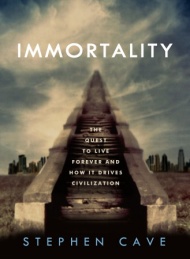 The Quest to Live Forever and How It Drives Civilization, by Stephen Cave (Amazon)
“The Mortality Paradox – On the one hand, our powerful intellects come inexorably to the conclusion that we, like all other living things around us, must one day die. Yet on the other, the one thing that these minds cannot imagine is that very state of nonexistence; it is literally inconceivable. Death therefore presents itself as both inevitable and impossible.”
“The Terror Management Theory – We must live in the knowledge that the worst thing that can possibly happen to us one day surely will. […] We have created institutions, philosophies and religions to protect us from this terror by denying or at least distracting us from the finality of death.”
“Immortality is not for the weak and foolish.”
“”Longevity Escape velocity” – living long enough to live forever”
“”Computational Resurrection” – the rerunning of software that is your mind on a new piece of hardware so that you might live again.”
“The Soul – the most influential single idea in the history of Western civilization”
“Whether or not we literally believe we have a soul that will go to heaven, the cosmic significance we ascribe to ourselves as unique individuals reassures us that we transcend mere biology. […] We are creating a myth of immunity to extinction.”
“Buddhists do believe in some essential part of you that survives the body in order to be reincarnated in accordance with the laws of karma. This is pure consciousness, stripped of all memories and convictions and the rest of the accumulated baggage of a lifetime. The Dali Lama describes it as a “continuum of awareness.””
“In Hinduism and Buddhism there is an undercurrent of recognition that the individual mind cannot continue without the body. Beyond the theory of reincarnation, which requires a soul robust enough to be punished for its past sins, there are hints of something more radical. Nirvana, for example, literally means “extinguishing” or “blowing out.” But what is it that is being “blown out” like a candle? Some Buddhists say worldly desires. Others, however, go further and believe it is the self that is extinguished. For some in the ascetic tradition, the source of worldly suffering is not just being in the world–it is being at all. Liberation therefore means to cease to be an individual altogether, or as the Hindus put it, to become one with the all, the Brahman.”
“We have already concluded you have no soul — no unchanging essence or immutable inner core. We could go further and say that there is, in fact, nothing that is the “real you.” You are just a collection of disparate thoughts, memories, sense impressions and the like, all bundled up together in a package we conveniently label a person. What is more, all these disparate parts are continually changing,as some things are forgotten and others learned, opinions changed and new memories formed. The question is, then, if you are such an ever-changing bundle, what does it mean for “you” to survive?”
“Psychologist Roy Baumeister has estimated the length of time for which most of us can expect to be remembered as seventy years. He points out that not many people can even *name* their great-grandparents.”
“People in modern cities long ago lost the ability to survive independently—we are utterly reliant on a complex higher level system for clean water, food, clothing, shelter, medicine, security and energy. Like the specialized cells of our bodies, which have given up their independence for the greater strength and security offered by life as part of a macro-organism, we have each given up our independence to be part of strong and secure superorganisms.”
“Individual humans are merely temporary forms taken by the single, shifting web of life on earth. If humans are not really separate things, then their births and deaths are also not real, but simply one way of seeing the rhythms of life.”
“The great social-reform movements of the last centuries — emancipation of slaves, equality between sexes and races, social welfare and son on — arose only when the preoccupation with the next world began to lose its grip on Western society. […] If this life here on earth is regarded merely as a series of tests for a place in another life, then it is necessarily devalued.”
“There are as I see it two sets of problems: on the one hand, the boredom and apathy that would result from having done and seen everything there is to do— that is, from having already lived a very long time—and on the other hand, the paralysis that would result from having an infinite future in which to do any further things. Both these problems, the backward looking and the forward-looking, threaten to suck the meaning out of life and leave one wishing for a terminal deadline.”
“Death is the source of all our deadlines.”
“Life as we know it may be too short to watch daytime TV, but eternity wouldn’t be.[…] Given infinity, time would lose its worth. And once time is worthless, it becomes impossible to make rational decisions about how to spend it. […] If civilization exists to aid our preparation into the future, then if that perpetuation were guaranteed, civilization would be redundant. […] Civilization exists to give us immortality, but if it ever succeeded it would fall apart.”
“We do not “see” or experience death; death is the end of all experience. […] Neither you nor I can ever literally *be* dead. Living things cannot be dead things. To talk of someone “being dead” is just a shorthand for saying they have ceased to exist. […] We can never be aware of (life) having an end — we can never know anything but life.”
“If you are happy now, then you are happy always, as there is only now.”
Mind Full, or Mindful?
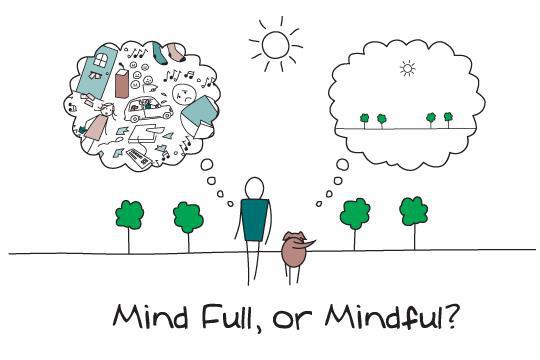
The Talking Window
Two minutes on the train
Radio Iowa (Early Days)
Remarks by Missourinet News Director Bob Priddy at event celebrating the 25th Anniversary of Radio Iowa, a statewide radio news network owned by Learfield Communications. Lots of insider stuff here but we’re sharing so you can enjoy the fine writing and beautiful sound of Bob’s voice and delivery. [watch on YouTube]
Travel Pain Quotient

I had a lot of time to think on that long train ride to Washington DC and I came to an important realization:
I don’t like to travel.
This is right up (down?) there with: “I don’t like kids.” There is some stigma attached.
I’ve battled (internally) this for years, forcing myself to take trips to “get over” my aversion. Like some gay teenager sleeping with the head cheerleader, trying to “cure” himself.
My train trip was an example of this. “You don’t like flying but maybe you’ll like travelling by train.” I didn’t.
Barb LOVES to travel but is mostly okay with the fact that I do not and (for years) has travelled with her sister and friends.
I know what you’re thinking.
The world is filled with wonderful and beautiful sites and experiences that you will never know if you don’t get out of that coffee shop. A full moon over the Great Pyramid; the temples of ancient Greece; the Grand Canyon (“You’ve never been to the Grand Canyon?!”)
But it’s time for me to ‘come out’ and embrace my inertia. Which doesn’t mean I’ll never take another trip. (Barb and I will visit my brother and his family in Malaysia in a few weeks.) But now I have a forumula to guide me.
TRAVEL PAIN QUOTIENT (TPQ)
Miles/Mode x Payoff = TPQ
MILES – To your destination (one way)
MODE – Of transportation (pick closest)
PAYOFF – The (subjective) value of experience once at your destination (1-10) Higher the number, the better the experience.
Mode Scale (subject to change)
10- Private Jet
9- Commercial Flight
8- Cruise Ship
7- Car
6- Motorcycle
5- Train
4- Bus
3- Bicycle
2- Pack Mule
1- Walking
Examples:
Private jet from NY to Paris (3,636) to party with Jessica Alba
3630
——- = 40
10 x 9
Drive from Milwaukee to Indianapolis for cousin’s wedding (her third)
280
——– = 20
7 x 2
I’m mathmatically challenged so feel free to modify this formula as necessary. Clearly the first trip above is more than twice as much fun as the second one. I’ll need some help with this.