
Meditation: 271 Days
After 271 consecutive days of meditation practice, I missed on Saturday. I was attending my 50th high school class reunion and just spaced it off. My previous streak of 371 days (starting on December 4, 2014) ended during a bout with pneumonia (December 5, 2015). I don’t get hung up on the quality of my practice or the duration but I do try to be consistent in sitting every day, if only for 10 minutes. Which is the only reason I keep track of my sessions. As I’ve noted previously, missing once a year might not be a bad thing if it keeps me from focusing on the string instead of today’s session. So today is two in a row!
The Internet Has Not Killed the Printed Book
“Sixty-five percent of adults in the United States said they had read a printed book in the past year, the same percentage that said so in 2012. When you add in ebooks and audiobooks, the number that said they had read a book in printed or electronic format in the past 12 months rose to 73 percent, compared with 74 percent in 2012. Twenty-eight percent said they had opted for an ebook in the past year, while 14 percent said they had listened to an audiobook.”
“The Pew study, based on a telephone survey of 1,520 adults in the country from March 7 to April 4, reports that people are indeed using tablets and smartphones to read books. Thirteen percent of adults in the United States said that they used their cellphones for reading in the past year, up from 5 percent in 2011. Tablets are a similar story: 15 percent said that they had used one for books this year, up from 4 percent in 2011.”
“While 6 percent said they read books only in digital format, 38 percent said they read books exclusively in print. But 28 percent are reading a combination of digital and printed books, suggesting that voracious readers are happy to take their text however they can get it.”
New York Times
Did social media kill graffiti?
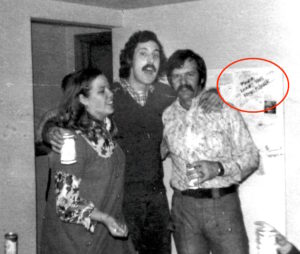 I’m not talking about spray painted tags on the sides of rail cars, rather those pithy little observations on the walls of restroom stalls.
This was a big thing (at least in my circle) during the late 60s and 70s. My first recollection of this art form was in the hall bathroom outside Dr. Peck’s TV room. This was hangout #1 for our tribe (we didn’t call it that back then). Someone (Richard or Charlie?) had tacked a piece of poster board to the bathroom door with a Bic pen hanging on a piece of string. Someone would scribble something clever and others would comment in endless strings of puns and nonsense.
I don’t recall these ever being discussed face-to-face, the conversation was limited to the poster board. When it was so filled there was no room for one more witticism, the poster was replaced and the old one archived somewhere.
In the photo below you see what I believe is a piece of sheetrock leaning against a wall in the living room of the house where AJ and I lived (Church Street, Kennett, MO). There was a party nearly every night and it didn’t take long to completely cover a piece of poster board.
If there was a zeitgeist for this golden age of my youth, it was scrawled on these graffiti boards. Today these bon mots are tweeted or IM’d Instagrammed but surely something is lost.
50th High School Class Reunion
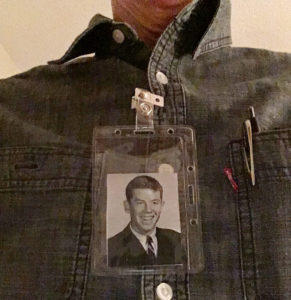
30 or 40 eighteen-year-old ghosts trapped in ravaged, aging bodies shuffling around the room desperately trying to recognize people you knew half a century ago. The time-honored tradition of name tags featuring photos from the high school yearbook was honored. So we smiled and shook hands and looked down at the kids we once were, unable to conceal the “what the fuck happened to you” horror.
 We only lost 30 or so classmates (from a class of about 150) which is sort of amazing given that we all grew up eating nothing but fried food and breathing crop dusting chemicals and the toxic plume that was sprayed every summer night to battle the clouds of mosquitos.
I went with some trepidation (I went to the 10 year reunion but none after) but wound up enjoying myself. I can’t speak for others but the person looking out of my eyes was/is that 18 year old who went to school with all of the old people in the room, with their titanium knees and heart stints. I couldn’t see the old me they were seeing. I hope and assume it was the same for everyone.
No, what I thought would be a depressing shuffle down memory lane turned out okay. Maybe a little “survivor high” if there is such a thing. We made it! We’re still here! “Fuckin A!” as we said in 1966.
When this is over
“When this is over, you will have nothing that you want.” Garrison Keillor in the Washington Post.
“The cap does not look good on you, it’s a duffer’s cap, and when you come to the microphone, you look like the warm-up guy, the guy who announces the license number of the car left in the parking lot, doors locked, lights on, motor running. The brim shadows your face, which gives a sinister look, as if you’d come to town to announce the closing of the pulp factory. Your eyes look dead and your scowl does not suggest American greatness so much as American indigestion. Your hair is the wrong color: People don’t want a president to be that shade of blond. You know that now.
Why doesn’t someone in your entourage dare to say these things? So sad. The fans in the arenas are wild about you, and Sean Hannity is as loyal as they come, but Rudy and Christie and Newt are reassuring in that stilted way of hospital visitors. And The New York Times treats you like the village idiot. This is painful for a Queens boy trying to win respect in Manhattan where the Times is the Supreme Liberal Jewish Anglican Arbiter of Who Has The Smarts and What Goes Where. When you came to Manhattan 40 years ago, you discovered that in entertainment, the press, politics, finance, everywhere you went, you ran into Jews, and they are not like you: Jews didn’t go in for big yachts and a fleet of aircraft — they showed off by way of philanthropy or by raising brilliant offspring. They sympathized with the civil rights movement. In Queens, blacks were a threat to property values — they belonged in the Bronx, not down the street. To the Times, Queens is Cleveland. Bush league. You are Queens. The casinos were totally Queens, the gold faucets in your triplex, the bragging, the insults, but you wanted to be liked by Those People. You wanted Mike Bloomberg to invite you to dinner at his townhouse. You wanted the Times to run a three-part story about you, that you meditate and are a passionate kayaker and collect 14th-century Islamic mosaics. You wish you were that person but you didn’t have the time.
Running for president is your last bid for the respect of Manhattan. If you were to win election, they couldn’t ridicule you anymore. They could be horrified, but there is nothing ridiculous about being Leader of the Free World. You have B-52 bombers at your command. When you go places, a battalion of security guys comb the environs. You attract really really good speechwriters who give you Churchillian cadences and toss in quotes from Emerson and Aeschylus and Ecclesiastes.
Labor Day and it is not going well. You had a very bad month. You tossed out those wisecracks on Twitter and the Earth shook and your ratings among white suburban women with French cookware declined. The teleprompter is not your friend. You are in the old tradition of locker room ranting and big honkers in the steam room, sitting naked, talking man talk, griping about the goons and ginks and lousy workmanship and the uppity broads and the great lays and how you vanquished your enemies at the bank. Profanity is your natural language and vulgar words so as not to offend the Christers but the fans can still hear it and that’s something they love about you. You are their guy. You are losing and so are they but they love you for it.
So what do you do this winter? Hang around one of your mansions? Hit some golf balls? Hire a ghostwriter to do a new autobiography?
What the fans don’t know is that it’s not much fun being a billionaire. You own a lot of big houses and you wander around in them, followed by a waiter, a bartender, a masseuse, three housekeepers, and a concierge, and they probably gossip about you behind your back. Just like nine-tenths of your campaign staff. You’re losing and they know it and they’re telling mean stories about you to everybody and his brother.
Meanwhile, you keep plugging away. It’s the hardest work you’ve ever done. You walk out in the white cap and you rant for an hour about stuff that means nothing and the fans scream and wave their signs and you wish you could level with them for once and say one true thing: I love you to death and when this is over I will have nothing that I want.
This is so strong because Mr. Keillor writes like he talks (or talks like he writes). How would Donald Trump ever come to read this? Who would dare send it to him or even mention that it exists. Yes, lots of people have written unkind things about Donald Trump but I don’t know that I’ve read anything this true or painful.
Nobody owns an oak tree
Who’s got the most money now, Bill Gates? Donald Trump? If you got lots you can purchase a nice piece of land with lots of big, beautiful trees… but you can’t buy a 70 foot oak tree. Only one way to get one (in the sense that I’m talking about). You plant a seed and wait a long, long time and then, maybe, you get to look at a beautiful tree. But you don’t own it.
Safe Deposit Box Time Capsule
When my buddy John traded in his old Windows box for a sleek new Chromebook, he quickly fell in love with Google Drive. When he added ScannerPro 7 to his iPhone there was no holding him back. Credit card statements, receipts, you name it. Last week he reported he had scanned the contents of his safe deposit box. That’s something I’d thought about but never got around to it… until today.
At my age a safe deposit box is something of a time capsule. The loan repayment schedule on your first home; the receipt for the engagement ring; draft registration card; birth certificates; high school diploma and on and on.
I’ve got it all in Google drive now (as well as in the safe deposit box). Some of you are scrambling for your keyboard to alert me to the dangers of having some of these docs in the cloud. I appreciate your concern. And your caution might be well founded.
But banks get hacked; credit card companies get hacked; the federal government gets hacked; my Blue Cross-Blue Shield insurance provided was penetrated a few years back. So all my shit is already up there somewhere. And on the really sensitive stuff, I’ve added and extra password in the the unlikely event Google gets compromised.
For me the key to this kind of task is a good scanner app and I’ve found none better than ScannerPro 7. It would have taken me three or four times longer to scan all those docs on my flatbed scanner. With the phone app, it was as fast as I could click, name and upload.
Shadowhawk X800 Flashlight
Most flashlights I’ve owned haven’t been very good. By that I mean they weren’t very well made and they weren’t very bright. Tiny incandescent bulb, couple of D batteries. Okay for looking under the couch but that’s about it. A couple of months ago I started reading about “tactical flashlights” and came across the Shadowhawk X800. From one of the company’s promotional pages:
“If you’ve ever had someone take a picture of you at night with the flash on, you’ll know how it takes a minute or two for your eyes to re-adjust. Now imagine that flash is 100x brighter and is strobing directly into your eyes. You wouldn’t be able to see a thing, and would most likely lose your sense of balance.”
I would have called bullshit on that before getting my hands on one of these. The company rates this flashlight at 800 lumens. I don’t know if that’s a lot but this thing is incredibly bright. I wouldn’t want to shine it directly in someone’s face.
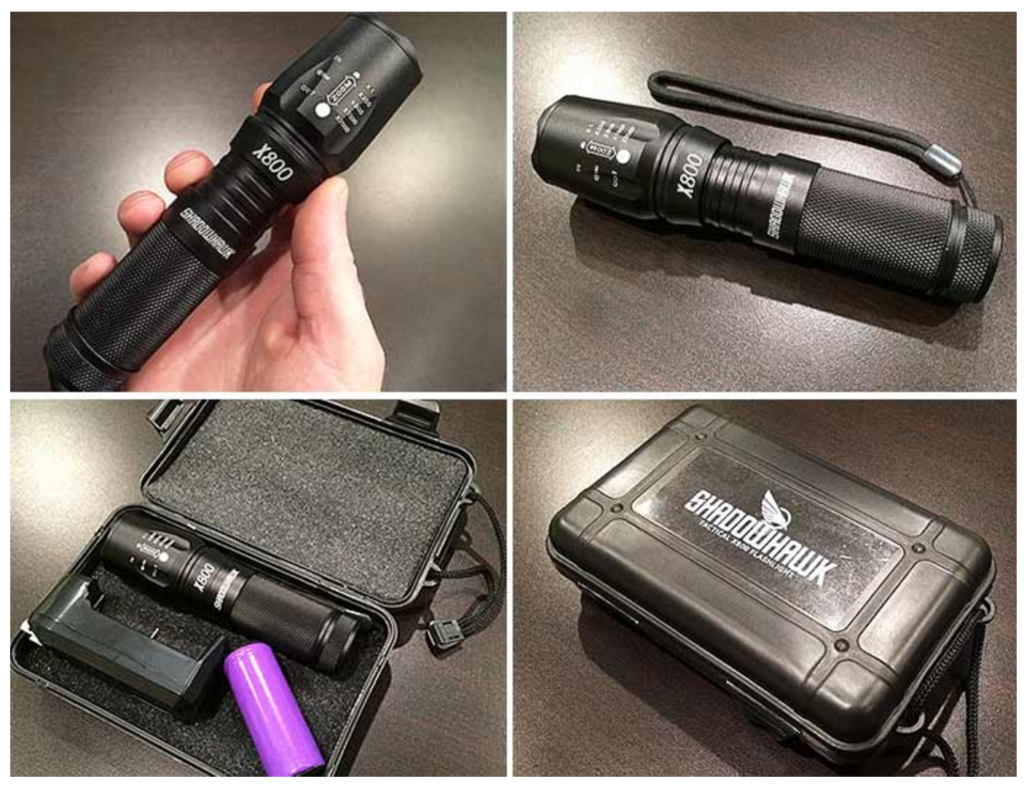
The focus is control by sliding the lens housing (?) forward and back. All the way back and the light filled up my front yard. All the way forward produced a tight (square) beam that illuminated the power transformer on a pole a couple hundred feet down the hill.
I haven’t played with the strobe setting which (according to the promotional material) has some self-defense use. You can also set it to strobe an SOS signal. Might be handy if you were injured and lost in the woods.
I tried to record some video but it didn’t come out. I’ve saw both positive and negative reviews on the Shadowhawk X800 and decided to give it a try. I’ve been impressed so far.
Dark Matter
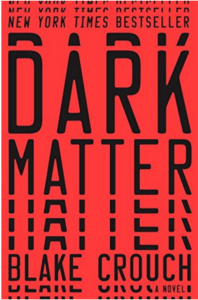 In this novel the multiverse is real (are real?) and the protagonist (and others) can visit these other realities which include other versions of himself. One would expect a novel based on quantum entanglement to get confusing and this one did. (There were moments in the story that reminded me of Philip Jose Farmer’s Riverworld series.) If you’ve ever pondered what you life would have been like if you had taken that other fork in the road, you might enjoy this novel. I found it well written but disturbing. I was eager to get to the end. (Amazon)