
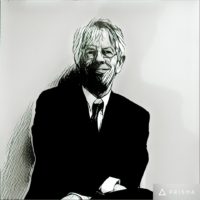
The casting director said I was too old and wrinkled to stunt double for Tommy Lee Jones. More fun with Prisma.


The casting director said I was too old and wrinkled to stunt double for Tommy Lee Jones. More fun with Prisma.
I Spent 5 Years With Some of Trump’s Biggest Fans. Here’s What They Won’t Tell You. That’s the title of a well-written and (for me) very informative article by Arlie Russell Hochschild. The excerpt below is “the deep story of the right.”
You are patiently standing in the middle of a long line stretching toward the horizon, where the American Dream awaits. But as you wait, you see people cutting in line ahead of you. Many of these line-cutters are black—beneficiaries of affirmative action or welfare. Some are career-driven women pushing into jobs they never had before. Then you see immigrants, Mexicans, Somalis, the Syrian refugees yet to come. As you wait in this unmoving line, you’re being asked to feel sorry for them all. You have a good heart. But who is deciding who you should feel compassion for? Then you see President Barack Hussein Obama waving the line-cutters forward. He’s on their side. In fact, isn’t he a line-cutter too? How did this fatherless black guy pay for Harvard? As you wait your turn, Obama is using the money in your pocket to help the line-cutters. He and his liberal backers have removed the shame from taking. The government has become an instrument for redistributing your money to the undeserving. It’s not your government anymore; it’s theirs.
This piece does a better job of explaining the Trump phenomenon than anything I’ve read.





“Turn Every Photo into Art Using Artificial Intelligence. Prisma transforms your photos into works of art using the styles of famous artists: Van Gogh, Picasso, Levitan, as well as world famous ornaments and patterns. A unique combination of neural networks and artificial intelligence helps you turn memorable moments into timeless art pieces.”
I would have said photo filters apps were pretty much over but Prisma is fun. And the filters are… more interesting? … than the other apps I’ve played with. These are just a few and the latest version of the app was very fast on my iPhone.
The clever kids at Bad Lip Reading never disappoint. Take special note of the voice actors doing Michelle Obama, HRC and Bill C. Absolutely perfect.
I’ve been searching for a better way to record video chats and found my way back to the eCamm website and Call Recorder for FaceTime. I used Call Recorder years ago but was not aware they had created an app specifically for FaceTime. The app cost $30 and that’s a non-starter for most folks but I’m impressed with this little app. George Kopp and I were both using FaceTime from the desktop but this would have worked fine had he been on his iPhone.
Call Recorder also records audio phone calls. When someone calls my iPhone, I have the option of answering the call on my MacBook (if both are on same wifi network). I can then record the call using this app. Sample below.
“Right now we see two possible futures welling up in the present. In one, society’s every decision is dominated by scarcity. Except for a few oligarchs, nobody has enough of anything. In that future, we build literal and figurative walls to keep out those who hope to acquire our stuff, while through guile or violence we try to acquire theirs.”
Through five election cycles WIRED has written about politics and politicians but avoided telling their readers who they viewed as the best choice. Until now.
“We have been studying Washington politics and Congress for more than 40 years, and never have we seen them this dysfunctional. In our past writings, we have criticized both parties when we believed it was warranted. Today, however, we have no choice but to acknowledge that the core of the problem lies with the Republican Party. The GOP has become an insurgent outlier in American politics. It is ideologically extreme; scornful of compromise; unmoved by conventional understanding of facts, evidence and science; and dismissive of the legitimacy of its political opposition.”
Washington Post op-ed by Thomas E. Mann, senior fellow at the Brookings Institution, and Norman J. Ornstein, resident scholar at the American Enterprise Institute

New York Times, August 17, 2016
“People are deleting advertising from their lives. Many simply don’t like or want it and now for the first time they have a choice in the matter. With the shift to streaming, the so-called ‘millennial’ has abandoned linear TV and, in turn, the ads that grace it. Higher-income consumers are more able to afford an ad-free existence by paying subscriptions for ad-free service experiences such as YouTube Red, Hulu+, or Spotify. This further erodes the pool of young, upwardly-mobile consumers that the ad industry so covets. In the future, only older, poorer people will experience advertising.”
And those ads you “see” online?
“A display ad is considered as ‘viewed by the visitor’ if “at least 50% of its pixels were displayed on the visitor’s browser for at least one continuous second.”
The Ad Industry’s Existential Crisis
In a few weeks I’ll make the five hour drive to the little town where I grew up for the 50 year reunion of the Kennett High School Class of 1966. I attended the 10 year reunion and vowed I’d never go to another. And didn’t. But there’s a strange (morbid?) appeal to the 50th. Like stumbling across the finish line of a marathon, throwing up and crapping your pants, yet elated to have completed the race.
I suppose this qualifies as a “right of passage,” and there won’t be that many more. Of the approximately 150 people in our class, 33 (22%) have been called to the office of The Great Principal’s Office in the Sky.
I’ve been fantasizing ways to make this event more fun: A prize for the most marriages/divorces? A little trophy for most number of times arrested/years served? Or a plaque for Best (and Worst) Cosmetic Surgery?
I’m not on Facebook so I have not kept up with most of my classmates. I don’t remember much about the 10 year reunion. I think that is the one where you show off your second/trophy wife and hand out business cards with titles of success. Those vanities will, I’m sure, have faded. Replaced by… what? The unspoken reality that this is the last time we’ll see most of these people. A bon voyage party for the Great Beyond.