
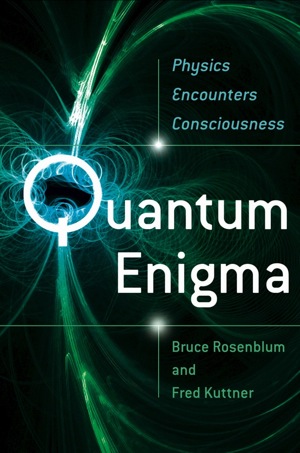
Quantum Enigma

For some years I’ve been fascinated by, and reading about, time. Which pretty quickly gets you into the realm of quantum theory. Recently I’ve come across some wonderful books suitable for folks like me that needed “assistance” getting through college algebra.

Quantum Enigma is co-authored by Bruce Rosenblum and Fred Kuttner, who teach physics at the University of California at Santa Cruz. If you suspect that things are not as they seem, I highly recommend this book.

I bring this up in an effort to understand —and explain— how my last post here was on Christmas Eve, almost 3 days ago, and yet no perceived time has “passed” for me.

UPDATE: The above was first posted on 12/27/09.  I have since finished this book. It was a challenging read and much more about physics than consciousness. Unless otherwise indicated, the quotes below can be attributed to the authors, Bruce Rosenblum and Fred Kuttner.

“In the beginning there were only probabilities. The universe could only come into existence if someone observed it. It does not matter that the observers turned up several billion years later. The universe exists because we are aware of it. – Martin Rees

“Space almost instantly expanded, or “inflated,” at a rate much faster than the speed of light. Starting from something vastly smaller than an atom, the entire universe we observe today presumably inflated almost instantaneously to the size of a large grapefruit.”

“The chance  that a livable universe like ours would be created is far less than the chance of randomly picking a particular single atom out of all the atoms in the universe.”

“Consider how improbably you are — the improbability of someone with just your unique DNA being conceived. (Millions of your possible siblings were not conceived. And now go back a few generation.) With those odds, you’re essentially impossible.”

“It is hard to imagine something truly astonishing that we don’t initially rule out as preposterous.”
The world is not flat?

Until the fifteen hundreds, people knew the earth was flat. But it wasn’t. Everyone was wrong. It probably took a long time for that new reality to sink in. A life time, perhaps? Makes a boy wonder if there are things I believe —I’m talking about the most fundamental things here— that are just wrong. Like, the sun does NOT circle the earth.

How do you wrap your mind around something like that? Your senses tell you one thing, but the reality is something different. Will there be something as jolting as “the earth is round, not flat” in my lifetime? How will I deal with it? Many would —I believe— choose denial. “It’s just not so. Uh uh, no way.”

If I’m just flat out wrong about some fundamental belief, do I want to know the truth. Remember, we’re talking the-world-aint-flat kind of truth here.

I do. As painful and unsettling as it would surely be, I want to know. And then I’ll try to keep it to myself.

Biocentrism

I’m reading a mind-stretching book. Biocentrism by Robert Lanza (with Bob Berman). I wouldn’t know where to begin describing what this book is about. Like John Sebastian said, “it’s like trying to tell a stranger ’bout rock and roll.”
The authors are very good at explaining the most complex concepts. Here’s a little riff on Time:
“Imagine that existance is like a sound recording. Listening to an old phonograph doesn’t alter the recording itself, and depending on wherethe needle is placed, you hear a certain piece of music. This is what we all the present. The music, before and after the song now being heard, is what we call the past and the future. Imagine, in like manner, ever moment and day enduring in nature always. The record does not go away. All nows (all the songs on the record) exist simultaneously, although we can only experience the world (or the record) piece by piece. We do not experience time in which “Stardust” often plays, because we experience time linearly.”
This book is not for everyone. If you have too much “reality” in you life to think about the possibility it’s all “in your head,” you can take a pass on Biocentrism. But it will get a spot on my nightstand as one of those books I’ll have to read again and again.

Screen shot 2009-12-14 at Mon, Dec 14, 8.15.12 PMI’m reading a mind-stretching book. Biocentrism by Robert Lanza (with Bob Berman). I wouldn’t know where to begin describing what this book is about. Like John Sebastian said, “it’s like trying to tell a stranger ’bout rock and roll.”

The authors, however, are very good at explaining the most complex concepts. Here’s a little riff on Time:

“Imagine that existence is like a sound recording. Listening to an old phonograph doesn’t alter the recording itself, and depending on where the needle is placed, you hear a certain piece of music. This is what we call the present. The music, before and after the song now being heard, is what we call the past and the future. Imagine, in like manner, every moment and day enduring in nature always. The record does not go away. All nows (all the songs on the record) exist simultaneously, although we can only experience the world (or the record) piece by piece. We do not experience time in which “Stardust” often plays, because we experience time linearly.”

This book is not for everyone. If you have too much “reality” in you life to think about the possibility it’s all “in your head,” you can take a pass on Biocentrism. But it will get a spot on my nightstand as one of those books I’ll have to read again and again.

“How a Web Design Goes Straight to Hell”

This little horror story (from The Oatmeal) woud be funnier but for the sad truth that I have committed some of the client sins described here. I like to think I paid for them (on the other side) and now make a concerted effort to let designers do what we hire them to do.

I too have no idea what “pop” means but assume it is a euphemism for: “I don’t like what you’ve shown me and want you to keep doing it over and over until I do.”

“Is it too late to catch up?”

A few questions from the always brilliant Seth Godin:

“What if your organization or your client has done nothing? What if they’ve just watched the last fourteen years go by? No real website, no social media, no permission assets. What if now they’re ready and they ask your advice?

I think my honest answer might have been, “Too late.” But Mr. Godin comes through with 10 practical suggestions. I encourage you to read them all. Here are my favorites:

  • Start a book group for your top executives and every person who answers the phone, designs a product or interacts with customers. Read a great online media book a week and discuss. It’ll take you about a year to catch up.
  • Offer a small bonus to anyone in the company who starts and runs a blog on any topic. Have them link to your company site, with an explanation that while they work there, they don’t speak for you.
  • Do not approve any project that isn’t run on Basecamp.
  • Don’t have any meetings about your web strategy. Just do stuff. First you have to fail, then you can improve.

Mr. Godin concludes the problem is no longer budget or access to tools, rather it is the will to get good at operating in our new world. I have to wonder if you haven’t found the will by now, how likely are you to do so

Drop a text “dime” on the jerk in the row behind you

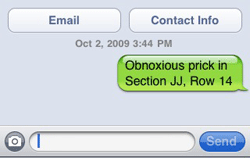
text250Iowa State and University of Iowa football fans can now text university staff to alert them to problems. Like some drunk ass clown sitting behind you screaming obscenities. Or a lost child or something.

They just punch in 97178, then type the word ALERT, before sending a text message (including your seat location).

Hawkeye officials implemented a new text messaging system before the season, in order to give fans quick and discrete access to ushers as well as security and medical personnel.

The texting program is part of a larger communications agreement with Learfield Sports (company I work for) and FanDriveMedia. Full story here.

Something we want and couldn’t have before

A thoughtful essay on “content” and publishing by Paul Graham

“I don’t know exactly what the future will look like, but I’m not too worried about it. This sort of change tends to create as many good things as it kills. Indeed, the really interesting question is not what will happen to existing forms, but what new forms will appear.”

“When you see something that’s taking advantage of new technology to give people something they want that they couldn’t have before, you’re probably looking at a winner. And when you see something that’s merely reacting to new technology in an attempt to preserve some existing source of revenue, you’re probably looking at a loser.”

Emphasis mine.

Websites: Fast, easy, inexpensive

A couple of weeks ago I got a call from one of the guys in our Minnesota office. He wanted a website to serve the advertisers of one of our networks. Said he didn’t really have a budget and he’d like to have it by the first home game, to be played in a brand new stadium (just over a week away). They were going to have lots of photos and didn’t have a good way to share them with fans and sponsors.

I purchased a WordPress theme (from Studio Press) for $65 and paid another hundred or so to have it customized (thank you, Rebecca). Ten days later the site was up and running (still adding content, obviously).

I’ve been at this long enough to be amazed that I could give the guy a credible website for $200 in a week-and-a-half. AND because it’s WordPress, he –or one of his interns– can update this site thorughout the season. I remember when this would have taken months and cost thousands of dollars.

Gnomedex 9.0

In a few days I make my annual pilgrimage to Seattle for Gnomedex (“a technology conference of inspiration and influence”). This is the only conference I attend and it’s important enough that I pay my expenses when necessary. I consider it a valuable investment (and tax deduction).

It’s a very small conference. Maybe 300 people? Brief bios of this year’s speakers give you some idea of the eclectic nature of Gnomedex. Here’s how one hoary attendee described the event:

“Every year I come back from Gnomedex with a sense of perspective. A better understanding of where I am on the technology continuum (for lack of a better term)… Attending Gnomedex is like cresting a hill and –for just a few minutes– I can see some of the smart kids way off on the horizon, running toward the future. I won’t catch them, but it’s nice to get a glimpse every now and then.” [More on the Gnomedex philosophy]

This is an easy conference to keep up with. This is the conference where I first heard about blogging, Twitter, social media and so much more that has become part of our lives. These are the geeks who come up with these little time munchers. I have no idea what I’ll learn this year but I’m all tingly with anticipation.