
Recommended reading: Frat House for Jesus. The Entity Behind C Street.
Category Archives: religion
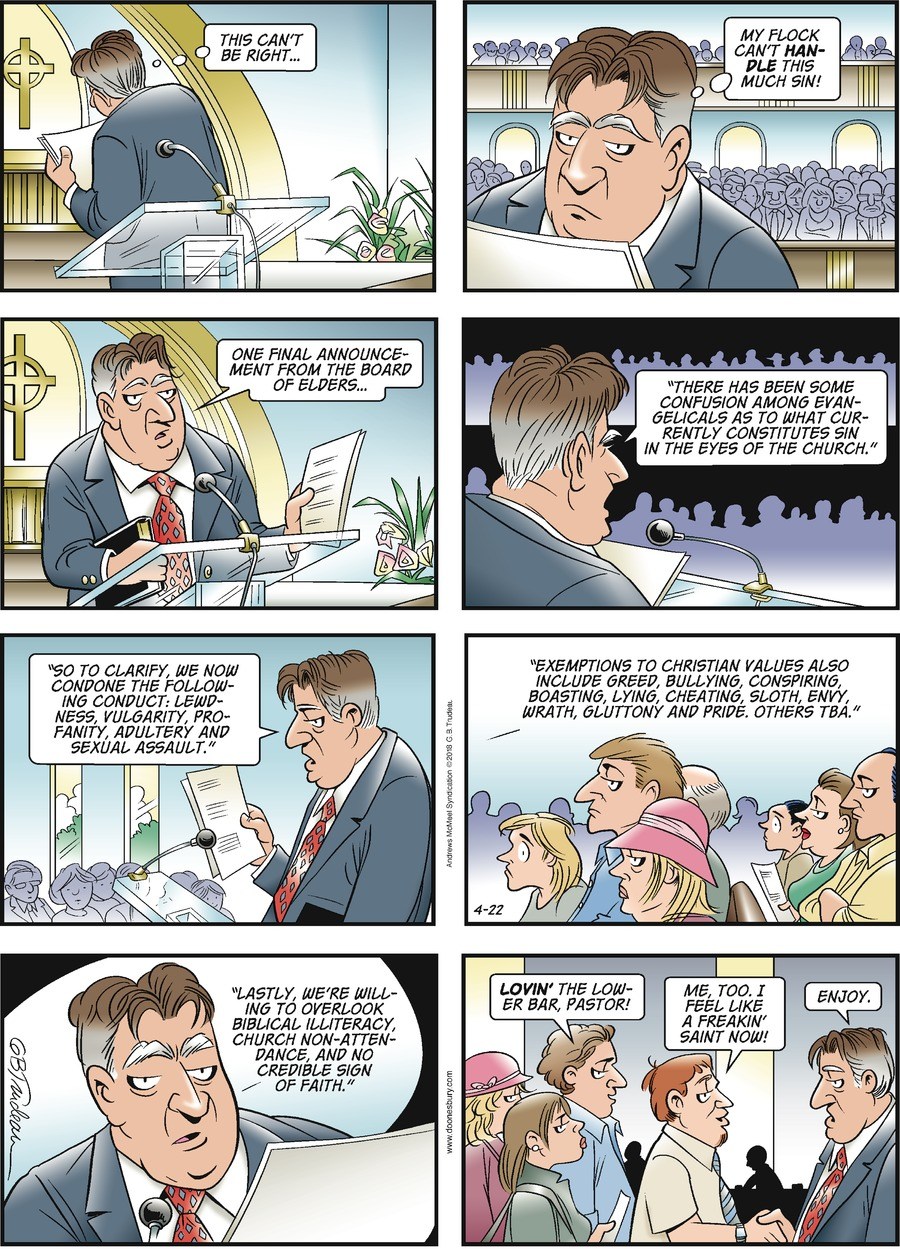
Low Bar
Less white and Christian than ever
Just forty years ago 81 percent of Americans identified as white and Christian, the majority (55 percent) Protestant. Today only 43 percent identity of white Christians, 30 percent claiming Protestantism.
America’s youngest groups are non-Christian: 42 percent of Muslims, 36 percent of Hindus, and 35 percent of Buddhists are under thirty.
While the old guard is aging, the religiously unaffiliated is ticking up. Fifty-eight percent consider themselves secular, with 27 percent claiming to be atheistic or agnostic. Sixteen percent state they’re religious while claiming no particular affiliation
When it comes to education, the three biggest groups of post-graduate degree holders are Unitarian-Universalists (43 percent), Hindus (38 percent), and Jews (34 percent). Researchers note that one-third of Muslims hold a four-year college degree, compared to one-quarter of white evangelical Protestants.
Source: Big Think
Homo Deus: Dataism
This is the third of three posts featuring excerpts from the new book by Yuval Harari (Homo Deus: A Brief History of Tomorrow). The first post dealt with traditional religions, creeds and ‘isms.’ The second post, free will and consciousness. The excerpts below are some of Dr. Harari’s thoughts on new religions that might replace the old.
The obvious problem with posting selected excerpts the the absence of contest which you can only get by reading the book. I encourage you to do so.
The new religions are unlikely to emerge from the caves of Afghanistan or from the madrasas of the Middle East. Rather, they will emerge from research laboratories. […] Despite all the talk of radical Islam and Christian fundamentalism, the most interesting place in the world from a religious perspective is not the Islamic State or the Bible Belt, but Silicon Valley. That’s where hi-tech gurus are brewing for us brave new religions that have little to do with God, and everything to do with technology.
These new techno-religions can be divided into two main types: techno-humanism and data religion. Data religion argues that humans have completed their cosmic task and should now pass the torch on to entirely new kinds of entities. Techno-humanism still sees humans as the apex of creation and clings to many traditional humanist values […] but concludes we should use technology to create Homo deus — a much superior model. Homo deus will retain some essential human features, but will also enjoy upgraded physical and mental abilities that will enable it to hold its own even against the most sophisticated non-conscious algorithms. (With the help of genetic engineering, nanotechnology and brain-computer interfaces.
What might replace desires and experiences as the source of all meaning and authority? Information. The most interesting emerging religion is Dataism.
Data (has been) seen as only the first step in a long chain of intellectual activity. Humans were supposed to distil data into information, information into knowledge, and knowledge into wisdom. However, Dataists believe that humans can no longer cope with the immense flows of data.
Dataism is most firmly entrenched in its two mother disciplines: computer science and biology.
As data-processing conditions change again in the twenty-first century, democracy might decline and even disappear. As both volume and speed of data increase, venerable institutions like elections, political parties and parliaments might become obsolete — not because they are unethical, but because the can’t process data efficiently enough.
In the early twenty-first century politics is bereft of grand visions. Government has become mere administration. It manages the country, but no longer leads it. Government ensures that teachers are paid on time and sewage systems don’t overflow, but it has no idea where the country will be in twenty years.
We often imagine that democracy and the free market won because they were ‘good’. In truth, they won because they improved the global data-processing system.
Dataism is the first movement since 1789 that created a genuinely novel value: freedom of information.
Homo Deus: Free Will and Consciousness
This is the second of three posts featuring excerpts from the new book by Yuval Harari (Homo Deus: A Brief History of Tomorrow). The first post dealt with traditional religions, creeds and ‘isms.’ The excerpts below are some of Dr. Harari’s thoughts on the concepts of free will and consciousness.
Free will exists only in the imaginary stories we humans have invented. […] (The question is not whether humans) can act upon their inner desires — the question is whether they can choose their desires in the first place.
I feel a particular wish welling up within me because this is the feeling created by the biochemical processes in my brain. […] I don’t choose my desires. I only feel them, and act accordingly.
Once we accept that there is no soul and that humans have no inner essence called ‘the self’, it no longer makes sense to ask, ‘How does the self choose its desires?’ […] There is only a stream of consciousness, and desires arise and pass away within this stream, but there is no permanent self that owns the desires.
If I am indeed the master of my thoughts and decisions, can I decide not to think about anything at all for the next sixty seconds?
(There are) at least two different selves within us: the experiencing self and the narrating self. The experiencing self is our moment-to-moment consciousness. The narrating self is forever busy spinning yarns about the past and making plans for the future. […] It doesn’t narrate everything, and usually weaves the story using only peak moments and end results. […] Most of us identify with our narrating self. When we say ‘I’, we mean the story in our head not the onrushing stream of experiences we undergo. […] We always retain the feeling that we have a single unchanging identity from birth to death (and perhaps even beyond).
If you want to make people believe in imaginary entities such as gods and nations, you should make them sacrifice something valuable.
Each of us has a sophisticated system that throws away most of our experiences, keeps only a few choice samples, mixes them up with bits from movies we’ve seen, novels we’ve read, speeches we’ve heard, and daydreams we’ve savoured, and out of all that jumble it weaves a seemingly coherent story about who I am, where I came from and where I am going. This story tells me what to love, whom to hate and what to do with myself. This story may even cause me to sacrifice my life, if that’s what the plot requires. […] But in the end, they are all just stories.
Every moment the biochemical mechanisms of the brain create a flash of experience, which immediately disappears. Then more flashes appear and fade, appear and fade, in quick succession. These momentary experiences do not add up to any enduring essence.