
I listened to Air America several times –for a few minutes at time– today. Not enough to form much of an opinion. Initial impressions: Sort of spooky hearing a talk show host wailing on the Republicans. After all these years of Rush, it just felt strange to hear someone so openly bashing the Republicans and Bush. (I know, I know, the liberal media blah, blah, blah). But I can’t say I was much impressed with the execution. But, it’s early. Sounds like Jeff listened more, and more thoughtfully, than I. (By my count, Jeff is on his third name for his weblog. I like this one.) Politics aside, Rush does radio very well. I suspect that has as much to do with his success as his views. I’ll be surprised if the Air America folks can measure up. We’ll see (hear).
Category Archives: Radio
New XM channel?
In a post titled The Death of Broadcast, Jeff Jarvis writes about Howard Stern, broadcast radio and government regulation and where it’s all headed:
– Stern will engineer his firing from Viacom.
– Stern will sign with satellite, giving satellite the boost it needs to become a viable business.
– Buy satellite stock now. Sell radio stock now.
– Broadcast radio will quickly falter, losing attention to MP3s, satellite, and cellular broadcast. Broadcast radio will die. Consolidation won’t kill it. Censorship will.
– Satellite will grow rapidly, getting more consumer revenue and ad revenue.
– Broadcast TV will suffer similar blows.
– Cable and satellite TV will grow.
– The bottom line: Any medium that can be government-regulated will shrink; any medium free of government regulation will grow.
XM Radio will provide local traffic and weather
On March 1, XM Radio will provide local traffic and weather in 21 metos, including St. Louis. The Weather Channel is doing the weather and a company called TrafficPulse is doing the traffic. You can listen to a sample on the XM site. Since I got my XM Radio, my friends in “traditional” radio have dismissed it as an expensive juke-box service. “Besides,” they pointed out, “they can’t do local stuff like traffic and weather.” Now when I drive in to St. Louis –or before I even start for St. Louis– I can check the traffic situation. Any reason they couldn’t hire some reporters in each market and provide local news?
Imus was right
Thirty years ago (during my KBOA days) I was attending the annual meeting of the National Association of Broadcasters. Lots of big name talent on hand, including Don Imus and Robert W. Morgan. I spotted them sitting at the bar (the Mint Julip according to the bar napkin) and couldn’t resist going over, introducing myself, and asking for their autographs (I know, I know). They saw my name tag and asked me what station I was with. I assured them they’d never heard of it. Then Imus asked how long I had worked there.
“About ten years,” I said. To which Imus replied, “If you’ve stayed at one little radio station for ten years without getting fired or quitting, you’ll never go anywhere in this business. You should pack it in.”
Robert W. Morgan thought that was a little harsh and told Imus so. I made my escape. I thought about it many times over the years and Imus was right. There are a million small town radio guys who lack the talent or the ambition or both to make it to the Bigs. I’m proud to have been one of them.
Music Radio
The following thoughts on radio are by Bob Lefsetz. I searched –unsuccessfully– for the article or a website to which I could link.
“The only people who still believe in music radio are the conglomerates with monopolies and the major record labels. All the LISTENERS, the POTENTIAL listeners, think it’s a JOKE! If you’re listening to music radio, you’re the lowest common denominator. You don’t have a CD player in your car. Like everybody with any MONEY! And, unlike the sixties, almost NO ONE listens to music on the radio at home. Really. Pay attention. When do people listen to the radio at home. In the morning. It’s PERFECT. While you’re walking around the house, getting your shit together. And, is there any MUSIC in the morning? Almost none. Because the music being purveyed SUCKS! Music radio is a giant sinkhole. I can understand the majors wanting to reduce indie promo costs, but what I CAN’T understand is their reluctance to explore new avenues of exploitation. Look at the statistics. Music radio listenership keeps going DOWN! Kids especially don’t listen.”
“Radio is a very sick canary in the coal mine”
“Radio is a very sick canary in the coal mine, and we’re about to infect television with the same disease”.
From FCC Commissioner Adelstein’s dissent on last week’s decision regarding broadcast ownership.
Mary Quass on radio and the Internet
Mary Quass is a really smart, really nice lady that’s been very successful in the radio business. I haven’t seen the full interview yet but today’s issue of RAIN pulled some excerpts from the May 26, 2003 issue of Radio Ink Magazine:
“This (Internet) is the first technology to mean that anybody can have a radio station as good as, if not better, than what’s out there today — and it has nothing to do with a license. I want to be in and out of the business by then… “
“When I go to the gym to work out, you know what I do? I listen to MP3s on my Rio. If I grew up with radio and I’m listening to MP3s, why should we expect young people to listen to radio when their lives are so packed with other things? That’s why, when the Internet becomes wireless, I want to be there.’.. “
“Radio has taken for granted that we will always have 96 percent of the adult population listening to this medium in a week. But we know that response rates and that kind of stuff are declining — not so much because Arbitron’s methodology necessarily is flawed or archaic, as much as it is that people want what they want when they want it.”
“It’s all about the product. If you have a great product and it’s in demand, people will use that product. If we don’t differentiate our product when the Internet becomes wireless, it will be a whole new ball game for all of us. We had better be ready, or the frustration we feel will only grow.”
You think?
Radio TiVo
“…the Radio YourWay might be the first one that actually functions like a TiVo. It’s an MP3 player with a built-in AM/FM radio recorder that can be set to record at specific times, and can save up to four hours of programming as MP3 files which can then be transferred to a PC when you run out of space.” I don’t listen to all that much (non-XM) radio these days but this is pretty damned cool. By way of evhead.
XM Radio to offer “real-time weather data
Starting this summer, XM Satellite Radio plans to offer “real-time weather data through a targeted service that will deliver information to map-display devices in boats, aircraft and emergency-response vehicles.” That’s according to a story in the April 18 issue of R&R (Radio & Records). In a letter to the FCC, NAB Sr.VP/General Counsel Jack Goodman wrote, “It appears that XM does intend to convert its service from an exclusively national program service to one that delivers locallay differentiated content.” Hmm. I couldn’t find the story online but will keep searching.
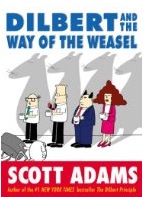
Dilbert and the Way of the Weasel
I’ve spent the last few minutes of the last few nights on my back laughing so hard tears trickled down to my ears. I’m highlighting my way through Dilbert and the Way of the Weasel by Scott Adams.
“You can ignore almost everything that is asked of you and in the long run it won’t matter. Either the tasks will become moot or your boss will forget what he asked you to do, or someone else will do it.” Or, “If you stall long enough, every corporate initiative ends, even layoffs.”
I particularly enjoyed the description an encounter with a salesman for a local radio station that was trying to convince Adams to buys advertising for the resturant he co-owns. Adams asked the sales person how many listeners the radio station had.
“The sales weasel explained, ‘You have to spend money to make money.’ I pointed out that he probably knew the number of listeners and that I could decide on my own if it was worth knowing. The weasel responded by explaining how many human beings lived within listening range of his station, i.e. weaselmath. I asked how that mattered if they weren’t actually listening, just potentially listening.”
“Then he explained that it’s much more expensive to advertise on other radio stations on a cost-per-relevlant-listener basis. I asked how he knew that if he didn’t know how many listeners he had.”
“He explained to me that some of my competitors were advertising on his station and they must be getting some benefit or they wouldn’t be doing it. I pointed out that most of my competitors weren’t advertising on his station and if not advertising wasn’t working, they wouldn’t be doing it. It wasn’t a good meeting.”
God help us if radio listening ever becomes as brutally measurable as the Web.