XM Radio to introduce digital storage

From NY Times story: Later this week, XM is set to introduce receivers capable of storing up to 30 minutes of any live broadcast to play back at a later time. With a function that works much like the pause control of a digital video recorder, the units will also be able to replay the last 30 minutes of the channel to which the unit was most recently tuned. Both companies also offer models that let users store the names of favorite artists and titles. When one of those is playing on another channel, the receiver beeps to alert the listener. In XM’s case, the unit will also automatically switch to that other station. Next month, Sirius will introduce its Sportster model, designed to complement its introduction of NFL Radio, which is a new talk channel, and several channels to transmit every NFL game. The radio can be programmed to jump automatically to the correct station when one of the user’s favorite teams is playing.

To appeal to investors, XM’s Roady2 can display continuously updated stock quotes across the screen. Sirius plans to introduce a radio with a similar feature. Beginning this fall, XM will offer NavTraffic, giving owners of the Acura RL and the Cadillac CTS the ability to combine XM’s continuously updated traffic information with the car’s navigation system, producing color-coded maps showing traffic delays, allowing drivers to obtain alternate routings.

To make it easier to receive satellite radio in the home, Sirius will introduce a $129 accessory antenna that, mounted on the roof, will transmit a signal through the walls into a secondary unit attached to the receiver. And by the beginning of next year, Sirius will offer a receiver that can download Sirius programming from the Internet for later playback in areas where signals cannot reach.

Transistor radio

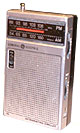
Most of my in-car radio listening is XM these days. But at home I still tune in to a couple of the local stations. And it dawned on me this week that the little transistor radio I listen to is more than 20 years old. We brought it with us when we moved to Jefferson City in 1984. And it could have easily been 10 years old then. I love this little radio (made in Hong Kong for General Electric). On the front it proudly announces “Integrated Circuit” and, on the back, there’s a little plasic clip for attaching to your belt. I’m trying to think of other things in my life that have worked as well or as long as this little transistor (when did we drop that adjective?) radio. I so clearly remember when a small, portable radio like this was the ONLY way to listen to music or news away from your home, car or office.

If/when this one breaks or dies, with what sort of device will I replace it? I’m sure they still make them but for how much longer. Will they become integrated with some kind of mobile device (cell phone)? That doesn’t seem practical. I’m not going anywhere with this. Just a small ode to a long-time companion.

42 million sat radio subs by 2009?

XM Satellite Radio and Sirius Satellite Radio could have more than 42 million subscribers by the end of 2009, according to a report by SkyWaves Research. Two week ago, XM announced that it had surpassed 2 million subscribers. On May 11, Sirius said it had reached the 400,000 mark.

What will radio look and sound like in 15 years?

(Forbes.com) “Had we asked the same question 15 years ago, the answer would have been “pretty much the same.” But it’s clear that radio is going through one of the most fundamental changes in its history since the dawn of stereo FM signals in the 1960s.

Already, satellite radio services like XM Satellite Radio (nasdaq: XMSR – news – people ) and Sirius Satellite Radio (nasdaq: SIRI – news – people ) have proved there’s a market for pay radio, though both have a long way to go before satellite radio is truly a mass-market service the way cable television is today. Ask any subscriber of either service and they’ll tell you they wonder how they ever got along without it.

Terrestrial broadcasters–those that broadcast from the ground, as opposed to in space via satellite like XM and Sirius–are in the process of rolling out enhanced services that will boost sound quality and add the ability to broadcast two programs on one station.

But what makes the future of radio interesting is the Internet. Some of the best radio programming is available online. This can be convenient if you’re from one region of the United States but living elsewhere, for example, and miss a favorite local radio program from back home. So far the best way to do this is via a computer equipped with a broadband connection.

But take a radio and give it a network connection. There are radios and tabletop stereo sets on the market that can connect to the Internet without a computer and stream audio from Internet radio stations. Add in support for Wi-Fi networking–essentially equal to an Ethernet port without a cord–and you have a radio that can go anywhere in the home and play sound from anywhere in the world without regard to the broadcasting station’s location. You may live in San Francisco and listen to state radio from Beijing or London or Bombay as easily as you do local radio, just as long as those faraway stations stream their programming online.

Take it a step further. Wi-Fi is limited by how far a network signal can reach–generally a few hundred feet from the access point or hot spot. Now imagine wireless Internet connections that aren’t as limited by distance. The new buzz is surrounding WiMax, a Wi-Fi-like networking technology that could boast a range of up to 30 miles from its source. Suddenly, every radio station in the world that broadcasts on the Internet will be reachable from nearly anywhere in the world where there’s WiMax coverage. A wireless Internet connection will be an expected feature, not a curiosity found only on a few high-end models. Radio will be a global medium once again.

That’s not all. Radios will have hard drives. At least one handheld radio, the Radio YourWay from Pogo Products, has one. The drives will serve at least two functions. You’ll use them to record favorite shows so you can listen anytime you like–the equivalent of TiVo (nasdaq: TIVO – news – people ) for television.

Second, the drives will be used to cache extra content that comes embedded inside the radio signal. You’ll select certain local stations that will broadcast constantly updated news, traffic, weather and perhaps even stock quotes, and those broadcasts will be automatically stored for you to listen to anytime you want to hear them at the push of a button.

Having a hard drive embedded in a radio opens up another range of possibilities. If a radio has both an Internet connection and a hard drive, it will be able to download software that gives it increased functionality. Radios will be able to do many things if only their owners are willing to pay for the features. Inside these radios will be chips that can adapt to whatever task they’re called upon to do.”

Forbes.com

Radio “in a broad-band, wirelessly networked world”

I mentioned in an earlier post that our company operates networks that provide statewide news to radio stations (Missouri, Iowa, Wisconsin and Nebraska). The thing we do best is covering state government, with an emphasis on the legislature. And because our medium is radio, we do a lot of sound. Here’s the way it worked in 1975:

Our reporter covered some event at the state capitol. Debate, a hearing, news conference…whatever. They recorded the event, asked some questions and returned to the newsroom where they wrote their stories and edited the audio. Once an hour, they produced a five minute newscast and “fed” it to affiliated radio stations over phone lines (later, via satellite).

We provide stations with programming (we’ve started calling it content) and they “pay” us with commercials on their stations which we, in turn, sell to advertisers. It’s been a good business model. It’s still a good model. But I wonder how current technology might affect that model. As silly and pointless as it sounds, let’s forget the economics for a moment and think about how this process might work in a broad-band, wirelessly networked world.

Our reporter (we’ll call her Lois Lane) is sitting in the back of a hearing room at the state capitol where a heated discussion on same-sex marriage is underway. She’s connected to the Net and posting almost-real-time updates on what’s happening to her network’s weblog. When a fight breaks out between two of the state senators, she snaps a picture with her Treo 600 and posts it to the weblog. Things heat up, security is called. Lois IM’s the webmaster and says she wants to stream live. Takes only a few minutes to get the encoders going. Order is restored and the hearing adjourned. In the hallway, Lois interviews the participants and records it on her small, hand-held video camera. She Blue Tooth’s it over to her laptop…does a quick edit…and zaps it straight to the website. Scattered across the country (and in a couple of other countries)…a few thousand folks receive a fresh RSS feed on their news aggregators. Holy shit! A gay activist kicked the shit out of a state senator in Missouri. And there’s video!

I’m not sure, but I think all of the technology for the above exists. We’re just not there on the business model. Yet. Oh, and there were no radio stations in my scenerio. Will there ever be a time when people can receive text, audio and video on some mobile device that is not a transistor radio? Uh, yeah. We call it a mobile phone or PDA today. I’m not sure what we call it tomorrow but it probably won’t be a radio. Before you start looking for a rope and a limb, know that I love radio. I grew up in a radio family. But I don’t believe the essence of radio is transmitters and towers and FCC licenses. It’s music and news and sports and interesting people with interesting things to say. How it gets from A to Z is less important every day.

The O’Franken Factor

The highly-promoted debut of author and comedian Al Franken’s talk show, “The O’Franken Factor,” on the new “Air America” radio network apparently set a record. Air America’s VP/Marketing Leon Colaco says the network’s website handled nearly 500,000 unique visitors in the 22-hour period between 7PM Wednesday and 5PM Thursday. (final numbers from Air America streaming provider RealNetworks will not be available until next week.) This might be the largest number of simultaneous listeners that Real had handled since ABC News’s coverage of the 9/11 attacks on September 12, 2001, which hit 86,700 concurrent listeners. [More at RAIN]

Air Left

I listened to Air America several times –for a few minutes at time– today. Not enough to form much of an opinion. Initial impressions: Sort of spooky hearing a talk show host wailing on the Republicans. After all these years of Rush, it just felt strange to hear someone so openly bashing the Republicans and Bush. (I know, I know, the liberal media blah, blah, blah). But I can’t say I was much impressed with the execution. But, it’s early. Sounds like Jeff listened more, and more thoughtfully, than I. (By my count, Jeff is on his third name for his weblog. I like this one.) Politics aside, Rush does radio very well. I suspect that has as much to do with his success as his views. I’ll be surprised if the Air America folks can measure up. We’ll see (hear).

New XM channel?

In a post titled The Death of Broadcast, Jeff Jarvis writes about Howard Stern, broadcast radio and government regulation and where it’s all headed:

– Stern will engineer his firing from Viacom.
– Stern will sign with satellite, giving satellite the boost it needs to become a viable business.
– Buy satellite stock now. Sell radio stock now.
– Broadcast radio will quickly falter, losing attention to MP3s, satellite, and cellular broadcast. Broadcast radio will die. Consolidation won’t kill it. Censorship will.
– Satellite will grow rapidly, getting more consumer revenue and ad revenue.
– Broadcast TV will suffer similar blows.
– Cable and satellite TV will grow.
– The bottom line: Any medium that can be government-regulated will shrink; any medium free of government regulation will grow.

XM Radio will provide local traffic and weather

On March 1, XM Radio will provide local traffic and weather in 21 metos, including St. Louis. The Weather Channel is doing the weather and a company called TrafficPulse is doing the traffic. You can listen to a sample on the XM site. Since I got my XM Radio, my friends in “traditional” radio have dismissed it as an expensive juke-box service. “Besides,” they pointed out, “they can’t do local stuff like traffic and weather.” Now when I drive in to St. Louis –or before I even start for St. Louis– I can check the traffic situation. Any reason they couldn’t hire some reporters in each market and provide local news?