
Some won’t make it to the new world

Michael Wolff speaking at MediaGuardian’s Changing Media Summit in London:

“The chickens are coming home to roost. Most of the people who run traditional media will not be the people to step in to this new world.

“There is a line and people are not going to get over it. It used to be, up until 18 months ago, ‘there is a line but I hope I get to retirement before I cross that line’. This recession has meant people really understand that they won’t.

“It’s been happening since before the internet – it’s not because of it.

“Every big-city newspaper in the U.S. is either in bankruptcy or will be in bankruptcy in the foreseeable future – that’s 12 months. The newspaper industry in the U.S. is over.

“This has happened again and again and again in every industry – new technology has come along, and you just can’t make the change; it almost inevitably never happens. It’s easier to start with people who have no historical bias.

“If you’ve spent your career in one technology, in one business model, it’s just not efficient to have to undo that.

I think Mr. Wolff is right and his comments [emphasis mine] remind me of a post by Jay Rosen from 5 years ago.

“An industry that won’t move until it is certain of days as good as its golden past is effectively dead, from a strategic point of view. Besides, there is an alternative if you don’t have the faith or will or courage needed to accept reality and deal. The alternative is to drive the property to a profitable demise.

Revolutions invent and destroy and only go one way

Seth Godin on the internet revolution:

“The internet is like Ice 9. It changes what it touches, probably forever. We keep discovering firsts, the biggest viral video ever, the most twitter followers ever, the fastest bestseller ever… And we constantly discover nevers as well. There’s never going to be a mass market TV show that rivals the ones that came before. There’s never going to be a worldwide brand built by advertising ever again either. And Michael Jackson’s record deal is the last one of its kind… And there may never be a job like that job you used to have either.

Revolutions are like that. They invent and destroy and they only go one way. It’s like watching a confused person in a revolving door for the first time. They push backwards, try to slow it down, fight the rotation… and then they embrace the process and just walk and it works.”

Know anybody fighting that revolving door? Yeah, me too. And there’s no way to help them. I guess a revolution is good or bad depending on where you are. The Czar and the French aristocrats thought their revolutions sucked. The people on the ramparts had a different view.

Cryptonomicon: Wisdom teeth

I don’t know when I read Neal Stephenson’s Cryptonomicon for the first time. My first post here was back in 2003. I linked to a horrifying (to me) passage that deserves an encore.

Wisdom. A few years ago, when Randy became tired of the ceaseless pressure in his lower jaw, he went out onto the north-central Californian oral-surgery market looking for someone to extract wisdom teeth. His health plan covered this, so price was not an obstacle. His dentist took one of those big cinemascopic wraparound X-rays of his entire lower head, the kind where they pack your mouth with half a roll of high-speed film and then clamp your head in a jig and the X-ray machine revolves around you spraying radiation through a slit, as the entire staff of the dentist’s office hits the deck behind a lead wall, resulting in a printed image that is a none-too-appetizing distortion of his jaw into a single flat plane. Looking at it, Randy eschewed cruder analogies like “head of a man run over several times by steamroller while lying flat on his back” and tried to think of it as a mapping transformation—just one more in mankind’s long history of ill-advisedly trying to represent three-D stuff on a flat plane. The corners of this coordinate plane were anchored by the wisdom teeth themselves, which even to the dentally unsophisticated Randy looked just a little disturbing in that each one was about the size of his thumb (though maybe this was just a distortion in the coordinate transform—like the famously swollen Greenland of Mercator) and they were pretty far away from any other teeth, which (logically) would seem to put them in parts of his body not normally considered to be within a dentist’s purview, and they were at the wrong angle—not just a little crooked, but verging on upside down and backwards. At first he just chalked all of this up to the Greenland phenomenon. With his Jaw-map in hand, he hit the streets of Three Siblings-land looking for an oral surgeon. It was already beginning to work on him psychologically. Those were some big-ass teeth! Brought into being by the workings of relict DNA strands from the hunter- gatherer epoch. Designed for reducing tree bark and mammoth gristle to easily digestible paste. Now these boulders of living enamel were horrifyingly adrift in a gracile cro-magnon head that simply did not have room for them. Think of the sheer extra weight he had been carrying around. Think of the use that priceless head-real-estate could have been put to. When they were gone, what would fill up the four giant molar—shaped voids in his melon? It was moot until he could find someone to get rid of them. But one oral surgeon after another turned him down. They would put the X-ray up on their light boxes, stare into it and blanch. Maybe it was just the pale light coining out of the light-boxes but Randy could have sworn they were blanching. Disingenuously—as if wisdom teeth normally grew someplace completely different—they all pointed out that the wisdom teeth were buried deep, deep, deep in Randy’s head. The lowers were so fir back in his jaw that removing them would practically break the jawbone in twain structurally; from there, one fuse move would send a surgical-steel demolition pick into his middle ear. The uppers were so deep in his skull that the roots were twined around the parts of his brain responsible for perceiving the color blue (on one side) and being able to suspend one’s disbelief in bad movies (on the other) and between these teeth and actual air, light and saliva lay many strata of skin, meat, cartilage, major nerve-cables, brain-feeding arteries, bulging caches of lymph nodes, girders and trusses of bone, rich marrow that was working just fine thank you, a few glands whose functions were unsettlingly poorly understood, and many of the other things that made Randy Randy, all of them definitely filing into the category of sleeping dogs.

Continue reading

Mark Ramsey interviews Seth Godin

Mark Ramsey has done another interview with Seth Godin that I highly recommend. Mr. Godin is promoting his new book, “Linchpin: Are You Indispensable?” I encourage you to listen to the interview. It isn’t long. Here are a few excerpts:

“…school was organized by the powers-that-be to turn the typical student into a compliant, quiet, sit-in-straight-rows, fill-in-little-circles-on-the-SAT, follow-the-path, go-to-the-job-you-get-at-the-placement-office kind of person. And there’s a reason for that: It’s that if you are the organization busy hiring people, the more people you have who want to do the jobs you’ve got, the cheaper you can get away with paying them. As a result, we’ve created a culture where a few people are able to drive the agenda and a lot of people end up working hard to fit in and have a lot of fear about doing anything but that.”

“You read about people who are making $80K, $90K, $200K a year as middle managers for Fortune 500 companies, and then they get laid off and can’t make $15,000 a year working at a 7-11, and the question I’d ask is: Where did the $70,000 worth of value go? Did the person change or just their income?”

“It’s a crisis because all these years that we were watching blue collar people lose their jobs, exported to China or wherever… All these years that we watched machines replace people on assembly lines, we just shook our heads and said that’s really sad but that’s not us, that’s them – good thing it’s not us. And now it’s us, now they’ve come for us.”

“Well, I think that broadcasters have now embraced the fact that spectrum is finally on its way to being valueless. It was an 80-year run, but there’s no intelligent person I know that says that in 10 or 15 years from now they are going to be glad they own 660 on the AM dial.”

“All those kids who are in school today, who are learning how to do the jobs of 1960 or 1970, they’re in big trouble. All those 40- or 50-year-old executives who are hoping they’re going to wait this thing out, they’re in really big trouble.”

Don’t interfere with the flow

“There is a profound Buddhist doctrine that speaks of a great river that flows through all of reality. Once you have found yourself, there is no more cause for action. The river picks you up and carries you along forever after. In other words, effort from the personal level, the kind of effort all of us are used to in daily life, becomes pointless after a certain point. This includes mental effort. Once you become self-aware, you realize that the flow of life needs no analysis or control, because it’s all you. The great river only seems to pick you up. Actually, you have picked yourself up — not as an isolated person, but as a phenomenon of the cosmos. No one gave you the job of steering the river. You can enjoy the ride and observe the scenery.”

I like that. I found it in a book by Deepak Chopra (“Reinventing the Body, Resurrecting the Soul”). I’m not recommending the book (you’ll read it if you’re supposed to). But this is where I jot done some of the lines and passages that I want to remember or find again.

Continue reading

Bruce Sterling: State of the World 2010

Every year the Well (one of the early, pre-web, online communities) invites Bruce Sterling to chat about the state of the world. This year, he paints a grim picture of where the “present” is heading:

“Various entities and institutions have scrambled together safety pins and gobs of glue to rig the global economy so that it appears to be ambling along, but isn’t it a great conceptual Jenga, ready to fall if you move the wrong block? What kind of shuffling and reshuffling can we expect, if there’s a global economic meltdown? And has the collapse already happened – are we like the coyote, run far beyond the edge of the cliff, waiting for gravity’s effect?”

On Google News and Twitter:

“I’m looking over my Twitter stream here, because it seems a more useful barometer to me now than Google News. Google News definitely has that rickety Jenga feeling that JonL is talking about. Whenever you see something on Google News nowadays, you have to wonder: “who owns this so-called news organization now? What’s left of them financially? Is there even a shred of objective fact in this?”

Pick your decade: Frustration or Change

I should just point www.smays.com to Seth Godin’s blog. Maybe change to WhatHeSaid.com. Mr. G picks two important trends for the coming decade. I’m opting for “change” over “frustration,” but you should read the full post.

Change: The infrastructure of massive connection is now real. People around the world have cell phones. The first internet generation is old enough to spend money, go to work and build companies. Industries are being built every day (and old ones are fading). The revolution is in full swing, and an entire generation is eager to change everything because of it. Hint: it won’t look like the last one with a few bells and whistles added.

In my experience, the people who poo-poo the idea of radical change usually have the most invested in keeping things the same. Good luck.

Biocentrism

I’m reading a mind-stretching book. Biocentrism by Robert Lanza (with Bob Berman). I wouldn’t know where to begin describing what this book is about. Like John Sebastian said, “it’s like trying to tell a stranger ’bout rock and roll.”
The authors are very good at explaining the most complex concepts. Here’s a little riff on Time:
“Imagine that existance is like a sound recording. Listening to an old phonograph doesn’t alter the recording itself, and depending on wherethe needle is placed, you hear a certain piece of music. This is what we all the present. The music, before and after the song now being heard, is what we call the past and the future. Imagine, in like manner, ever moment and day enduring in nature always. The record does not go away. All nows (all the songs on the record) exist simultaneously, although we can only experience the world (or the record) piece by piece. We do not experience time in which “Stardust” often plays, because we experience time linearly.”
This book is not for everyone. If you have too much “reality” in you life to think about the possibility it’s all “in your head,” you can take a pass on Biocentrism. But it will get a spot on my nightstand as one of those books I’ll have to read again and again.

Screen shot 2009-12-14 at Mon, Dec 14, 8.15.12 PMI’m reading a mind-stretching book. Biocentrism by Robert Lanza (with Bob Berman). I wouldn’t know where to begin describing what this book is about. Like John Sebastian said, “it’s like trying to tell a stranger ’bout rock and roll.”

The authors, however, are very good at explaining the most complex concepts. Here’s a little riff on Time:

“Imagine that existence is like a sound recording. Listening to an old phonograph doesn’t alter the recording itself, and depending on where the needle is placed, you hear a certain piece of music. This is what we call the present. The music, before and after the song now being heard, is what we call the past and the future. Imagine, in like manner, every moment and day enduring in nature always. The record does not go away. All nows (all the songs on the record) exist simultaneously, although we can only experience the world (or the record) piece by piece. We do not experience time in which “Stardust” often plays, because we experience time linearly.”

This book is not for everyone. If you have too much “reality” in you life to think about the possibility it’s all “in your head,” you can take a pass on Biocentrism. But it will get a spot on my nightstand as one of those books I’ll have to read again and again.

Leaving the Information Age

http://blog.joeandrieu.com/2007/09/22/leaving-the-information-age/
Leaving the Information Age
I missed the Agrarian Age and the Industrial Age but have been pretty much in the thick of the Information Age, so I was a little startled to learn that it was over. Or nearly so.
David Wienberger pointed to an essay by Joe Andrieu titled “Leaving the Information Age,” written in September of 2007. It makes a compelling case for the the idea that we’re nearing the end of the Information Age:
As cable television and the Internet invaded our homes, we began to find that we could satisfy many of our wants and desires through Information rather than physical goods. It was liberating, intoxicating, and led to one of the most outrageous economic bubbles since the heyday of the Industrial Age triggered the Great Depression.
Similarly, the Information Age is, (surpise!), defined by MORE information. More channels. More telephones. More email. More websites. More advertising. More media.
And in a (perhaps) surprisingly short period, we now find ourselves echoing a new version of the mantra that ended the Industrial Age: “Enough! We don’t need so much Information!”
Mr. Andrieu makes the topic much more interesting than your junior high history teacher.

I missed the Agrarian Age and the Industrial Age but have been pretty much in the thick of the Information Age, so I was a little startled to learn that it was over. Or nearly so.

David Wienberger pointed to an essay by Joe Andrieu titled “Leaving the Information Age,” written in September of 2007. It makes a compelling case for the the idea that we’re nearing the end of the Information Age:

“As cable television and the Internet invaded our homes, we began to find that we could satisfy many of our wants and desires through Information rather than physical goods. It was liberating, intoxicating, and led to one of the most outrageous economic bubbles since the heyday of the Industrial Age triggered the Great Depression.

Similarly, the Information Age is, (surpise!), defined by MORE information. More channels. More telephones. More email. More websites. More advertising. More media.

And in a (perhaps) surprisingly short period, we now find ourselves echoing a new version of the mantra that ended the Industrial Age: “Enough! We don’t need so much Information!”

Mr. Andrieu makes the subject of “ages” much more interesting than your junior high history teacher. Well worth the read.

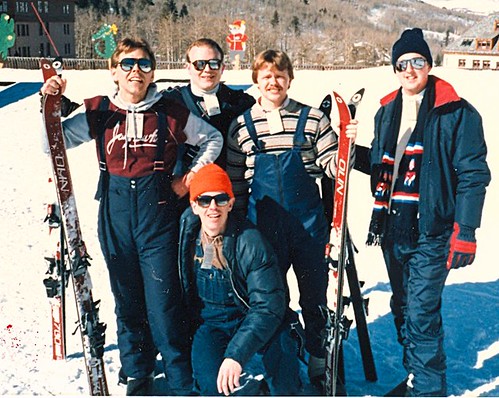
“Journalism is like skiing in the 50s or 60s”

An interesting analogy by Dave Winer:

“Previously it had been a sport that very few people enjoyed, and they were all very good. But now the doors are opening to amateurs. The pros have to share the slopes with people who don’t take the sport as seriously as they do. They’re still going to be able to ski, but the rest of us are not just going to admire them for how skilled they are, we’re going to do it too. They can earn a living as ski patrol and ski instructors. Or lift operators or more mundane jobs like people who work in hotels and drive the shuttle bus. There are still jobs in skiing after the arrival of the amateurs. But the exclusivity is gone.”

I think he might have nailed it. Oh, for the days before the lift lines were long and the slopes clogged with morons who didn’t know the right way to come down the hill.