
What will 2011 bring for journalism?

“…syndication makes little sense in a world with URLs. When news outlets were segmented by geography, having live human beings sitting around in ten thousand separate markets deciding which stories to pull off the wire was a service. Now it’s just a cost.”

“Giving credit where credit is due will reward original work, whether scoops, hot news, or unique analysis or perspective. This will be great for readers. It may not, however, be so great for newspapers, or at least not for their revenues, because most of what shows up in a newspaper isn’t original or unique. It’s the first four grafs of something ripped off the wire and lightly re-written, a process repeated countless times a day with no new value being added to the story.”
Full article by Clay Shirky

Where is Your Mind Right Now?

This kind of moment has been happening more and more often. The most encouraging part of it is that it doesn’t seem to matter what the content of the scene is, only whether I’m aware enough to absorb it without assessing its implications to my personal interests. When my interests and preferences aren’t informing the picture — when I am not looking at it in terms of what it’s adding or taking away from me — it’s like I can watch it without being there. I am alive and aware without the normal heaviness of being a needy, self-obsessed human being. And that is where beauty is found. — (raptitude.com

This reminds me of the massive amount of data that floods into our brains every second. Every sense is pumping information that gets translated by the mind.

I have this fantasy of waking from a coma with no memory and being bombarded by this… tsunami? … of data. The light, sounds smells hitting my consciousness as if for the first time. What would that be like? Could we survive it?

Our minds (brain?) would throttle it back to something that would not make our heads explode. But what if we want to go the other way? Take the throttle off. Let the data come streaming in. But that’s not right. The data IS streaming in. We’re just not really experiencing it. What if I want ever photon? Every 1 and 0?

It seems logical that we have that capability. The hardware is the same. It must be the software that has robbed us of seeing all the world has to offer.

Perhaps if we reformat and reinstall?

Clay Shirky: The Shock of Inclusion

“If you were in the news business in the 20th century, you worked in a kind of pipeline, where reporters and editors would gather facts and observations and turn them into stories, which were then committed to ink on paper or waves in the air, and finally consumed, at the far end of those various modes of transport, by the audience.

What’s going away, from the pipeline model, isn’t the importance of news, or the importance of dedicated professionals. What’s going away is the linearity of the process, and the passivity of the audience. What’s going away is a world where the news was only made by professionals, and consumed by amateurs who couldn’t do much to produce news on their own, or to distribute it, or to act on it en masse.

We are living through a shock of inclusion, where the former audience is becoming increasingly intertwined with all aspects of news, as sources who can go public on their own, as groups that can both create and comb through data in ways the professionals can’t, as disseminators and syndicators and users of the news.”

Scott Adams: Eliminating Political Parties

“Now imagine what would happen to campaign funding if political parties didn’t exist. In our current system, a union can give a million dollars to the Democratic Party and it doesn’t seem too wrong because the party represents about half of the voters in the country. But if political parties didn’t exist, unions or corporate interests would have to donate to individuals. And a large donation to an individual campaign would either be illegal or it would look so much like a bribe that it would be counter-productive.

I think political parties made sense in pre-Internet times. It was a good way to organize and to produce candidates who had a legitimate chance of getting elected. Now it’s easy to imagine the Internet being a better platform for electing the right people. The problem is that there’s no way to get to a different type of system from here. The major parties are too entrenched to give up power, and belonging to organizations is a fundamental freedom.”

Kevin Kelly loves technology

The full quote (by MIT sociologist Sherry Turkle) is: “We think with the objects we love, and we love the objects we think with.” I came across it near the end of Kevin Kelly’s new book, What Technology Wants. (More on that in a later post.) Mr. Kelly beautifully captures my own feelings about technology:

“I am no longer embarrassed to admit that I love the internet. Or maybe it’s the  web. Whatever you want to call the place we go to while we are online, I think it is beautiful. People love places and will die to defend a place they love, as our sad history of wars proves. Our first encounters with the internet/web portrayed it as a very widely distributed electronic dynamo –a thing one plugs into– and that it is. But the internet as it has matured is closer to the technological equivalent of a place. An uncharted, almost feral territory where you can genuinely get lost. At times I’ve entered the web just to get lost. In that lovely surrender, the web swallows my certitude and delivers the unknown. Despite the purposeful design of hits human creators, the web is a wilderness. Its boundaries are unknown, unknowable, its mysteries uncountable. The bramble of intertwined ideas, links, documents, and images creates an otherness as thick as a jungle. The web smell like life. It knows so much. It has insinuated its tendrils of connection into everything, everywhere. The net is now vastly wider than I am, wider than I can imagine; in this way, while I am in it, it makes me bigger, too. I feel amputated when I am away from it.”

“In that lovely surrender, the web swallows my certitude and delivers the unknown.” Who can ask for more.

“A radical pessimist’s guide to the next 10 years”

(October 10, 2010) There are no shortage of scary predictions on the net. But Douglas Coupland’s “45 tips for survival” give me a shiver. Here are a few of my least-favorites from his list:

6) The middle class is over. It’s not coming back – Remember travel agents? Remember how they just kind of vanished one day? That’s where all the other jobs that once made us middle-class are going – to that same, magical, class-killing, job-sucking wormhole into which travel-agency jobs vanished, never to return. However, this won’t stop people from self-identifying as middle-class, and as the years pass we’ll be entering a replay of the antebellum South, when people defined themselves by the social status of their ancestors three generations back. Enjoy the new monoclass!

13) Enjoy lettuce while you still can – And anything else that arrives in your life from a truck, for that matter. For vegetables, get used to whatever it is they served in railway hotels in the 1890s. Jams. Preserves. Pickled everything.

17) You may well burn out on the effort of being an individual – You’ve become a notch in the Internet’s belt. Don’t try to delude yourself that you’re a romantic lone individual. To the new order, you’re just a node. There is no escape

20) North America can easily fragment quickly as did the Eastern Bloc in 1989 – Quebec will decide to quietly and quite pleasantly leave Canada. California contemplates splitting into two states, fiscal and non-fiscal. Cuba becomes a Club Med with weapons. The Hate States will form a coalition.

41) The future of politics is the careful and effective implanting into the minds of voters images that can never be removed

43) Getting to work will provide vibrant and fun new challenges – Gravel roads, potholes, outhouses, overcrowded buses, short-term hired bodyguards, highwaymen, kidnapping, overnight camping in fields, snaggle-toothed crazy ladies casting spells on you, frightened villagers, organ thieves, exhibitionists and lots of healthy fresh air.

45) We will accept the obvious truth that we brought this upon ourselves

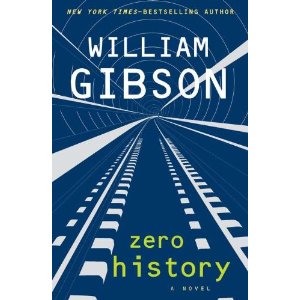
zero history

zero history is the final novel in William Gibson’s trilogy that started with Pattern Recognition. Hollis Henry is back from book two, Spook Country. I wouldn’t presume to review the work of Mr. Gibson. Here are a few of his words that got some highlighter:

“It was like being on the bottom of a Coney Island grab-it game, one in which the eclectically ungrabbed had been accumulating for decades. He looked up, imagining a giant three-pronged claw, agent of stark removal.” – pg 9

“His attempted smile felt like something froced from a flexible squeeze-toy.” – pg 10

“An overly wealthy, dangerously curious fiddler with the world’s hidden architectures.” – pg 18

“We do brand vision transmission, trend forecasting, vendor management, youth market recon, strategic planning in general.” – pg 21

“Addictions (start) out like magical pets, pocket monsters.” – pg 53

Continue reading

Interview with William Gibson

My favorite author, far and away. Just finished his new novel, Zero History. Here are a few bits that caught my attention in the interview:

  • I find Twitter to be the most powerful aggregator of sheer novelty that humanity has yet possessed.
  • “I think the concept of “mainstream” is probably becoming archaic in some sense.”
  • “The mainstream is more digestible by osmosis”
  • “I wonder if we’ll ever have consensus (again)?”
  • “Generally, we don’t know what we were doing with something until we quit doing it.”
  • “When I see Glenn Beck –to the very small extent I do, if I can help it– it’s like Devo’s vision made flesh”
  • “I now write with the assumption that someone will google every unfamiliar word and term as they go through the book.”
  • “The footnote now lives in cyberspace, a click away”

Scott Adams: “Shape Shifters”

“One idea we all share is the narrow view that ideas are not alive in any way we like to define such things. We believe ideas are our tools, not our masters. That is exactly what the Shape Shifters have programmed us to believe. While we know that the ideas in our head control our behavior, we have an idea that we can choose any path we like, so we are blind to the fact we are little more than milk cows for our non-corporeal overlords. Everything we humans do is in the service of creating a better environment for ideas to reproduce. We create more babies so there are more brains to fill with ideas. We write books, make movies, build schools, and expand the Internet, all to help the reproduction of ideas.”