“A planetary soul”

“I think we should prepare ourselves for all kinds of new religions based around the idea of a planetary soul. As in a single web of electronic neurons around the globe, connecting all sentient beings. The Noosphere will go from a hypothetical speculation by a Catholic priest to an outright competitor to the Catholic faith. We will see the rise of Noosnics, Globalists, Overminders, Bit Monks, Quantumarians, and a hundred other sects and cults that take seriously the idea of a glorified planetary spirit as a reflection of the divine.”

“The internet will become a religion in part because everything will happen on it, including all other religions. But mostly because it will be the first platform for true Otherness that will appear on the planet. Not Other as in other variety of human, or other variety of animal, but Other as in an agent not like us, yet bigger than us. A true alien being. Of which we are part. This conundrum will trigger so many spiritual and religious buttons that it will also shake the established religions.”

Kevin Kelly interview in CHRISTIANITY TODAY

Bonus Link: AI, God, and the Future of Faith: A conversation

Kevin Kelly: Found Quotes

My thanks to Kevin Kelly for finding and sharing the following quotes:

“The core function of memory is to imagine the future. Memory is not designed to perfectly replay past events; it is to flexibly construct future scenarios. “– Tali Sharot, The Optimism Bias, Time, June 6, 2011

“It is said that we are all three different people: the person we think we are (the one we have invented), the person other people think we are (the impression we make) and the person we think other people think we are (the one we fret about).” — Stephen Bayley, The Gentle Art of Selling Yourself, March 4, 2007

“In attempting to construct such machines we should not be irreverently usurping His power of creating souls, any more than we are in the procreation of children. Rather we are, in either case, instruments of His will providing mansions for the souls that He creates.” — Alan Turing, Computing Machinery and Intelligence, 1950, p. 444.

“Is it a fact – or have I dreamt it – that, by means of electricity, the world of matter has become a great nerve, vibrating thousands of miles in a breathless point of time? Rather, the round globe is a vast head, a brain, instinct with intelligence!” – Nathanial Hawthorne, The House of the Seven Gables. Chapter 17.

Teflon mind

“The awakened mind is free flowing, natural and well rounded. It’s like Teflon — nothing sticks. On the other hand, the unawakened, ordinary mind is rigid, limited, and sticky like flypaper; the ordinary mind has corners and sharp jagged edges on which ideas get caught, hanging us up. Dualistic thinking is like Velcro; it takes two to tangle. Unitary vision is more like a crystal through which all forms of light can pass unimpeded.”

— Awakening the Buddha Within

Stories we told ourselves

“History in the older sense was narrative, stories we told ourselves about where we’d come from and what it had been like, and those narratives were revised by each new generation, and indeed always had been. History was plastic, was a matter of interpretation. The digital had not so much changed that as made it too obvious to ignore. History was stored data, subject to manipulation and interpretation.”

— All Tomorrow’s Parties by William Gibson

Moving from ownership to access

“Who owns this data? Who owns your friendships? There’s another party involved. Who owns your genes? 99.9% are shared by other humans. Who owns your location? The knowledge that you’re in a public space is hard to own. Your reputation or history? Your conversations? The real issue is that we’re moving away from ownership altogether to access. The benefits of accessing are eclipsing the benefits of (owning) it – consumers may eventually not own anything at all. Netflix means you can stop owning movies – if you have access to all movies anytime, why would you buy movies? This may be leaking from the virtual to the material world, particularly once we have personal fabrication. It may eventually play out into data, because access is often better than ownership.”

From Kevin Kelly’s remarks at the Quantified Self conference in May this year. More of Kelley’s speech.

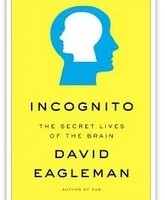
Incognito – The Secret Lives of the Brain by David Eagleman

It’s easy to think of “me” has “having” a brain, but this book left me thinking my brain has me. If there is a me apart from my brain, I fear it’s mostly along for the ride. Here are some ideas that brought out my highlighter.

The brain generally does not need to know most things; it merely knows how to go out and retrieve the data. It computes on a need-to-know basis. pg 28

You’re not perceiving what’s out there. You’re perceiving whatever your brain tells you. pg 33

We have no access to the rapid and automatic machinery that gathers and estimates the statistics of the world. pg 34

Your brain is in the dark but your mind constructs light. pg 40

The difference between being awake and being asleep is merely that the data coming in from the eyes anchors the perception. Asleep vision (dreaming) is perception that is not tied down to anything in the real world; waking perception is something like dreaming with a little more commitment to what’s in front of you. pg 45

It’s easy to spot a hallucination only when it’s bizarre. For all we know, we hallucinate all the time. pg 46

Our expectations influence what we see. There has to be a match between your expectations and the incoming data for you to “see” anything. Awareness of your surroundings occurs only when sensory inputs violate expectations. pg 48, 50

The brain refines its model of the world by paying attention to its mistakes. pg 49

The brain tries to see the world only as well as it needs to. We are not conscious of most things until we ask ourselves questions about them. What we perceive in the outside world is generated by parts of the brain to which we do not have access. pg 54

Instead of reality being passively recorded by the brain, it is actively constructed by it. pg 82

There are thoughts you cannot think. pg 82

Evolution has carefully carved your eyes, internal organs,sexual organs, and so on — and also the character of your thoughts and beliefs. pg 82

“In general, we’re least aware of what our minds do best.” — Marvin Minsky, The Society of Mind

We are not able to see the instincts that are the very engines of our behavior. These programs are inaccessible to us not because they are unimportant, but because they’re critical. Conscious meddling would do nothing to improve them. pg88

Briefly glimpsed people are more beautiful. pg 92

We come to know our own attitudes and emotions, at least partially, by inferring them from observations of our own behavior. pg 134

David Eagleman is neuroscientist at Baylor College of Medicine, where he directs the Laboratory for Perception and Action.

“If I can just hang on for another couple of years”

“This idea of “hanging on for another few years” isn’t just dangerous; it’s suicidal. I know this comes off as harsh, but media companies should be asking themselves this question (actually, they should have been already): Is our topmost leadership capable of looking past their personal needs to do what’s right for the company in the long run? In the answer to that question lies the future of all media.”

— Terry Heaton

We just don’t know which half

“Every advertising should be measurable. You should be able to adjust it, right? Then you should be able to tune it, track it, track the right users, and target to the right people.” – Susan Wojcicki, Google Ad Chief (from In the Plex by Steven Levy)

Mel Karmazin calls this “fucking with the magic.” And sixty years ago, it was magic.

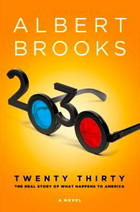
2030: The real story of what happens to America

I’m a big fan of Albert Brooks. Defending Your Life, Lost in America, Taxi Driver, Private Benjamin… pick your favorite. He writes, directs, acts… TV, movies and, now, novels.

I just finished 2030 and found it both depressing and inspiring. Here’s a little taste from a NYT review:

In the future America of “2030,” the national debt has long since surpassed the gross national product. Why anyone would want to be president is “more and more of a mystery.” On the rosy side — well, sort of — a cure for cancer has been found, turning the man who did it, Dr. Sam Mueller, into a billionaire and a guru.

The bad news? Along with a stock of lesser rejuvenating drugs and gadgets, Mueller’s breakthrough has left spry hordes of senior citizens cheerily hogging most of the country’s remaining resources. Seeing their own chance at the good life shrink to zero, young people are forming “resentment gangs” and committing acts of escalating violence against “the olds.” The White House’s first Jewish occupant, the brainy but melancholy Matthew Bernstein, would like to give them a fairer share of the pie, but even he doesn’t dare risk the wrath of AARP.

I have to say that just about everything in this story seemed plausible to me. Brooks fans won’t be disappointed. A few excerpts after the jump… Continue reading

The Great Mystery

“I regard the brain as a computer which will stop working when its components fail. There is no heaven or afterlife for broken down computers; that is a fairy story for people afraid of the dark.” — Stephen Hawking

“We’ll be alive again in a thousand blades of grass, and a million leaves, we’ll be falling in the raindrops and blowing in the fresh breeze, we’ll be glittering in the dew under the stars and moon out there in the physical world which is our true home and always was.” — His Dark Materials by Phillip Pullman

“You’re a collection of molecules and those molecules are made of smaller bits, and those bits are made of even smaller bits. The smallest bits in the universe are all identical. You are made of the same stuff as the concrete in the floor and the fly on the window. Your basic matter cannot be created or destroyed. All that will survive of what you call you life is the sum of your actions. Some might call the unending ripple effect of those actions a soul, or a spirit.” – The Religion War by Scott Adams

“When you die, it is said you see your whole life. But you don’t see it minute by minute, like a speeded-up film. It’s like everything you ever did in all your days was a brushstroke, and now you see the whole painting all at once.” — Lawrence Block’s Everybody Dies

I wonder how it all got started, this business about seeing your life flash before your eyes while you drown, as if panic, or the act of submergence, could startle time into such compression, crushing decades in the vice of your desperate, final seconds.
From The Art of Drowning by Billy Collins

You’re going to stay here for a week. Everyone gets a private room. Please feel at home. But while you’re here there’s one thing you must do. Out of the __ years of your life, we’d like to ask you to choose one memory, the one you remember and cherish most. There is a time limit. You have three days to decide. After you choose your memory, our staff will recreate it on film as exactly as possible. On Saturday we’ll show the films to everyone. The moment the memory comes back to you most vividly, you’ll go on to the other side, taking only that memory. — From the motion picture After Life

“Imagine that existence is like a sound recording. Listening to an old phonograph doesn’t alter the recording itself, and depending on where the needle is placed, you hear a certain piece of music. This is what we call the present. The music, before and after the song now being heard, is what we call the past and the future. Imagine, in like manner, every moment and day enduring in nature always. The record does not go away. All nows (all the songs on the record) exist simultaneously, although we can only experience the world (or the record) piece by piece. We do not experience time in which “Stardust” often plays, because we experience time linearly.” — Biocentrism by Robert Lanza (with Bob Berman)

“In spiritual terms the cycle of birth and rebirth is a workshop for making creative leaps of the soul. The natural and the supernatural are not doing different things but are involved in transformation on separate levels. At the moment of death the ingredients of your old body and old identity disappear. Your DNA and everything it created devolve back to their simple component parts. Your memories dissolve back into raw information. None of this raw material is simply recombined to produced a slightly altered person. To produce a new body capable of making new memories, the person who emerges must be new. You do not acquire a new soul, because the soul doesn’t have content. It’s not “you” but the center around which “you” coalesces, time after time. It’s your zero point.” — Deepak Chopra, Life After Death