“Why the impossible happens more often”

Kevin Kelly is one of the brilliant thinker/writers I look to for hope (along with Scott Adams, Clay Shirky, William Gibson and a few other). Following are from a post on why the impossible happens more often these days:

“Collectively we behave differently than individuals. Much more importantly, as individuals we behave differently in collectives. This has been true a long while. What’s new is the velocity at which we a headed into this higher territory of global connectivity. We are swept up in a tectonic shift toward large, fast, social organizations connecting us in novel ways. There may be a million different ways to connect a billion people, and each way will reveal something new about us. Something hidden previously.”

“Most of what “everybody knows” about us is based on the human individual. Collectively, connected humans will be capable of things we cannot imagine right now. These future phenomenon will rightly seem impossible.”

“My prediction is that in the coming years our biggest surprises — the ones that aren’t predicted — will be the result some new method of large scale social interactions. While we will get good at predicting the next advance of technological innovation, we won’t get very good at predicting what happens with the hive mind. And exploring the hive mind — the thousands of ways in which we can connect and reconnect ourselves — will be the chief activity of our civilization in the near term. If I am right then we’ll have to get better at believing in the impossible.”

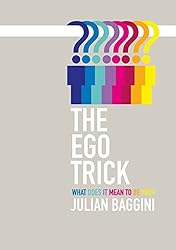
The Ego Trick: In Search of the Self by Julien Baggini

Excerpts from The Ego Trick: In Search of the Self by Julien Baggini

We all tend to think there’s a connection between the four-year-old child on our first day of school and us now. What makes us the same is we believe we’re the same. Sense of self over time is therefore the story that we tell ourselves that keeps us together. pg 39

The Ego Trick – The remarkable way in which a complicated bundle of mental events, made possible by the brain, creates a singular self, without there being a singlular thing underlying it. pg 123

There is an Ego Trick, but it is not that the self doesn’t exist, only that it is not what we generally assume it to be. pg 151

Consciousness of self emerges from a network of thousands or millions of conscious moments. pg 40

We are constantly rewriting our histories to keep our inner biographies coherent. pg 40

The self is a construction of the mind, one flexible enough to withstand constant renovation, partial demolition and reconstruction. pg 41

We all ignore and do not commit to memory facts and events that conflict with the way we see ourselves and the world. We remember selectively, usually without conscious effort or desire to do so. And yet because we believe memory records facts, objectively, we fail to see that all this means that we are constructing ourselves and the world. pg 49

“I have a belief that dementia actually makes you more like yourself, so rather than rob you of your self, it robs you of all the exterior things that you pile on through life, all the baggage that you carry and the layers. What you’re left with at the end of the day with dementia is the core person, the soul, or whatever term you want to put on it. We’ve described it as an onion. If you peel an onion, from the brown skin outwards, you’ve got lots and lots of layers. When you get right to the centre of the onion you get to a little pearl in the middle and you can’t peel any more off it. It seems to me that is the real essense of the person.” – pg 54

We are nothing but our parts, but we are more than just our parts. pg 69

The self is not a single thing, it is simply what the brain and body system does. pg 83

18th century philosopher David Hume: “For my part, when I enter most intimately into what I call myself, I always stumble on some particular perception or other, of heat or cold, light or shade, love or hatred, pain or pleasure, colour or sound, etc. I never catch myself, distinct from some such perception.”

(Baggini) Our minds are just one perception or thought after another, one piled on another. You, the person, is not separate from these thoughts, the thing having them. Rather you just are the collection of these thoughts.

(Hume again) “nothing but a bundle or collection of different perceptions, which succeed each other with an inconceivable rapidity, and are in a perpetual flux and movement.” pg 119

“non-reductive physicalism” — The self is not a substance or thing, it is a function of what a certain collection of stuff does. In other words, we are made up of nothing more than physical stuff, but to describe our true nature, you need more than just a physical vocabulary. You cannot full describe what it is to be a person in the language of biology; but that does not mean a person has non-biological parts. pg 120-121

“The Buddha’s idea of self therefore is something we create. Your identity, your sense of being a person is formed through your actions, and that is only possible becasue there is not a fixed self. There is no unchanging essence or substance to which those attributes are then attached at all.” — Stephen Batchelor pg 148

“The existence of the self as an independent, eternal and atemporal unifying principle is an illusion.” — Thupten Jinpa pg 148

The self is not an illusion. What is illusory is an idea of self which sees it as an unchanging, immortal essence. pg 148

The self is an illusion, but not just an illusion. But still, I would prefer to do away with talk of illusion altogether. Talk of illusion suggests there is a way of perceiving onself free from that illusion. But there isn’t. pg 150

The solidity of self is an illusion; the self itself is not. pg 152

“We are responsible for our actions not because they are our products but because they are us, because we are what we do.” — Christine Korsgaard pg 168

The Ego Trick: In Search of the Self

God as software engineer

“When we make these virtual worlds in the future —worlds whose virtual beings will have autonomy to commit evil, murder, hurt, and destroy options— it’s not unthinkable that the game creator would go in to try to fix the world from the inside. That’s the story of Jesus’ redemption to me. We have an unbounded God who enters this world in the same way that you would go into virtual reality and bind yourself to a limited being and try to redeem the actions of the other beings since they are your creations. So I would begin there. For some technological people, that makes the faith a little more understandable.”

— From a piece titled “Geek Theologian” Kevin Kelly talks with Christianity Today’s Katelyn Beaty.

Difficult to noodle on such things and not recall the scene with The Architect in the later Matrix films.

“A planetary soul”

“I think we should prepare ourselves for all kinds of new religions based around the idea of a planetary soul. As in a single web of electronic neurons around the globe, connecting all sentient beings. The Noosphere will go from a hypothetical speculation by a Catholic priest to an outright competitor to the Catholic faith. We will see the rise of Noosnics, Globalists, Overminders, Bit Monks, Quantumarians, and a hundred other sects and cults that take seriously the idea of a glorified planetary spirit as a reflection of the divine.”

“The internet will become a religion in part because everything will happen on it, including all other religions. But mostly because it will be the first platform for true Otherness that will appear on the planet. Not Other as in other variety of human, or other variety of animal, but Other as in an agent not like us, yet bigger than us. A true alien being. Of which we are part. This conundrum will trigger so many spiritual and religious buttons that it will also shake the established religions.”

Kevin Kelly interview in CHRISTIANITY TODAY

Bonus Link: AI, God, and the Future of Faith: A conversation

Teflon mind

“The awakened mind is free flowing, natural and well rounded. It’s like Teflon — nothing sticks. On the other hand, the unawakened, ordinary mind is rigid, limited, and sticky like flypaper; the ordinary mind has corners and sharp jagged edges on which ideas get caught, hanging us up. Dualistic thinking is like Velcro; it takes two to tangle. Unitary vision is more like a crystal through which all forms of light can pass unimpeded.”

— Awakening the Buddha Within

Speak when spoken to

I am clearly incapable of remaining silent for 24 hours. I fantisize about this from time to time but can’t summon the will to try it. So I’m wondering if I could go for a day only speaking in response to a direct question. No follow-up queston, I remain mute. I could puss out by allowing me to ask a direct question.

I’d really like to see a transcript of everything said to me and by me for a full day. I’d go through it line by line, deleting stuff that didn’t need to be said. You know there wouldn’t be much left.

Somewhere in the archives there’s a post in which I speculate a word rationing plan. I get 1,000 words alloted for every 24 hours. My iPhone app counts my words and gives me updates on remaining. Once gone, can’t talk. Have to rely on 100 pre-recorded phrases to interact with others. Would the quality of my discourse go up given such a limitation?

Stay tuned.

Einstein on Buddhism

“The religion of the future will be a cosmic religion. It should transcend personal God and avoid dogma and theology. Covering both the natural and the spiritual, it should be based on a religious sense arising from the experience of all things natural and spiritual as a meaningful unity. Buddhism answers this description. If there is any religion that could cope with modern scientific needs it would be Buddhism.” 

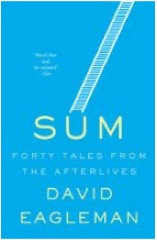
Sum: Forty Tales from the Afterlives

I’m reading a wonderful little book by David Eagleman called Sum: Forty Tales from the Afterlives. But it’s really “an examination of what it means to live.” At first I marveled at the strangeness of some of the stories but realized none are stranger than the stories most of us grew up with (Bearded white man sitting on golden throne surrounded by harp playing angels). This is a book I’ll keep close and read again and again.

UPDATE (6/18/11):  I’m trying to savor these stories and make them last but I’m getting near the end and everyone is better than the one before. One of my favorites so far is Death Switch:

“So an afterlife does not exist for us per se, but instead an afterlife occurs for that which exists between us. When and alien civilization eventually bumps into Earth, they will immediately be able to understand what humans were about, because what will remain is the network of relationships: who loved whom, who competed, who cheated,who laughed together over road trips and holiday dinners. Each person’s ties to bosses, brothers ad lovers are etched into the electronic communiques. The death switches simulate the society so completely that the entire social network is reconstructable. The planet’s memories survive in zeros and ones.”

Author and broadcaster Stephen Fry reads from Sum: Forty Tales from the Afterlife, neuroscientist David Eagleman’s first work of fiction.

Reality, there’s nothing like it

“We can’t comprehend Reality with our intellect. We can’t pull it into a static view of some thing. All our explanations are necessarily provisional. They’re just rigid frames of what is actually motion and fluidity. In other words, if you can think of how Reality is, you can be sure that’s how it isn’t. Reality simply cannot be put into a conceptual form — not even through analogy, for there’s nothing like it. Reality simply doesn’t fit into concepts at all. Nevertheless, Reality is something you can see. You can’t conceive of it, but you can perceive it.”

— Buddhism Plain and Simple by Steve Hagen

The Great Mystery

“I regard the brain as a computer which will stop working when its components fail. There is no heaven or afterlife for broken down computers; that is a fairy story for people afraid of the dark.” — Stephen Hawking

“We’ll be alive again in a thousand blades of grass, and a million leaves, we’ll be falling in the raindrops and blowing in the fresh breeze, we’ll be glittering in the dew under the stars and moon out there in the physical world which is our true home and always was.” — His Dark Materials by Phillip Pullman

“You’re a collection of molecules and those molecules are made of smaller bits, and those bits are made of even smaller bits. The smallest bits in the universe are all identical. You are made of the same stuff as the concrete in the floor and the fly on the window. Your basic matter cannot be created or destroyed. All that will survive of what you call you life is the sum of your actions. Some might call the unending ripple effect of those actions a soul, or a spirit.” – The Religion War by Scott Adams

“When you die, it is said you see your whole life. But you don’t see it minute by minute, like a speeded-up film. It’s like everything you ever did in all your days was a brushstroke, and now you see the whole painting all at once.” — Lawrence Block’s Everybody Dies

I wonder how it all got started, this business about seeing your life flash before your eyes while you drown, as if panic, or the act of submergence, could startle time into such compression, crushing decades in the vice of your desperate, final seconds.
From The Art of Drowning by Billy Collins

You’re going to stay here for a week. Everyone gets a private room. Please feel at home. But while you’re here there’s one thing you must do. Out of the __ years of your life, we’d like to ask you to choose one memory, the one you remember and cherish most. There is a time limit. You have three days to decide. After you choose your memory, our staff will recreate it on film as exactly as possible. On Saturday we’ll show the films to everyone. The moment the memory comes back to you most vividly, you’ll go on to the other side, taking only that memory. — From the motion picture After Life

“Imagine that existence is like a sound recording. Listening to an old phonograph doesn’t alter the recording itself, and depending on where the needle is placed, you hear a certain piece of music. This is what we call the present. The music, before and after the song now being heard, is what we call the past and the future. Imagine, in like manner, every moment and day enduring in nature always. The record does not go away. All nows (all the songs on the record) exist simultaneously, although we can only experience the world (or the record) piece by piece. We do not experience time in which “Stardust” often plays, because we experience time linearly.” — Biocentrism by Robert Lanza (with Bob Berman)

“In spiritual terms the cycle of birth and rebirth is a workshop for making creative leaps of the soul. The natural and the supernatural are not doing different things but are involved in transformation on separate levels. At the moment of death the ingredients of your old body and old identity disappear. Your DNA and everything it created devolve back to their simple component parts. Your memories dissolve back into raw information. None of this raw material is simply recombined to produced a slightly altered person. To produce a new body capable of making new memories, the person who emerges must be new. You do not acquire a new soul, because the soul doesn’t have content. It’s not “you” but the center around which “you” coalesces, time after time. It’s your zero point.” — Deepak Chopra, Life After Death