
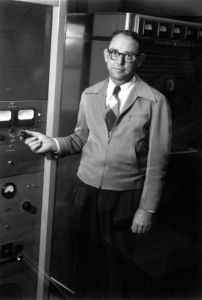
Ray Van Hooser was on the original staff of KBOA.
Category Archives: Radio
The Lumpkin Family
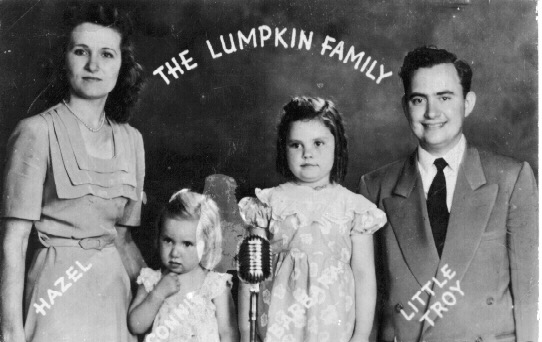
I’d watch a TV show based on a 50’s era family that made their living performing on small town radio stations. I might make one or both of the children “little people” passing as kids. Maybe the wife transgender. The gimmick would be they are all very talented but couldn’t make it as solo acts and discover — by humorous accident — that they’re a hit as a family. The thing practically writes itself.
An end of radio
 “Just as newspapers fell off a cliff, radio is about to follow. It’s going to happen faster than anyone expects. And of course, it will be replaced by a new thing, a long tail of audio that’s similar (but completely different) from what we were looking for from radio all along. And that audience is just waiting for you to create something worth listening to.”
Seth Godin blog post
The transistor radio
From Walter Isaacson’s The Innovators:
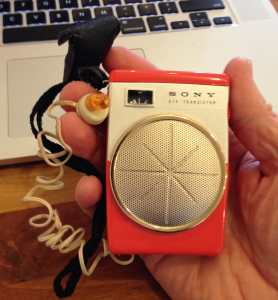 “Transistors were being sold in 1954 to the military for about $16 apiece. But in order to break into the consumer marker. Haggerty insisted that his engineers find a way to make them so that they could be sold for less than $3. They did. He also developed a Jobs-like knack, which would serve him then and in the future, for conjuring up devices that consumers did not yet know they needed but would soon find indispensable. In the case of the transistor, Haggerty came up with the idea of a small pocket radio. When he tried to convince RCA and other big firms that made tabletop radios to become a partner in the venture, they pointed out (rightly) that consumers were not demanding a pocket radio. But Haggerty understood the importance of spawning new markets rather than merely chasing old ones. He convinced a small Indianapolis company that built TV antenna boosters to join forces on what would be called the Regency TR-1 radio. Haggerty made the deal in June 1954 and, typically, insisted that the device be on the market by that November. It was. The Regency radio, the size of a pack of index cards, used four transistors and sold for $49.95. It was initially marketed partly as a security item, now that the Russians had the atom bomb. “In event of an enemy attack, your Regency TR-1 wiU become one of your most valued possessions,” the first owner s manual declared. But it quickly became an object of consumer desire and teenage obsession. Its plastic case came, iPod-like, in four colors: black, ivory, Mandarin Red, and Cloud Gray. Within a year, 100,000 had been sold, making it one of the most popular new products in history.”
“More fundamentally, the transistor radio became the first major example of a defining theme of the digital age: technology making devices personal. The radio was no longer a living-room appliance to be shared; it was a personal device that allowed you to listen to your own music where and when you wanted—even if it was music that your parents wanted to ban.”
Gaylon Watson

Yesterday I drove to the little town of Piedmont, in southeast Missouri, to meet Gaylon Watson. Gaylon worked at KBOA back in the fifties and I have long wanted to meet him and capture some oral history from those early days of the station where my father and I once worked. Gaylon’s eighty now but healthy and sharp as a tack. His 28 years in broadcasting covered a lot of ground and we only captured some of it in this recording.
Gaylon’s eighty now but healthy and sharp as a tack. His 28 years in broadcasting covered a lot of ground and we only captured some of it in this recording. We had to leave some on the editing room floor because of the noisy restaurant. After lunch Gaylon gave me the “Chamber of Commerce” tour of Piedmont (where he was mayor for 16 years) and then took me to meet his three dogs who live in splendor on 20 beautiful acres in the Missouri Ozarks.
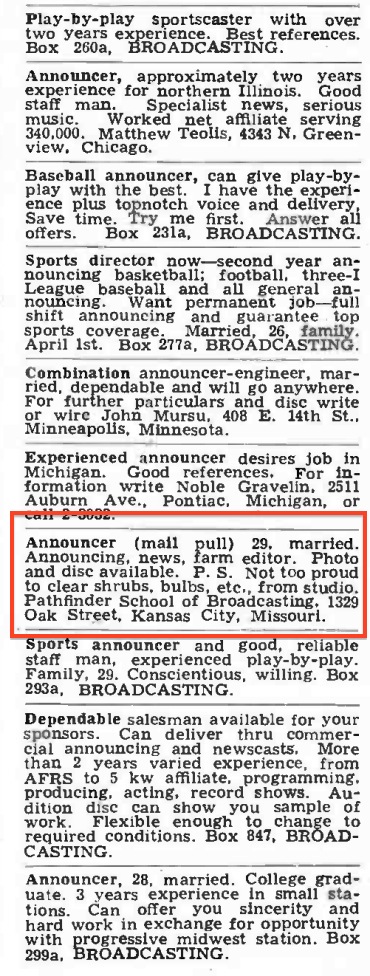
Broadcasting Magazine (1949)
For many years this publication was the “bible” of the industry. This was how radio folks found and filled jobs for many years.
I wanna be a DJ or a cowboy
You know how when you cut down the rain forest you destroy the natural habitat of some exotic wild animals and they become extinct? Say goodbye the Spotted American DJ. It’s all there in an excellent (and depressing) story by Clay Barbour in The Virginian-Pilot:
10 companies control two-thirds of the country’s listeners and ad revenue; two of them – Clear Channel and Infinity Broadcasting – own more than 40 percent of all stations.
Edison Research found that as many as 75 percent of 12- to 24-year-olds were listening to online radio, with nearly half of them using their phones to do so while in the car. Essentially, if you are younger than a certain age, you don’t listen to terrestrial radio anymore.
Many of you have ready my nostalgic ramblings about my dozen years as a small town radio DJ in the 70s. (sigh) Really glad I got to ride the range before all the media sod busters arrived.
Changing listening habits
“A new Edison research study warns that among the six most common places where listeners consume audio media, broadcast radio dominates in just two of them (in car, at home); is tied with Internet radio for two (at work, on public transportation); and is defeated by Internet radio in two (while working out, while walking around). Another red flag in the study for broadcasters is that 50 percent of at-work listeners who listen to Internet-radio-only stations/services (that is, stations/services that don’t broadcast on FM/AM) have replaced their FM/AM listening time with Internet-radio-only stations/services.”
“According to Triton Digital, at any given moment among online listeners (M-F 6am-8pm), Pandora has more than twice the audience of all of the radio stations owned by Clear Channel, CBS, Cumulus, Entercom and the next seven broadcasting companies combined.”
— All Things Digital
A quest to save AM radio
Most of my on-air time for the dozen years (1972-82) I worked at my hometown radio station was on the AM station. In the 60s (?) the station sold (at cost?) “FM converters” because so few cars had FM receivers. This NY Times story tells the tale:
“In 1978 half of all radio listening was on the AM dial. By 2011 AM listenership had fallen to 15 percent, or an average of 3.1 million people, according to a survey by Veronis Suhler Stevenson, a private investment firm. While the number of FM listeners has declined, too, they still averaged 18 million in 2011. (The figures are averages based on measuring listeners every 15 minutes.)”
“In 1970 AM accounted for 63 percent of broadcast radio stations, but now it accounts for 21 percent, or 4,900 outlets, according to Arbitron. FM accounts for 44 percent, or 10,200 stations. About 35 percent of stations stream content online.”
“Nearly all English-language AM stations have given up playing music, and even a third of the 30 Major League Baseball teams now broadcast on FM. AM, however, remains the realm of conservative talk radio, including roughly 80 percent of the 600 radio stations that carry Rush Limbaugh.”
Asking the right questions
“…the implicit assumption is that radio’s past must be sustained into the future, and with a few tweaks here and there we can dial up our relevance […] and dial down our risk. This is equivalent to the consumer products company that asks “how can we make a new product that we can successfully sell?” – as long as that product is envisioned, made, and sold to fit with all the previous products the company has sold in the past.” — Mark Ramsey
Heavy snow knocked out power to our house yesterday so as darkness fell, I built a fire, turned on some solar LED lamps and dug out a transistor radio. I didn’t sample a lot of stations but the ones I listened too sounded… quaint?
I probably haven’t listened to a full hour of “terrestrial radio” in the last 5 years so what I heard felt strange in my ears. The phony DJ voices; snatches of Alice Cooper’s syndicated show (shudder)… but the most jarring was the lack of control over my experience. Don’t like a song? Well, tough shit, just gotta wait till it’s over and hope you like the next one better.
I’m going to take it on faith there are radio stations (somewhere) breaking new ground and reinventing themselves for the new media world in which they find themselves. If you know of one, drop a link (or just the call letters) in the comments.