
Dan Shelley named RTDNA/F Executive Director

“The Radio Television Digital News Association and Foundation (RTDNA/F) today announced that longtime Association member, former Chairman of the Board and current Foundation Secretary/Treasurer Dan Shelley has been named Incoming Executive Director of the two organizations. Shelley begins work immediately and will assume the role of Executive Director in September.”

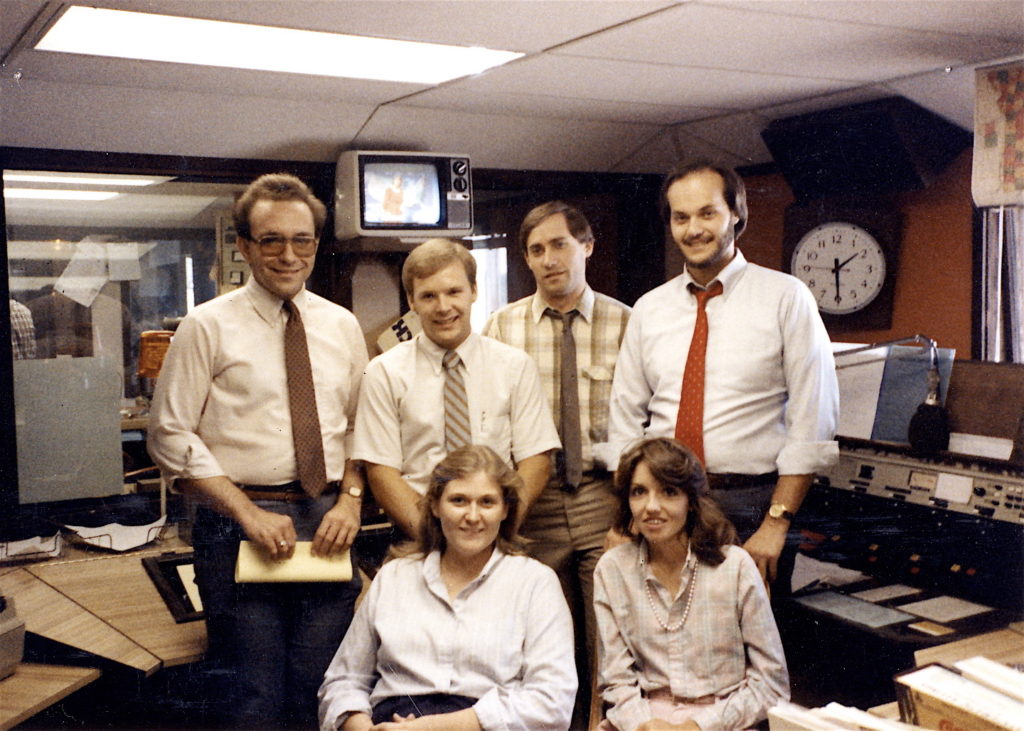
I met Dan in 1984 when he was news director at KTTS in Springfield, Missouri, and I was doing affiliate relations for The Missourinet (Dan’s the guy in the red tie). From Springfield Dan moved up to Milwaukee where he was news director of WTMJ for a few years before moving to New York to take over digital media for WCBS-TV. Then on to Radio One and, in 2015, iHeartMedia.
I interviewed Dan in 2005 when he was elected chairman of what was then RTNDA (Radio Television News Directors Association). They changed the name in 2009 because this digital thing just wasn’t going away. During that interview we talked about blogging, podcasting, satellite radio. For a little context, XM (satellite) Radio did it’s first broadcast in 2001; Facebook launched in 2004; podcasting became a thing that same year; YouTube started 2005; Twitter in 2006; and in January of 2007, Steve Jobs introduced the iPhone. Whew.

Media, journalism and Life As We Know It has undergone some big changes in the last dozen years. According to a 2016 Gallup Poll“Americans’ trust and confidence in the mass media ‘to report the news fully, accurately and fairly’ has dropped to its lowest level in Gallup polling history, with 32% saying they have a great deal or fair amount of trust in the media. This is down eight percentage points from last year.” 

I don’t see how he can possibly find the time but Dan says we’ll talk again. Boy, am I looking forward to that.

This post was updated on April 6, 2017 at 6:50 p.m.
My first interview

I remember the first recorded interview I did (1972). It was with Bill Walsh and Jack McDaniel, two local businessmen who organized the Fall Festival Parade every year in the little town where we lived. When I got back to the studio and dubbed the audio from a cassette to reel-to-reel tape, I was horrified to hear how awful I sounded. Long, rambling questions. It still makes me cringe.
I grabbed a splicing block, a grease pencil and some splicing tape (look ‘em up) and sliced out my questions. But first I had to record the questions without sounding like a moron… and then — oh so tediously — splice them back with the answers. Yes, the interview still sounded like shit.

No idea how many interviews I recorded during the next 40 years. A bunch. And I don’t think I got much better at it. Looking back it’s easy to see what I was doing wrong: talking too much. I mistakenly thought I was and equal part of the interview. A natural hubris, I suppose.

Few things infuriate me more than listening to an interview with someone who really has something interesting to say but never gets to say it because the interviewer continuously interrupts. Or eats up vast amounts of time with endless, rambling questions.

In recent years I’ve found a way to address this failing of mine. I write out every question I want to ask (trying to stay close to 10) and do my best not to vary. But more often than not, when I listen to the interview, I find I can delete my questions entirely, leaving the listener/viewer with what they came for.

There are some interviewers who add more than they detract. I’m fond of Daniel Tosh’s interviews (if one can really call them that). I like James Lipton’s (Inside the Actor’s Studio) style. But — like me — most interviewers simply can not shut the fuck up and let the subject talk.

Radio: There will be no more new music formats

Mark Ramsey says the last successful new radio format was the Variety Hits format, “Jack.” I barely remember that format (now 15 years old). Mr. Ramsey says there as been no new youth-based format on the radio fail in generations… and there never will be “but because the tastes are so fractured among millennials that there is no popular thread of music that isn’t already absorbed sufficiently well by an existing format.”

I’m not sure who would care about this theory besides someone who programs a radio station. He offers some insight into who listens to which formats and why but it all seems a bit… academic to me. Like reflecting on Mayan culture.

People still listening to radio. Even for news.

“91% of Americans ages 12 and older had listened to traditional AM/FM radio in the week before they were surveyed in 2015, according to Nielsen Media Research. […] In research asking about how people are learning about the U.S. presidential election, 44% of adults said they learned about it from radio in the past week. Radio outpaced both national (23%) and local (29%) print newspapers, although it trailed local TV news (57%) and cable TV news (54%).”

Pew Research State of the News Media 2016

Will radio find a home in your next car?

This article says yes (I think). Everyone seems to agree younger listeners are turning to their phones for audio but there are still lots of folks listening to the radio.

Ninety-three percent of U.S. adults listen to radio weekly, according to Nielsen. 96 percent of U.S. adults (and 94 percent of 18- to 34-year-olds) owned a radio in 2008; today, 79 percent of adults do, and just 68 percent of 18- to 34-year-olds do.

The big radio companies are apparently in the shit but that might be the result of some bad business decisions as much as changing listening habits.

iHeartMedia (formerly Clear Channel), the largest radio company in the U.S. with 850 stations, currently trades for just around a dollar a share, down from around $6 last April. The company is loaded down with debt, and restructuring or bankruptcy could be in its future. Cumulus Media, which owns 454 stations, trades at just $0.54 a share, and NASDAQ has warned that its share price is so low it could be delisted. Emmis Communications stock trades under a dollar. And CBS announced last month that it is planning to sell off its radio stations.

I could certainly have done without the CD player in my MINI. And probably the radio but I don’t think that was even an option.

Warren Krech: 40 years behind the mic


Warren (“Krech in the Morning”) Krech is retiring from radio at the end of the month, wrapping up a career that started in 1972. He’s been on the air in Jefferson City, Missouri, since 1984. Almost half a century of getting up every morning at 3 a.m. Be hard to find someone more involved in his community than Warren and it’s hard not think in terms of “end of an era.” He has seen and been part of a lot of changes in radio and talked about them in this 16 minute chat/shoptalk.

How to hire radio talent

Mark Ramsey is a “media strategist, researcher and trend-maker.” What we used to call a consultant. Here’s part of his answer to the question: “what qualifications should we be looking for in talent, programming, and sales that are different from today’s conventional qualifications?”

For talent, nothing else will be more important than that talent’s skill and engagement with social media and digital platforms.

Here’s some questions he’d ask before hiring:

  • How big is your personal audience, the one you have direct relationships with, as measured by social media?
  • How many Twitter followers do you have?
  • How big is your Facebook fan page, and how strong is your engagement?
  • How many Instagram followers and likes do you have?
  • How many YouTube subscribers and total views do you have?
  • Do you have a website for your own brand?
  • How big is your brand’s personal email list? How often do you send out email? What do you send?
  • What podcasts do you produce? How much listenership do they receive? How many podcast subscribers do you have?

“In other words, to what degree do you – the talent – take responsibility for building your own personal brand? And how can you demonstrate the power of that brand to me?”

I think he’s right. As I’ve watch social media grow and evolve I’ve wondered how I would have fared in this new media environment. Glad I didn’t miss the “spinning records” era.