
989 people out of 1,000 listen to radio

Regular readers know I’m a fan of Mark Ramsey’s blog, Hear 2.0. Mark is the president of San Diego-based Mercury Radio Research, which recently conducted a 1,000-person national study of radio listening habits of people ages 12 through 54. Just 11 people said they didn’t listen to radio.

Mark spoke at one of the sessions at the NAB Radio Show, underway this week in Dallas and the Dallas Morning News covered:

“One of the key things that makes radio different from all these others (iPods, satellite radio, Internet radio, etc) and makes it stand out, and valuable, is the fact that there’s stuff between the songs that people value. In fact, the loyalty to the stations, preference for those stations, is driven very much by what’s between those songs. It’s about connecting with other people.”

Here’s Mark’s take on commercials:

“…there’s one group that hates commercials and another that can tolerate them. The issue with commercials seems to be, ‘Look, if you’re a zealot about commercials, well, of course you’re going to listen to an iPod.’ People inherently understand that commercials are a tax that you pay. The issue for radio is whether we demonstrate to them what that tax is buying them. … ‘Are we giving people something that’s worth the price they’re paying in commercials?’

That wasn’t such a scary question when there were no alternatives to the radio.

Note to self: Record a couple of hours of morning drive on one of the local radio stations and edit out everyhing except the “stuff between the songs that people value.”

Comment from Jim M:

“It seems to me the ratio between commercial time and music / content is way out of whack compared to what it used to be. I wonder if there are some statistics on how this ratio has evolved over time? I was thinking about this today, again, when a drive to the store and back treated me to 100% advertising. I like commercial radio for the fact that I can pick up on new music and the variety, but finding music these days seems to be truly hit and miss.”

NAB Radio Show: The Newspaper of the Future

Scott Brandon’s latest dispatch from the NAB Radio Show (“How to Make Your Station Website the Newspaper of the Future”):

“We begin with internet problems. Not a good sign. Wish I had my camera. Feels like a college lecture hall. The session is led by Paul Coates from Branson. Roger Utnehmer (DoorCountyDailyNews.com) was scheduled to present but had to drop out due to illness.

Really, this thing was all about why to do it (revenue opportunities, audience movement) nothing much about how to do it. More “ain’t this neat” than anything else. Toward the end people started to push him for logistic info. At some point, Coates lost control and the herd took over. Lots of independent conversations and random questions being thrown out and answers coming from the gallery.

Some notes:

  • Traditional newspaper is continuing to decline. That means there is an opportunity to grab those non-traditional readers.
  • Radio can drive people to the web and make money. If newspaper drives you to web, they lose your traditional sub rev.
  • Your website has to supply news not history.
  • You already have news and sports departments.
  • You can charge premium price. Print buyers used to spending lots. Too low and it doesn’t seem worth it.
  • Sky is limit on content.
  • [More internet problems. Everyone in the crowd has advice.]
  • Fresh content is needed everyday and early in the morning. By 5:30 or 6:00.
  • His unique visitors have leveled out but his per-day visits have gone up. On average, each person visits 3 times a day. Guess what? They update the news 3 times a day.
  • “Show-me more” feature on Roger’s site allows sponsors to put up a video of their biz or offerings.
  • Hometowndailynews.com is working on adding a feature to their “area dining” section that will allow you to do on-line orders to your favorite restaurant.
  • Your site should have different name than station. Must be a full stand alone feel. Otherwise, people feel they are just spending more money/time on your station.
  • Did not hire new staff. Shuffle duties of existing staff.
  • Now we’re into legal stuff. Is it legal to link to google? Sigh.
  • Mistakes he made: 1) Have more patience; 2) Sell it to your staff first; 3) Crawl, walk, run”

NAB Radio Show down with New Media

Scott reports there are at least eight sessions on “New Media” at the NAB Radio Show going on this week in Dallas:

1) Pod Squad – Getting the Drop on Podcasting
2) Text Messaging – Where U @?
3) How to Make Your Radio Station Website the Newspaper of the Future
4) Promotions with New Technologies
5) Harnessing the Power of Blogging
6) Radio’s Future in Focus: What Millennials REALLY Think
7) It Ain’t Just Radio: Where Else Can You Find New and Bigger Revenues?
8) Email marketing

Let’s hope Scott fires up that Blackberry and files some dispatches from a few of these sessions. We’ll post them here if we get ’em. They’ve got some people who know their stuff on the blogging and podcasting panels. (Scottie: Make Roger buy the tapes for those two sessions.)

Radio: “Changing Its Tune”

I pulled the following excerpts from an article (Media & Advertising) in today’s New Your Times (“Changing Its Tune,” by Richard Siklos).

“While more than 9 out of 10 Americans still listen to traditional radio each week, they are listening less. … As a result, the prospects of radio companies have dimmed significantly since the late 1990’s, when broadcast barons were tripping over themselves to buy more stations. Radio revenue growth has stagnated and the number of listeners is dropping. The amount of time people tune into radio over the course of a week has fallen by 14 percent over the last decade, according to Arbitron ratings.”

“Over the last three years, the stocks of the five largest publicly traded radio companies are down between 30 percent and 60 percent as investors wonder when the industry will bottom out.”

“Clear Channel Communications, the nation’s largest radio operator, is now considering selling some of its 1,200 stations in smaller markets after years of acquiring everything in sight, according to industry analysts. The CBS Corporation did the same thing recently and now says it is looking at further station sales. The Walt Disney Company struck a deal this summer to get out of the radio business altogether.”

” ‘A possible reason is that unlike other media businesses, radio appears to have come late to the game of focusing on viable online business models. Although digital revenues are growing fast, they accounted for only $87 million of the industry’s $20 billion in 2005 revenues, according to Veronis Suhler Stevenson Communications. As an industry, we’ve lost the hipness battle,” said Jeffrey H. Smulyan, the chief executive of Emmis Broadcasting. “Like a lot in life, it may be more perception than reality.’ ” (Mr. Smulyan tried to take his company private earlier this summer in the face of its sagging stock price, down more than 40 percent since 2003.)

“Amid so much uncertainty, it is little wonder that sessions at next week’s National Association of Broadcasters radio convention in Dallas advertise things like: “Learn to steal money from your local newspaper” and “Harnessing the power of blogging.” It is also a sign of the times that the convention’s opening reception does not have a broadcaster as a host. Instead, Google will be buying the drinks.”

Chicken LittleI wonder if this isn’t a very positive trend for broadcasting. Could “small be the new big” here? Perhaps a locally owned and managed radio station could better serve the community than a cog in some monstrous media machine. What if you didn’t have to claw your way up through many layers of corporate org charts (and back down) to try something new? What if it really became about serving the local community and not the share price?
No, I don’t think it’s ever going to be the way it was. But a more nimble, self-directed, home-town radio station might be able to change course faster than the USS Juggernaut.

Interview: Dan Shelley, WCBS-TV

In July, my old friend Dan Shelley left WTMJ in Milwaukee and moved to New York as Executive Editor of Digital Media for WCBS-TV. I spoke with him this morning about digital media, journalism, blogging, radio, life in NY and riding in the elevator with Andy Rooney. Dan is pumped about his new job and living in Manhattan.

AUDIO: Interview with Dan Shelley

Dan offered this warning to broadcasters: “If you don’t do more than just stick your toe in the water, if you don’t plunge head-first and totally immerse yourself in the digital media future, and do it now, you will die.”

For those that might have missed it, I interviewed Dan in May, 2005, right after he took over as chairman of the Radio and Television News Director’s Association. He talked the “digital talk,” and now he’s “walking the digital walk.”

Sprint Radio

Digital Music News: “Sprint has just expanded its music service with several new features, including streaming radio. Sprint Radio, a collaboration involving Palo Alto-based mSpot, will offer fifty different audio and video channels across various music genres. News, weather, sports, finance and entertainment from NPR, ESPN and Radio Disney will also be part of the mix. Sprint Radio will be available for a $5.95 monthly fee.”

So, I can get music, news, weather and sports…on my cell phone. Commercial free, I assume. Will people pay $1.50 a week for this? Sprint obviously thinks they will.\

Update: I pulled the comments to this unintentionally inflammatory post.

Blipvert update

Clear Channel Radio has found its first buyer for blinks, its new one- to three-second radio spots. Fox Broadcasting Co. is the first to purchase and use two-second radio spots in an effort to promote the fall season premiers of “Prison Break,” “House” and “The Simpsons.” [AdAge]

Tod Maffin calls these “pop-up’s for radio.”

Problems for XM and Sirius?

WSJ: “Many people are simply having iPod adapters installed in their cars and skipping satellite altogether, a concept that was barely on the horizon when the industry was young.”

Not sure how big a problem this is. But I’m one of those folks spending more time with the pod and less listening to satellite radio. If I had to renew today… I would. A year from now…?

Car stereo with USB port

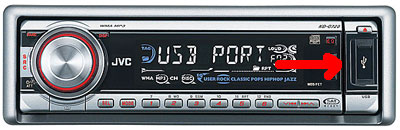
Eric Benderoff (Tech.Buzz/Chicago Tribune.com) loves his JVC KD-G720 car stereo, an aftermarket item into which he can plug (via USB port) an iPod, or a thumb drive filled with MP3 files. The songs play through the car stereo, and he can control the volume and song selection directly through the unit, not the iPod. When his iPod is plugged in, the car stereo charges the music player as it plays. And the song information scrolls across the stereo’s screen, telling him the artist, song name and album title. The thing can also receive satellite radio from XM or Sirius, spin CDs (in WMA and MP3 formats) And play terrestrial radio stations. All for about $200, not including installation.

JVC USB Stereo

This just makes so much more sense than some proprietary, factory-installed hardware. I might have to get me one of these. Yum. [via RAIN]

The radio ads I want to hear

Tod Maffin is looking forward to the day his satellite radio delivers ads he wants to hear:

“So, let’s take this to its natural next step in, say three years. You call up XM or Sirius and activate your radio. Besides asking for your billing address, they also seek out some basic demographic information. How old are you? What are your interests? Suddenly, your radio begins playing ads that are aimed at you and people like you. With my demographic profile in hand, the satellite service could have screened those (crappy spam-like ads) out and sent me ads specific to my interests.”

I sort of dread going through some long “check the products and services you’re interested in” procedure, but you’d only have to do it once and then keep it updated. Then, maybe once a month, they send me a link to a web page where I see a list of all the advertisers that hit my reciever in the past 30 days. I remove any that I don’t like. Sort like signing up for Netflix. Or, maybe they just have a bot crawl this blog and figure out what I care about.