

Category Archives: Media & Culture
Sikeston man on America’s Got Talent
It’s always fun to showcase talent from “down home.” Neal E. Boyd is from Sikeston which is just up the road (from Kennett, MO) in Sikeston, where he’s an insurance salesman.
He’s also a competitor on America’s Got Talent, the show I’ve (never watched) but always thought of as the poor man’s American Idol. Neal sings opera. And from our Small World File, Neal attended choir camp at Arkansas State University under the direction of my old friend Viretta and he sang at the Christmas Eve service of the Presbyterian Church in Kennett a couple of years back. A gig made famous by frequent appearances by Sheryl Crow.
The Future Radio Morning Show
It isn’t simply streaming your current morning show. Or putting it online for download. Jerry Del Colliano lays it out — in ten easy steps — on his blog (invitation only). #1 gives you the setup and #7 and #8 my favorites.
1. Start ten morning shows (other than the one that is airing on your terrestrial station). The content should aim at one demographic that is desirable to sell. Example: women 25-54. Ten shows that don’t air on the radio.
7. Hire the right person(s) to host this 45-minute show – not, I repeat, not anyone from your airstaff. Podcasting is not to be confused with broadcasting. You may be a professional broadcaster but it is not in your best interest to make these podcasts son of what is already on your air. Give the host a piece of the show and lock him or her into it for the long term. As it develops it will be a moneymaker for you and for your talent.
8. Do not include traditional spots in the podcast. Commercials have seen there better days. Young people don’t listen – but consider the “live read” approach that goes over very well with young people. If they are hooked on a podcast then they will listen to a “live read” by the host(s) if it is sincere and keeping with the overall approach of the show.
Mr. Del Colliano concludes his post with a bit of insight into Generation Y:
(Gen Y) went through childhood without a love for radio, unlike baby boomers or Gen X. They are attached to their iPods and smart phones – their new radio. If you still want to be in the content business when the last baby boomer passes into The Hall of Fame, learn about the new radio – podcasting.
The “ten morning shows” had me puzzled at first. But I’m guessing you need this many, all aimed at the same demo, to reach the numbers that will be attractive to advertisers. The advertises cares about reaching the demo (Women 25-54 in the example above) and not so much about how many shows he sponsors to reach them, assuming the price makes sense.
So let’s assume we have a 25 minute commute to Jefferson City (from Columbia or Loose Creek). Would I be willing to produce five, 25-min podcasts a week for a piece of the show? I would if Mr. Del Colliano was managing the station.
“When was the last time you saw a dead American soldier on TV?”
 I was talking with a co-worker about Lara Logan’s (CBS Chief Foreign Correspondent) recent appearance on The Daily Show. She posed the question, “When was the last time you saw a dead American soldier on TV?” She was making the point that media in the U. S. has been MIA on the war in Iraq (except for that victorious march into Baghdad).
My co-worker’s take was: “The only reason to show a dead American soldier would be to turn someone against the war.”
Or maybe that war is news and death is part of the story?
Actually, I didn’t have a response. I can understand that view coming from W or Rumsfeld (back in the day). But how many citizens feel the same? How many would rather not to see the bloody reality of war on their TV screens?
By this logic, we also shouldn’t be seeing the critically wounded at Walter Reed. Or can we translate missing limbs to a “don’t-let-their-sacrifices-be-in-vain” message?
So I’m asking myself why we saw more dead troops during the Viet Nam war, and it came to me. We had lots of reporters on the front lines in that war. But not so many on the mean streets of Baghdad.
In the old days, you could make a career filing reports from the front lines. Sure, you could shot, but you weren’t likely to wind up the star of a YouTube beheading video.
Naw, American journalism took a pass on this war. Better to let the Brits cover this one.
Radio for the blind and print-disabled
Reply
The Kansas Audio-Reader Network is “a reading and information service for blind, visually impaired, and print disabled individuals in Kansas and western Missouri. Services are offered free of charge to anyone in our listening area who is unable to read normal printed material.”
AUDIO: Excerpt from audio-reader network 6 min MP3
This would seem to be an invaluable service for those who cannot read a newspaper. I wonder what impact, if any, the Internet is having on services like this. I understand that not everyone has a computer and access to the web but that number is shrinking daily.
I assume the blind or visually impaired can have the text on any web page translated to spoken audio. While this would give the user more control over the information she consumes, it might be more… entertaining? …to have a human read it aloud. Or why not have both.
Already missing Tim Russert (and my dad)
And I’m not sure why. I didn’t “know” the man but, like many of his faithful viewers, felt as though I did. NBC devoted the full half-hour of the evening newscast to memories of Tim (“Mr. Russert” doesn’t feel right).
Maybe it’s my new-found interest in politics… or Father’s Day rolling around again… but I’m reminded of my pop, who died six years ago.
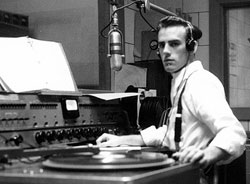
Dad was not the “family man” Tim Russert was reported to be. At least not demonstrably so. But he had his passions and radio was one of them. One I shared.
So, in memory of Tim Russert –and my dad– I share this interview I did with my dad shortly before he retired from radio.
What is it with the Apple logo on TV?
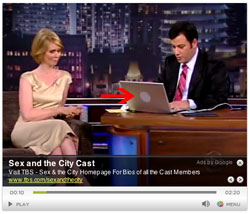
"Sex and the City’s" Miranda, Cynthia Nixon, sat down with Jimmy Kimmel on Wednesday night to promote her blockbuster chick flick. Jimmy brought out his laptop partway through the interview for an online multiple choice quiz, which decides which of the four main SATC characters the taker is most like."
I started noticing this after I turned in to a Mac fanboy. What’s the big deal about masking the Apple logo? I guess they’d mask any recognizable brand logo. The difference is how distinctive the MacBook is. But maybe that’s true only of Mac fans. To everyone else, it’s just a laptop.
So here’s today’s assignment: Name another product that is equally recognizable (without seeing the brand logo). Begin.
Microsoft’s Ballmer on future of media?
“In the next 10 years, the whole world of media, communications and advertising are going to be turned upside down — my opinion. Here are the premises I have. Number one, there will be no media consumption left in 10 years that is not delivered over an IP network. There will be no newspapers, no magazines that are delivered in paper form. Everything gets delivered in an electronic form.”
PageCast: Short, sweet and real
There are just so many things I like about The PageCast, I’m not sure where to begin. First, what is The PageCast.
It’s a 60 second video by Time Magazine’s Mark Halperin, previewing the three stories that he thinks you should be watching for today. You’ll find it on the top/right of The Page. Big whoop, right? Okay, here’s some of the things I like about this simple idea (and this particular PageCast):
- It maximizes the reach of a popular, plugged-in political reporter.
- It’s short. One minute. Easy to watch, easy to produce.
- It’s real. Or at least it appears real. Today’s PageCast was recorded in what appears to be Mr. Halperin’s hotel room in South Dakota (prior to Tuesday’s primary). And he obviously just came from the gym or a run. (Note to TV and Hollywood directors: THIS is what real sweat looks like. Not the little spritz you put under your star’s arms and on his chest. Save this image for future reference). And Mark hasn’t shaved yet. The guy looks like we all do on a Sunday morning.
- Zero production. If I had to guess, I’d say he recorded this with his Mac Book sitting on the hotel desk. Probably in one take. He emails the file to some web monkey who uploads to The Page and it’s done. No crew, no director, no editing.
The news directors of our radio networks would be great at this. And their listeners/readers/viewers would eat it up.
UPDATE: My buddy Kay reports that Mark Halperin records PageCast between 7-9 a.m. (usually), wherever he happens to be and in whatever he happens to be wearing. If he’s on the West Coast, he usually records them at night. He thinks of what he wants to say just before he begins recording (or in the shower or at the gym), on his MacBook Pro (edits with iMovie).
The idea was prompted by the desire to put video on The Page, while keeping it easy to produce and watch. Just as I suspected. Simple idea, well executed.
Next generation radio
Jerry Del Colliano shares a few ideas on “next generation radio” he’ll be presenting to an interactive session for radio executives next month:
“My view is that terrestrial radio is now a destination entertainment medium for available listeners – older members of Gen X and the baby boomers.”
“…there is no need to produce 24/7 programming online. … But the radio station of the future may only provide three hours of programming a day – that’s right, a day – and deliver it on a cell phone or mobile device.
“Podcasting will be the new radio for Gen Y.”
“The successful content provider in the future will have to unlock the genius of Steve Jobs in understanding a generation they are not in – and Jobs, arguably, knows Gen Y better than they know themselves.”
“In the past, a radio station had to be on-air, all the time and doing the same format over and over again. But in the future, new media will require radio broadcasters who want to play in this arena to be many things for which it does not presently have skills.”
If you’re interested in where radio might be headed, I encourage you to read the full post. Companies that provide programming to radio stations — like our company– are sure to be affected by the same forces. Are we ready?