
Category Archives: Media & Culture
Ghost Studios
When I got my first (and only) radio job in 1972, our FM station was mostly automated but the AM station was live from sign-on to sign-off. An "announcer" (or DJ if you prefer) was sitting at a control board, cuing up and "spinning" records, talking live into the microphone. It was the most fun I ever had and I'm grateful I didn't miss the opportunity.
This morning I'm wondering if there are still radio stations that operate this way. With 13,000+ stations, you'd think there would be at least one. Some hard-headed eccentric that just refuses to automate and cut staff.
If you know of such a station, leave us a comment.
Radio Rapture
Jerry Del Colliano (Inside Music Media) on yesterday’s firing of 590 people by Clear Channel Communications and why radio “consolidation” turned into such a bad thing:
“I’m sorry that these virtual monopolies didn’t work, but the reason they failed is because their arrogant CEOs ran up the debt to buy stations at prices that were, frankly, never really worth what sellers pumped them up to. Now they can’t service that debt and even though they could probably survive an economic downturn (radio always used to in past recessions), the debt they ran up during the consolidation years is killing them.”
I think I might have run out of anything more to say about the challenges facing radio.
In my radio fantasy, everyone working in radio today is raptured up to heaven, leaving thousands of empty stations with the transmitters still on and records “chick” “chick” “chick’ing” on the still spinning-turntables. (Okay, I know they don’t use turntables anymore but it’s my fantasy.)
Listeners tip toe down deserted hallways, peeking into empty studios, wondering where Rush went.
Eventually, someone sits down at the microphone and figures out how to turn it on. What do they say? What would radio become? Would they hastily call a sales meeting and begin selling ads? Would they assemble a focus group and put together a tight playlist?
I have no idea. Maybe they’d just stick their ear buds in slip out quietly, locking the door behind them.
“Homeless American”
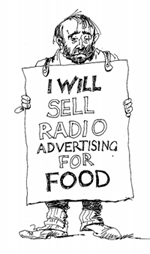 On the way home from the airport yesterday I gave some money to a man sitting at an intersection. I don’t usually do that and I’m not sure why I did this time. But I think it was something about the sign he was holding. It read simply: “Homeless American.”
Now, I don’t know if he was homeless (he looked the part) or American, but something about the sign spoke to me. The simplicity? Maybe. For the rest of my trip I thought about the signs used by… beggars? Too Third World. Panhandlers? Let’s go with that.
How important is the sign? Without it, I might have thought he was just looking for a ride, so I think the sign is a must. Usually brown cardboard and almost always lettered with black marker.
But most important of all would seem to be what your sign says. Haven’t seen “will work for food” for a while (Sounds a little too much like a negotiation.) Can’t be too long if you’re working an intersection or even busy pedestrians.
Is there some secret list of Great Signs That Work Every Time? I’m thinking it ain’t on line so they must move it from hand to hand.
Some would insist the guy I saw —and those like him— are lazy and could get a job if they wanted one. I’m not so sure.
Zombie Jobs
“Real creative urges, those we are meant to express, don’t go away. If ignored, they bother us, affect our health, fester and eventually turn us into the living dead.”
— from Pamela Slim’s piece in NYT
Radio needs to escape radio
“Society needs the comfort of our favorite songs. We need the real-time connection to our community (however we define “community”). We need to know what to wear today and whether or not school is canceled. We need to stay up to date or to revel in our past. We need to be outraged and informed and soothed and amused. We need to be told what to do in a crisis. We need to know what’s on sale and where. And we need these things wherever we are – at home, at work, in the car, and on our hip. As an industry, radio needs to recognize that its social currency is in what it provides, not in the manner it provides it.”
— Mark Ramsey
When listening was enough
Reply
“I am terribly tired of broadcasters ranting about how many folks listen to the radio. I get it. Everybody listens to the radio. That’s not the issue. The issue is why – or if – that matters to your clients. The issue is how that usage translates directly into ROI.”
— Mark Ramsey
Hometown Radio
A long-time radio pal shared this item from AllAccess:
DELMARVA BROADCASTING adds an FM partner for Talk WICO-A/ SALISBURY- OCEAN CITY, MD, flipping WXMD (MAX FM)/POCOMOKE CITY, MD to Talk as WICO-FM and installing separate programming from the AM side. The WICO-FM calls move from 97.5, which changes to WKTT, but retains its Country format and CAT COUNTRY slogan.
After a 5-6a simulcast of “AMERICA IN THE MORNING,” the FM carries syndicated QUINN AND ROSE, PREMIERE’s GLENN BECK and RUSH LIMBAUGH, TALK RADIO NETWORK’s JERRY DOYLE, MICHAEL SAVAGE, and RUSTY HUMPHRIES, and then simulcasts WESTWOOD ONE’s JIM BOHANNON and PREMIERE’s “COAST TO COAST AM” with GEORGE NOORY. Weekends feature music programming.
The AM side is carrying DIAL GLOBAL’s MICHAEL SMERCONISH, TRN’s LAURA INGRAHAM, DIAL GLOBAL’s NEAL BOORTZ, syndicated DAVE RAMSEY, DIAL GLOBAL’s CLARK HOWARD and TRN’s MICHAEL SAVAGE. Weekends include “best ofs” from LIMBAUGH, HOWARD and BOORTZ along with the syndicated KIM KOMANDO, CIGAR DAVE, TAMMY BRUCE, and CAR AND DRIVER shows.
My pal estimates that four major network syndicators provide 95% of programming on 80% of all talk stations in the country. Just a guess, he says, but not far off.
“To follow or not to follow? How do you decide?”
Here's how Phil Johnson, writing in Advertising Age, decides:
"When somebody new crosses my path, I take a look at their last 10 tweets and ask myself three sets of questions:
- Can I learn something from this person? Does he connect me with information that I would never find on my own?
- Is she original? Does she have a distinct voice and make interesting observations about the world and business?
- If I'm not getting a clear answer, I ask the ultimate question, "Would I drink with him?"
If I know the person, there's a good chance I'll follow them. If I don't, I'll look at their profile and check out a website if they provide a link. If they're "following" hundreds of people, I figure they're just trying to pump up their numbers and I block them.
When I hear someone sneer, "I don't care about what someone had for breakfast," as a way of dismissing something about which they are clearly ignorant… I immediately think: I don't remember the last time I saw a tweet like that. Why would I follow someone with so little to say? No, this is just an easy rationale for learning something new.
New series from creator of The Wire
David Simon –creator of The Wire and Generation Kill– is currently shooting a pilot for Treme, his proposed new series about musicians in post-Katrina New Orleans.
“It will feature at least two veterans of his earlier work: Clarke Peters, who played Lester Freamon in The Wire, and Wendell Pierce, who played Bunk Moreland. If commissioned by HBO, Simon promises, Treme will remain true to the philosophy he pungently encapsulates in the phrase “Fuck the average viewer”. His shows, he explains, reject the conventional TV wisdom that everything must be explained upfront, instead demanding intense concentration from viewers, who must grapple with an unfamiliar world. Rather than writing for a general audience, he says: “I want to write for the guy living the event.”
So, are there people who watched and enjoyed The Wire… and were also regular viewers of Extreme Home Makeover?