
Okay, here’s your feel-good moment of the day. A little bit of live magic that could not be faked. And think of how bad this could have been.
Category Archives: Media & Culture
“Why did the world shatter at the touch of a hyperlink?”
Dr. David Weinberger asks (and answers?) the question: “Why did the world shatter at the touch of a hyperlink?”
“Newspapers, encyclopedias, record companies, telephones, politics, education, analytics, scientifics, genetics, libraries, mass media, high culture, television, classrooms, assholism, channels, columns, stations, tours, travel, marketing, picketing, knitting, hectoring, picturing, gossiping, friendship redefined, attention redefined, leadership redefined, defamation redefined, curating, editing, publishing, correcting, crowds, mobs, shopping, bar-hopping, catalogs, sing-alongs, fact-checking, being together, being apart, staying together, moving on. Social forms and major institutions, many set in the Earth on stone foundations, fell down at the flick of a hyperlink.”
This started me thinking about tech changes over the last ten years. Digital cameras; high speed Internet access; social media (blogs, Twitter, Facebook); iTunes; smart phones; Google; Tivo; ebooks and on and on.
And, finally, how has our company changed during the past ten years? Can we list the Ten Biggest Changes? Five? Three? And is that even a relevant question?
Random thoughts on death of OBL
-
He was living in a mansion instead of hiding in the mountains with his Holy Warriors
- He could have taken his own life and had his remains hidden, denying his enemies the “victory” of his capture/death. Why didn’t he?
- If he was “dropped into the sea,” the body was probably weighted. What did they use for this purpose?
- Somewhere there is film of the raid and the disposal of the body
- The screenwriter has been hired
- There are no 72 virgins in Paradise
The end of radio coverage maps?
A radio station coverage map is just what it sounds like: a cirle showing how far your station’s signal reaches. The bigger the circle the better. Now a new BMW option might make coverage maps less important (obsolete?)
Yes, I know, not everyone can afford a BMW but is there any doubt this technology will find its way into every vehicle? Not for moi.
Mark Ramsey sees the car as “a digital lifestyle accessory” and wonders how broadcasters fit into the consumer’s mobile digital lifestyle?
“Maybe it’s with unique and exclusive content. Maybe it’s with digital bells and whistles that make your content sing. It’s not with the same old same old. And no number of debates about FM on mobile phones will solve this problem for you.”
On more than one occasion I’ve wondered what would I do to stay fresh and relevant if I were running a radio station. How might I insure that my station was on that BMW dashboard/iPhone? And I don’t have a good answer. But smarter folks than I are figuring this out.
“The Cultural Imperative For A Social Business”
 That’s the title of a blog post by Maria Ogneva that has been stuck in my head for a week or so. It’s about how businesses and organizations communicate and share information. A topic of discussion in our company recently. Here are a few of my take-away’s from Maria’s post:
“Transparency and openness require the braveness of “opening up the kimono”, not when convenient, but all the time. It involves letting people know what’s happening and why, with advance notice, providing a channel to share feedback, and closing the feedback loop – in the open.”
I give us a B- on that one. We’d like to be there but aren’t quite.
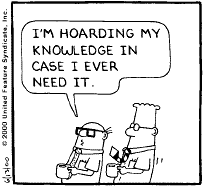
“Knowledge hoarding is replaced by sharing. Traditionally, our educational systems have emphasized becoming a specialist. We have hoarded our knowledge in fear that if we shared what we knew, we will become more replaceable.”
Ouch. Been guilty of that myself. I suspect we still have pockets but by the very nature of hoarding, it’s difficult to know.
“Command and control mindset: Traditionally, corporations have been structured with tightly managed controls at the top, which were passed down through levels of management, down to the people who actually performed the work. Tasks to be done, as well as the processes by which these tasks had to be done, were mandated from the top.”
The C&C manager often has an “I-know-best-that’s-why-I’m-the-manager” mindset. Takes a lot of self-confidence to break free of this approach. But the command and control style of management be less and less effective in any event:
“Rigid hierarchies: Scarcity of information pre-Internet, combined with specialization, has contributed to knowledge hoarding. At times, this asymmetry of information, and not the right leadership skills, allowed people to rise up the corporate ladder. Hierarchies were developed to preserve this status quo. However, things are changing rapidly, and democratization of information is definitely putting the emphasis back on leadership style, and not access to information, as a competitive advantage.”
This is why I’m all in on the Network and shared information. It’s breaking down these 20th century approaches to business, communication and everything else.
If you manage a company or work at a company, you should take a few minutes to read this insightful post. I’ll let you know how things come out at our company.
Garageband on the iPad
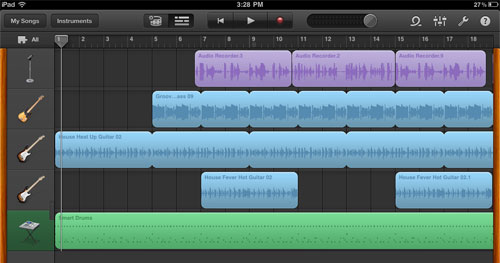
I fiddled around with Garageband when I got my first MacBook but couldn’t really figure out much to do with it. Figured it was just for musicians. Today I tried out the new iPad app and discovered a completely different experience.
First, there’s something about using your fingers that just seemed so much more intuitive than a cursor. And they’ve made the iPad app for people like me who can’t read a note of music or carry a tune.
I’ve only started playing with Garageband so won’t attempt a review, they must be all over YouTube and the Apple website. But here’s my first effort.
The post-anchor era of network news
Reply
“So perhaps when CBS News signed Couric it understood that we had reached the end of the anchor-era better than I give it credit for. Indeed, when ABC News gave Diane Sawyer the keys to its World News telecast in 2009, they were overtly endorsing the CBS News strategy of hiring a middle-aged bottle blond from morning TV to chaperone all the unschooled geezers turning on their sets at night. Putting Couric and Sawyer in the anchor chairs was admitting that the programs had no future, only a past that could continue to be harvested for profits (yes, the evening shows are still profitable, thanks to pharmaceutical ads) until their audiences finally die off.”
–Jack Shafer, Slate
The music of the 2050’s
 My earliest memories of music are from the 50’s. If I described a song as having “a 50’s sound,” you’d probably understand what I meant.
I divide the next decade into Early 60s and Late 60s. The 70’s connote Disco for me. For some reason I don’t have any recollection of the music of the 80’s and 90’s.
So here’s my question for your musicologists out there:
How is that each musical era can sound not only different from the previous era, but from ALL previous eras? Will we have a period that repeats some earlier period?
If not, does this mean that it will get more and more difficult to create a completely fresh sound? How different will music sound to these disturbingly large ears in 30 years?
Man glues hat to his head
There but for the grace of God go I.
A day made of glass
Thanks to Bob Priddy for the link.