Category Archives: Media & Culture
“Homeless American”
On the way home from the airport yesterday I gave some money to a man sitting at an intersection. I don’t usually do that and I’m not sure why I did this time. But I think it was something about the sign he was holding. It read simply: “Homeless American.”
Now, I don’t know if he was homeless (he looked the part) or American, but something about the sign spoke to me. The simplicity? Maybe. For the rest of my trip I thought about the signs used by… beggars? Too Third World. Panhandlers? Let’s go with that.
How important is the sign? Without it, I might have thought he was just looking for a ride, so I think the sign is a must. Usually brown cardboard and almost always lettered with black marker.
But most important of all would seem to be what your sign says. Haven’t seen “will work for food” for a while (Sounds a little too much like a negotiation.) Can’t be too long if you’re working an intersection or even busy pedestrians.
Is there some secret list of Great Signs That Work Every Time? I’m thinking it ain’t on line so they must move it from hand to hand.
Some would insist the guy I saw —and those like him— are lazy and could get a job if they wanted one. I’m not so sure.
Zombie Jobs
“Real creative urges, those we are meant to express, don’t go away. If ignored, they bother us, affect our health, fester and eventually turn us into the living dead.”
— from Pamela Slim’s piece in NYT
Radio needs to escape radio
“Society needs the comfort of our favorite songs. We need the real-time connection to our community (however we define “community”). We need to know what to wear today and whether or not school is canceled. We need to stay up to date or to revel in our past. We need to be outraged and informed and soothed and amused. We need to be told what to do in a crisis. We need to know what’s on sale and where. And we need these things wherever we are – at home, at work, in the car, and on our hip. As an industry, radio needs to recognize that its social currency is in what it provides, not in the manner it provides it.”
— Mark Ramsey
“To follow or not to follow? How do you decide?”
Here's how Phil Johnson, writing in Advertising Age, decides:
"When somebody new crosses my path, I take a look at their last 10 tweets and ask myself three sets of questions:
- Can I learn something from this person? Does he connect me with information that I would never find on my own?
- Is she original? Does she have a distinct voice and make interesting observations about the world and business?
- If I'm not getting a clear answer, I ask the ultimate question, "Would I drink with him?"
If I know the person, there's a good chance I'll follow them. If I don't, I'll look at their profile and check out a website if they provide a link. If they're "following" hundreds of people, I figure they're just trying to pump up their numbers and I block them.
When I hear someone sneer, "I don't care about what someone had for breakfast," as a way of dismissing something about which they are clearly ignorant… I immediately think: I don't remember the last time I saw a tweet like that. Why would I follow someone with so little to say? No, this is just an easy rationale for learning something new.
New series from creator of The Wire
David Simon –creator of The Wire and Generation Kill– is currently shooting a pilot for Treme, his proposed new series about musicians in post-Katrina New Orleans.
“It will feature at least two veterans of his earlier work: Clarke Peters, who played Lester Freamon in The Wire, and Wendell Pierce, who played Bunk Moreland. If commissioned by HBO, Simon promises, Treme will remain true to the philosophy he pungently encapsulates in the phrase “Fuck the average viewer”. His shows, he explains, reject the conventional TV wisdom that everything must be explained upfront, instead demanding intense concentration from viewers, who must grapple with an unfamiliar world. Rather than writing for a general audience, he says: “I want to write for the guy living the event.”
So, are there people who watched and enjoyed The Wire… and were also regular viewers of Extreme Home Makeover?
Newspaper on home computer (1981)
1981 KRON-TV report on experiment that allows you to get a San Francisco newspaper on your home computer.
I love this video. It was just a few years later (1984) that I got my first computer. It seems like a lifetime ago. Or a week.
“If we don’t teach our children about Barney Fife and Jack Tripper, who will?”
“Every day, 350,00 babies are born at risk of not knowing that Bob Barker was the host of The Price is Right. Pop Literate is dedicated to doing something about that.
This is a place for you to find parenting tools you need to turn out healthy, well-adjusted children. Children who won’t be shunned by their peers because they believe David Copperfield is only a Charles Dickens character.”
The blog died long ago, alas. A good idea.
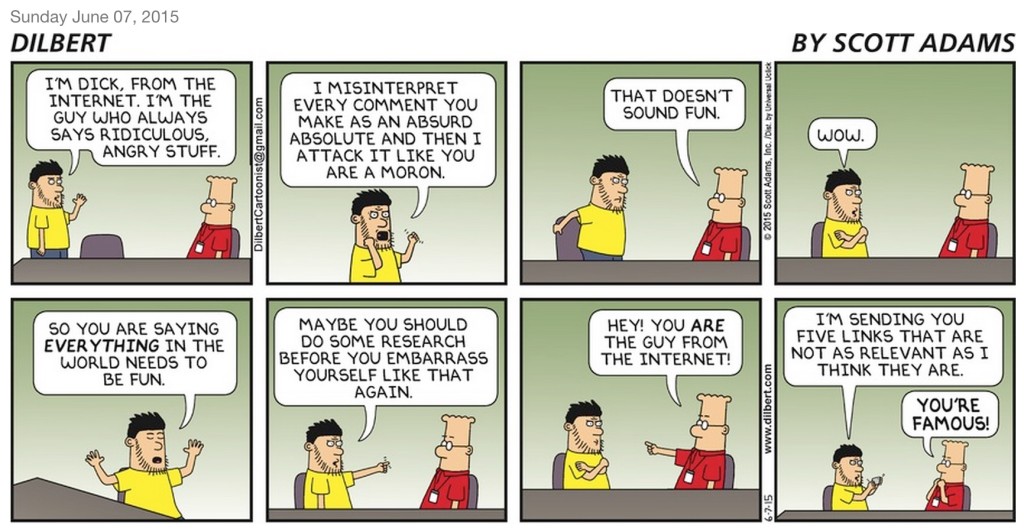
Everybody is on Facebook
“For a long while—from about the late ’80s to the late-middle ’90s, Wall Street to Jerry Maguire—carrying a mobile phone seemed like a haughty affectation. But as more people got phones, they became more useful for everyone—and then one day enough people had cell phones that everyone began to assume that you did, too. Your friends stopped prearranging where they would meet up on Saturday night because it was assumed that everyone would call from wherever they were to find out what was going on. From that moment on, it became an affectation not to carry a mobile phone; they’d grown so deeply entwined with modern life that the only reason to be without one was to make a statement by abstaining. Facebook is now at that same point—whether or not you intend it, you’re saying something by staying away.”
— Slate
Does size (of your audience) matter or not?
“What we are going to witness in 2009 is the diminished importance of how large your (radio) audience is and the increasing importance of how effectively you connect that audience, whatever its size, with the advertisers and marketers who have the goods and services that audience craves.” — Mark Ramsey Hear 2.0
For some reason this made me think of Apple. I don’t think I’ve ever heard an Apple or Mac or iPod spot on the radio. Lots on TV, of course. And Apple sales are through the roof. I’m trying to think of how I am “connected” with Apple products and how that came to be.
I’m just trying to think of ways radio stations can make –or are making– the connections Mr. Ramsey describes. And what does this trend mean for radio networks?