A YouTube playlist featuring oral history of KBOA, Kennett, MO. All of these are available as MP3 files at www.KBOA830.com.
Category Archives: Media & Culture
How the Internet Will Save the World
Dr. David Eagleman gives lecture titled How the Internet Will Save the World: Six Easy Steps to Avert the Collapse of Civilizations. Rome, the Mayans… lots of great civilizations assumed they would go on forever. Just as we do. Eagleman shows you this is not necessarily the case.
Radio’s Salvation?
“Television is the last protected media business,” but it’s going to get disrupted. For one, once televisions are computers, analytics of who watches will get more accurate than Nielsen panels. “Everyone knows that if we go to actual measurement, ad rates will collapse because the numbers aren’t as good as Nielsen makes them look.”
Social media immortality
P. O. Box: Fighting spam
Reply
 I rented a post office box this week. The smallest size. Costs $42 a year. The post office is just a couple of blocks from The Coffee Zone, my morning hang-out. My plan is to check the box on Saturday mornings. If someone needs to reach me more often, there’s email.
“Home delivery” for us has been a box at the entry to where we live. Every night Barb brings up all the cataloges and 3rd class junk mail that cannot be stopped. Nine of ten pieces go into the trash. Nothing –absolutely nothing– needs to be delivered every day.
So I pursaded Barb to let me rent a PO Box.
The USPS will forward 1st class mail to the box but not the junk (“You’ll want to let them know your new address,” reminded the carrier.) Uh huh.
I’m unclear if all of the 3rd class spam will find me. I assume it will. The spammers just pay USPS for sticking some shit in my box. I got the smallest box in an effort to make it harder for them. If the piece is too large, they leave me a note and I can pick it up at the front desk. Right.
I don’t feel like I am giving up any convenience and I will have at least the illusion of some control.
Ultra Realistic Dental Training Robot
The End of Demographics
In small market radio we were thrilled to have research that told us how many men listened to our station compared to how many women. And, of course, the demos: 12+, 18-24, 35-54… I think I missed one but that’s not the point. From 8 or 10 “diaries” in a county we were supposed to extrapolate useful information for out programmers and advertisers. Uh huh.
This article illustrates how much things are changing.
“The rise of mass-produced consumer goods also brought the rise of mass-market advertising. In the 1950s and 1960s, the goal of television was to aggregate the most possible eyeballs for advertisers. In order to convince consumers that an advertising message was relevant to them, consumers had to buy the idea that they were just like everyone else. The year that someone was born will not tell you how likely he is to buy your product.”
“Threads of advertising-sponsored content”
“Advertising is becoming content, not message. Or, more specifically, the message is knit into the content. Under that scenario there is no 30-second spot per se, there are simply threads of advertising-sponsored content.
Creating “content that people choose to watch (and share)” (and listen to) is the job of every company that calls itself “media.” This goes to the heart of radio’s revenue model because it is clearly out of step with the direction of clients and their agencies.
This is why the structure of so much of radio is outdated. We have sellers who move spots and programmers who mix music. What we need amongst these are content creators who match consumers with clients in the presence of our brands by bringing compelling ideas to life.”
— Mark Ramsey Media
Your business card a billboard for your brand
“In my universe a powerful brand should be able to explain their mission in a single paragraph–the fewer words, the better. But what most brands forget is that their business card is indeed their ‘napkin,’ a blank canvas enabling them to communicate the essence of their brand (or fail to do so).
We live in a super-cluttered world where no one has time for anything. We’re bombarded with text messages, TV commercials, billboards and online ads, and so companies need to know what they stand for. It’s a fact that you cannot remember more than three television commercials in a row, let alone recall the design of your average business card unless they manage to rise above the cacophony and stand out in a way that’s completely relevant.”
nd.
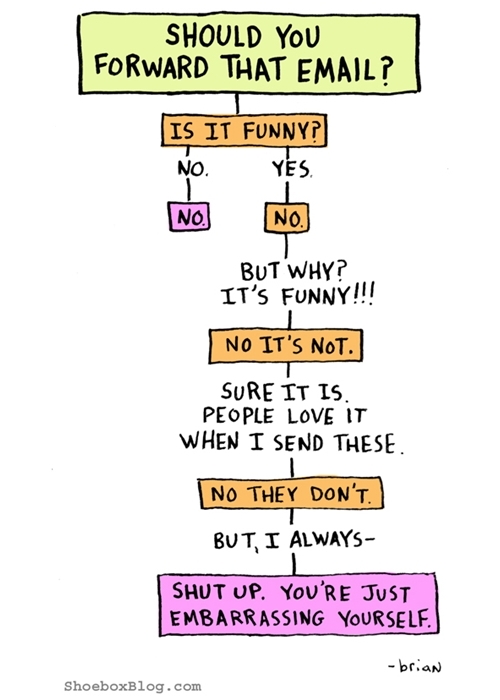
Should you forward that email?