It was 28 years ago, most likely the spring of 1996, when I was plundering around our newly obtain Apple Power Macintosh 9600 in my tiny office at the center of Learfield Communications, the operator of Radio Iowa, the Missourinet, and numerous collegiate sports radio networks based in Jefferson City, Missouri. My little company, Echo Communications and jointly formed a partnership with the regional radio giant called Straylight and we had set about to build websites and streaming audio programming around Learfield’s properties using the recently invented Progressive Networks Real Audio player, later dubbed simply Real Audio.
The room, probably not more than about 10′ x 10′, had a rack of low-end Compaq desktop computers in one corner, a high-end Compaq Proliant Server running Windows NT 4.0, and my desk in the other. On my desk was this beautiful new machinery from Apple Computers, the last of its generation it turned out that I had first seen Steve Jobs announce in person at the Moscone Center only a few years before to a crowded room full of hypnotized zealots. I was one of those zealots.
This PowerMac on my desk was the crown jewel of our little high tech setup, as we had outfitted it with a special graphics card that had to be purchased separately (a first for a Mac). I had waited for the graphics card for weeks; without it the computer was useless and could not even show a boot screen. But properly configured with the card and a beautiful 17″ Sony Triniton monitor and the latest version of Adobe Photoshop, it was truly a bicycle of the mind. With this machine and some rudimentary HTML skills, we created the marvels of the New Media age: websites.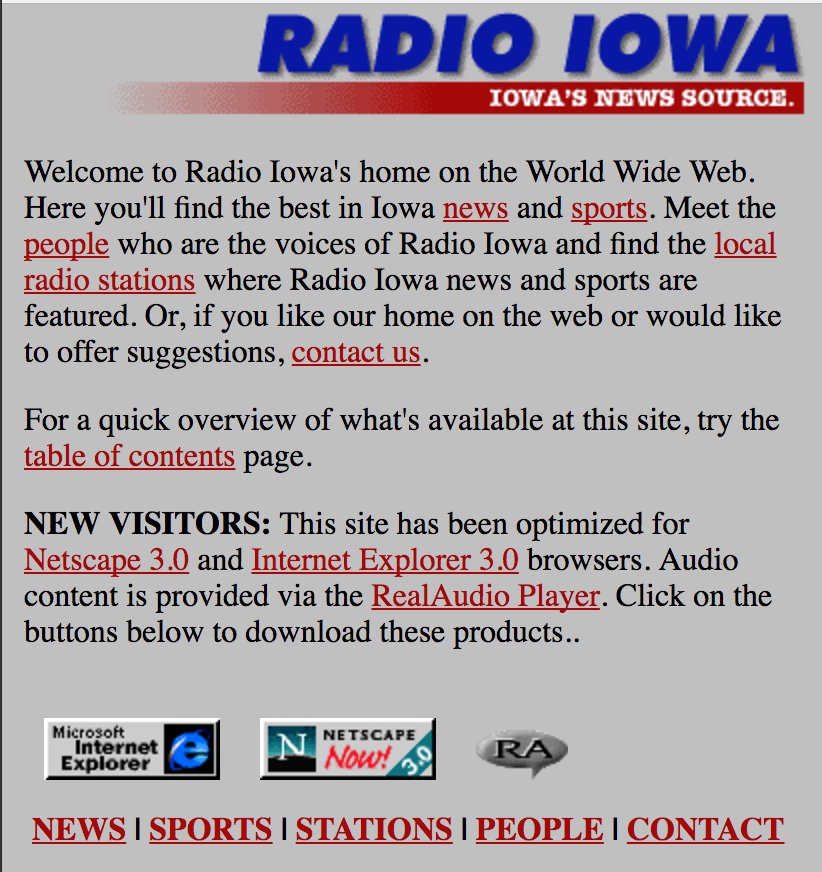
What was special about the websites that we produced with Learfield’s award winning news and sports programming content is that ours had something that almost no other had: live streaming audio. Through our partnership with Learfield, we wired in audio feeds from our satellite connections just on the other side of the wall where I was hacking out the little Netscape and Internet Explorer buttons that told our visitors which browsers our pages could best be “surfed” on.
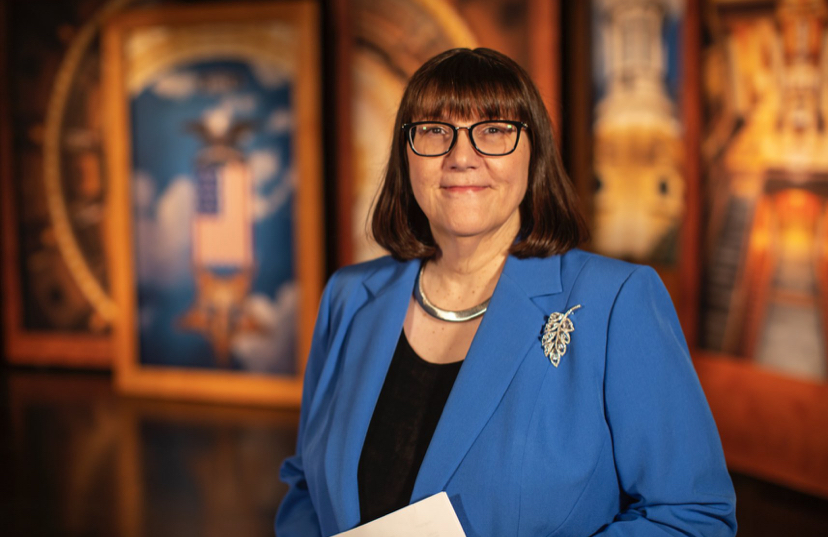
We had built RadioIowa.com as a place to feature the award-winning news programming created under the leadership of O. Kay Henderson, whom we just called Kay. I had had the pleasure of meeting Kay and her team of journalists at their offices in Des Moines. We were already publishing her stories on the website and we had been able to use our new Real Audio technology to include features from the recent Iowa Caucuses.
While I can’t remember exactly which website project I was working on that day — I had driven to Jefferson City from Columbia where I was still a Computer Science student at the University of Missouri — I will never forget the day or the precise moment when O. Kay Henderson and I made history.
I think actually from a news perspective it was a pretty routine day. Apparently — I knew little of these things at the time — President Clinton had signed a very significant piece of agricultural legislation known as the Freedom to Farm Act which was a big shift in how farmers would receive subsidies from the U.S. Government. Big news in Iowa and for the nation, but for me, I was completely clueless.
But as a 23 year old who had experienced the Presidential Election of 1992, the appearances of then Governor Clinton on Arsenio Hall Show, the live saxophone performances and the momentous energy among his supporters, I knew something of Mr. Bill Clinton.
When I picked up the phone, it was Kay asking me in an excited voice, “Allen, can you put the President live on the Internet right now? I’ve got him on the line. He’s just become the first president to digitally sign legislation. We can make him the first President live streamed on the web.”
I was speechless, nervous, and nearly fell out of my chair. “Of coursee! Give me two minutes.” (In radio, you have about 10 seconds before the moment has passed.)
I fired up the Real Audio service and hoped that our T-1 connection would not be giving us any problems today. We needed that ultra-high bandwidth connection (it cost us a few thousand dollars a month to lease the line) to support up to 100 (one hundred!) live listeners at the time.
Of course I had no time to get the word out that we would be live streaming. No Google existed. No social media.
The radio listeners wouldn’t know we were online and they would already be hearing the interview anyways.
But we DID IT! “Mr. President, can you hear me?” Yes I heard him say. Then I muted and Kay did her magic, as she had done with Mr. Clinton many times before and as she would continue to do with other powerful leaders the rest of her career.
I never streamed a President again after that. I did stream Margaret Thatcher as she spoke on the anniversary of Winston Churchill’s speak in Fulton, Missouri in the website we built called “Words On the War”.
But I’ll never forget that day we put the President online. A blip for him and perhaps not even a memory for Kay, but it’s etched in my mind forever.
— Allen Hammock, July 4, 2024
More on Learfield’s online adventures: Learfield and the Internet (1995-2005)