
Everyman Journalism

In a recent interview by Rocketboom, Dave Winer talked about making an introductory course in journalism a requirement for college students.

“Journalism is the new practice for Everyman, it’s what we all will be doing all the time in this new century. As the professional media pulls back, the citizens, you and me, need to fill in and replace every pro with 100 of us, to cover every school board meeting, every planning commission, defense contractor, civic organization. It’s like the Second Amendment for information and ideas. We need a well-informed electorate to make the tough decisions n our future.”

I’m not sure why professional meda would “pull back,” but I like this idea and see no reason why those of us that didn’t go to J-School can’t help cover some events that would otherwise go unreported. During my dozen years at KBOA, I covered every kind of event. Took my little cassette recorder, interviewed folks. Edited the audio. Wrote a little story. Put it on the radio. Could my reports have been more “professional.” Sure. But the listeners to our little station were just happy someone covered the event and reported it.

For my money, we could drop the Algebra requirement and replace it with Journalism 101.
Website as newsroom apendage

Based on this memo, Miami Herald editor Tom Fieldler understands it is nut-cutting time in the news business:

“We are beyond being satisfied with incremental change and giving polite head nods toward other media platforms. We are going to execute fundamental restructuring to support that pledge. Every job in the newsroom — EVERY JOB — is going to be redefined to include a web responsibility and, if appropriate, radio. For news gatherers, this means posting everything we can as soon as we can. It means using the web site to its fullest potential for text, audio and video. We’ll come to appreciate that MiamiHerald.com is not an appendage of the newsroom; it’s a fundamental product of the newsroom. No more will some people be strictly newspaper staff and others will be strictly on-line or multi-media staff. If you produce news, you’ll be expected to produce it as effectively for the electronic reader or listener as you would for the newspaper reader. If you edit or design for the newspaper, you’ll learn to edit and design for the web site.”

Looking (from the outside) at our newsrooms in this regard, I would rank us at 5 or maybe 6 (out of 10). No higher. Reading Fiedler’s memo, it sounds like he sees no reason the Miami Herald can’t do “radio.” For us to ignore that challenge, we have to believe there is something so magical about what we do, that nobody else can do it as well. I don’t know. [Via BuzzMachine via Onsquared]

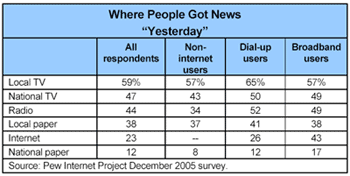
Where did you get the news yesterday?

Pew_news

Interesting answers to that question in the latest PEW study (PDF). For those of us with broadband, 49% got yesterday’s news from the radio…while 43% got it from the Internet. Will there come a time when more people get the news from the Internet than radio? If so, what does that mean for News/Talk radio? What does that mean for regional news networks like ours? [via Radio Marketing Nexus]

Working on our news moves

Scott Rosenberg recounts how he got the news that the next version of Windows will be delayed, and what that might mean for people in the news business:

As tech news goes today, so ultimately will go the rest of the news. It’s not the death of newspapers or pro journalism, but it’s further evidence that the pros face an extremely tough challenge: they’re rarely going to be first, so they’d damn well better be good. But it’s hard to hire enough good people to be good at everything; a newsroom has only so many seats, and the Web’s supply of amateur experts, anonymous insiders and random kibitzers with an occasional insight is limitless. The pros had better prepare to be outgunned.

This competition will force journalists to stop being lazy and to find and reconnect with what is unique about their work, now that so much of what they used to do is being done for free, and often well, by amateurs.

BatteredIf I had the time (and the nerve), it might be interesting to look at every story one of our networks did for the past 30 days. Put a check-mark beside every story that was “original”…that we didn’t get from an affiliate, a news releases, or from some other source.

The next question might be: Did we do this story any differently or better than the other news organizations that covered it? Like the man said, we’re rarely going to be first, so we damn well better be good. [via Scripting News]

Seven in 10 watching TV news?

That’s one of the findings in a new Harris Poll of about 3,000 U.S. adults.

While broadcast television news appears to be the most popular medium sought, many adults also get their news several times a week or daily by going online to get news (64%), reading a local daily newspaper (63%), listening to radio news broadcasts (54%), listening to talk radio stations (37%), listening to satellite news programming (19%), and reading a national newspaper (18%).

Update: Table on Media Usage from Radio Business Report. The most disturbing stat? Radio news tied with online in the 59+ group. Shudder.

Media Usage