What IS the best tool for the job?

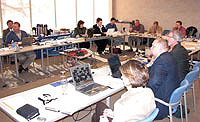
ReportersA bunch of ag reporters (including one of ours) are at a media event in Johnston, Iowa (near Des Moines), hosted by Pioneer (big ag company). Not sure how many of the reporters were blogging the event but a couple for sure. As I watched the blogs I started wondering, what is the “best” medium for covering an event like this.

While highly unlikely that a broadcast station (radio or TV) or network would cover a day-long event live…would that, in fact, be better coverage? Probably the closest thing to being there yourself but unless they put the video/audio online for later, on-demand acess (and did so almost immediately)…you’d have to catch it live or miss it completely. And live broadast coverage (TV or radio) would offer little opportunity for some context and perspective by the reporter covering the event.

Is it even remotely possible that a really well-done blog (with still images, video, audio, RSS feed, etc etc etc) could have advantages over traditonal live coverage of the event? My heart wants to say “no way,” but my head is saying, “maybe.”

I’ve been doing radio for almost 35 years and blogging for just four and this just blows my mind. And I could be missing something here. For example, the print reporter might argue that his/her 1,000 word story in tomorrow’s (or the day after) newspaper/magazine offers greater depth and insight and detail than a few short blog posts. Good point.

A TV guy might point out that his/her well-edited, high quality video package on the evening news is far superior to a few minutes of poorly-lighted video from a camcorder. True enough.

I’m not sure what the technical or content advantages radio has in this scenerio. I’ll get back to you.

This sounds heretical –more blog hype– until you actually watch a first-rate blogger cover an event and compare that to the more traditional media. And in the end, it will be the public that decides where to get the latest/best info.

The Multimedia Reporter

The News-Press in Florida has dedicated two reporters called mobile journalists, or mojos who are equipped with digital cameras, MP3 recorders and wireless laptops. Their job is to find hyper-local stories that don’t get into the newspaper and to train members of the community to file directly to the Web site. [Blogspotting]

Does that sound like a fun job, or what? I wonder what kind of stories we might get if we accepted audio reports from people throughout the states we serve? (That sound you heard was the people in our newsrooms, screaming.) I can’t beleive someone isn’t already doing this. Think Flickr but “news” audio instead of images. Upload MP3 files to a big database, tagging each one (politics, St. Louis, sports, etc). Sure, you’d get a lot of crap but people would sort that out with some kind of “trust” rating system. The better stuff would float to the top…the crap would sink to the bottom.

As a statewide radio network, we sometimes struggle to get news from areas where we have no affiliate. Would it make sense for us to be recruiting and training “citizen reporters?” We have about 60 radio station affiliates in each of the states we serve. And not all of them have full-time reporters. What if we had digital stringers in 600 cities and towns throughout the state? What if we weren’t limited to 4 minute newscasts and 10 second sound bites?

Local radio stations could building this kind of news gathering effort. I remember when newspapers featured “community highlight” columns written by people in the small towns they served. It’s probably still being done.

Okay. I’m tired of thinking about this.

Podcasts, blogs and Dave Barry

According to a piece by C. W. Nevius on SFGate.com, Dave Barry has left the newspaper business. A little more than a year ago, Barry announced that he was taking a sabbatical from his column, and has now decided to make the break permanent. The reason, he stresses, was not that he had a lack of faith in the industry, but that he was ready to move on. Still, he has grave doubts about the future of newspapers.

And the story talks about Barry’s blog and his interest in podcasting. Is this a very funny rat, leaving a sinking ship? I never read Barry’s column in a newspaper but hit his blog frequently. Somehow this seems…significant. [Thanks, David]

Talkin’ bout my g-g-generation

Bonneville International says it is launching a major initiative to recruit new talent to create radio news content that appeals to young listeners. Bonneville says it is out to recruit on-air talent, reporters, producers, production personnel, and website developers for its new initiative.

“The company’s new venture will seek to deliver a product that entertains, provides needed depth that currently might be found only on some public-radio stations, and provides news through the perspective of Generations X and Y,” Bonneville said in a statement.

My old friend Morris (one of the Lost News Boys) sent this along and it appears to have come from the Radio Business Report.

Does “needed depth currently found on some public-radio stations” appeal to those in Gen X and Y? I mean, do you cover different stories? Do you cover the same stories but with some hipper, younger presentation? Is it even possible to lure young web-heads back to the radio for their news?

And what if your best news trick is covering the state legislature and government news? Do we/can we fit into such a format?

J-School head poo-poo’s political blogs

Cub Reporter Bob Hague sends along this link to an interview with James Baughman, head of Journalism/Communications at UW Madison. Bob says what started as a discussion of celebrity journalism spread to political blogs. Baughman thinks they’re going to be great for political geeks, but is pretty pessimistic about new media’s impact on the electorate. [Thanks, Bobby.]