
Could blockchain fix broken Internet?

A day doesn’t pass that I don’t see half a dozen articles about some new use for distributed ledger technology (Blockchain). Some interesting ideas in a short piece from Fortune:

“If we were to design the Internet all over again, it’s a good bet we wouldn’t build what we have today: A giant advertising oligopoly where consumers trade privacy for free services, and which is so insecure that hackers and criminals run wild.”

One idea for ‘fixing’ the Internet comes from a company called Blockstack:

“Blockstack is building a new type of Internet browser using the distributed ledger software known as blockchain. The idea is that people will no longer have to supply log-in information to the likes of Facebook and Google to interact with others on the web. Instead, they’ll keep control of their identity by using blockchain’s authentication features.”

ACT! and Reflex

In the late 80’s I was doing affiliate relations for about 120 radio stations (in Missouri and Iowa). I had a card for each station in a Rolodex on my desk. Using a typewriter, I packed as much information on each card as possible. Station manager, program director, news director, address, phone, fax (few if any email addresses in ’87). By my right knee was a file drawer containing manila file folders for each station. This would contain copies of all correspondence; notes from phone calls and f2f visits. It was a paper world. The portable version of the Rolodex was a page with as much of the info as could be crammed on a sheet of paper. (Columns: City, GM, PD, ND, Address, Phone, Fax, etc)

I had a computer on my desk but I don’t recall when I moved from DOS to Windows. But somewhere in here I was using Borland Reflex, a flat-file database management system for DOS. It was the first commercial PC database to use the mouse and graphics mode, and drag-and-drop capability in the report formatting module.

I used Reflex as a ‘customer relationship management’ program before there was such a thing (that I knew of). I was in heaven. I sorted and searched and generated reports. I used one field for notes (every phone call, letter and in-person visit).

Sometime around 1987 I was visiting Bill Weaver, the GM of KFRU in Columbia, MO, and I must have mentioned my little database. Bill showed me the program he used to manage all of his contacts: ACT! I was smitten! Did all the things I hacked out of Reflex but so much more. I immediately bought a copy and became insufferable to my co-workers.

While attending COMDEX in 1992 (Chicago), I saw what I believe was the first Windows version of ACT! $500 but I had to have it. Bought it on the convention floor.

I lived in ACT! for many years after. Probably well after Outlook took over the company network. Grown men were reduced to tears when they were forced to give up ACT!

Find oldest file in Google Docs/Drive

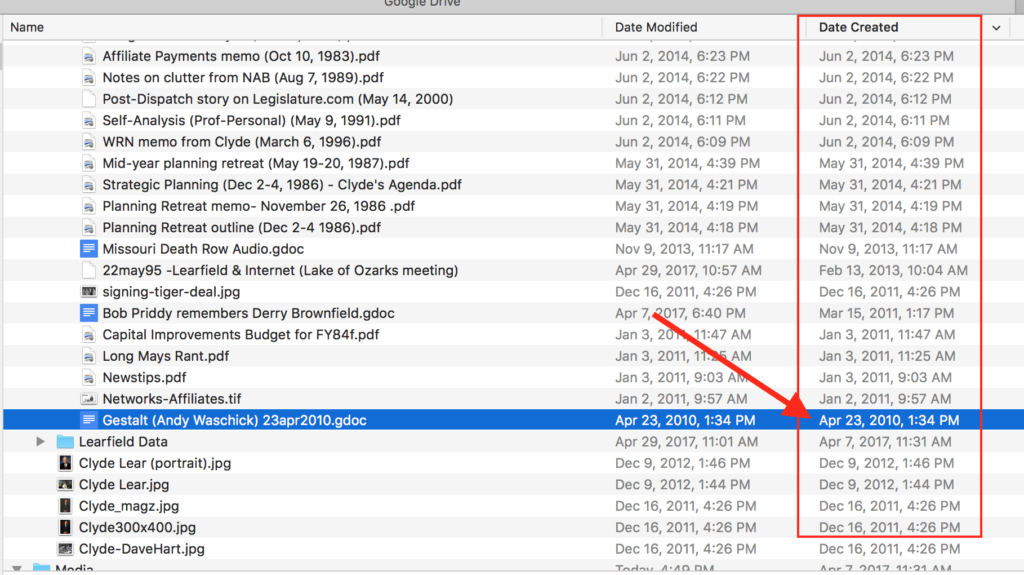
Maybe. This is the only way I could come up with. I have the Google Drive app on my MacBook. It syncs with my account in the cloud so anytime I add a file either place, within a few seconds it’s in both. When I open the app on my MacBook I see fields across the top just as I do in Finder (it might be finder). File name, Date modified, etc. I just added “Date created” and then sorted by that field (newest to oldest). Then I opened each folder, one at a time, and looked for the older file in that folder.
Assuming I’m not overlooking something, the oldest doc I have is from April of 2010. Google Drive launched in February 2007. This would mean I didn’t use Google for the first few years. Can’t imagine why but that’s possible.

Echo Look: Hands-Free Camera and Style Assistant

“Using just your voice, easily take full-length photos and short videos with a hands-free camera that includes built-in LED lighting, depth-sensing camera, and computer vision-based background blur. See yourself from every angle with the companion app. Build a personal lookbook and share your photos. Get a second opinion on which outfit looks best with Style Check, a new service that combines machine learning algorithms with advice from fashion specialists. Over time, these decisions get smarter through your feedback and input from our team of experienced fashion specialists.”

Echo Look from Amazon »

Mastodon

I’ve been hanging out in a new social media neighborhood for the last week or so. It’s called Mastodon and it’s sort of like Twitter that you made in your garage with a glue gun and some Gorilla tape. This article will explain it better than I can.

I created my Twitter account on February 21, 2007 (account #786,471). When I stopped using Twitter last November I was following 176 people and 118 were following me (but I never saw any evidence of that). In those ten years I tweeted 11,565 times. Twitter was where I got most of my news.

But in 2016, nearly every single tweet, from every single user I followed, was politics. A solid fucking year of politics. And while I haven’t been back to my account, I assume that has not changed and will not for the foreseeable future. So I moved on. No idea if I’ll ever go back.

This Mastodon thing is fun and interesting but I’m not sure I can explain why. Where there’s one Twitter, owned and operated by a big corporation… there a thousand (?) Mastodon ‘instances.’ Maybe like 1,000 Twitters that can talk to each other?

I liked Twitter’s 140 character limit but Mastodon’s 500 character posts are growing on me. I’ve always leaned more toward writing something than throwing up one of the annoying goddamned animated GIFs (you an do that on Mastodon, too). There’s a bit of a Wild West feel for now but I suppose that will change.

I’m meeting new people and that’s a breath of fresh air. I’m reading the businesses don’t like it and that is a BIG plus for me. I do not like being “monetized.”

Mastodon is just confusing enough to keep your grandmother from showing up, another plus.