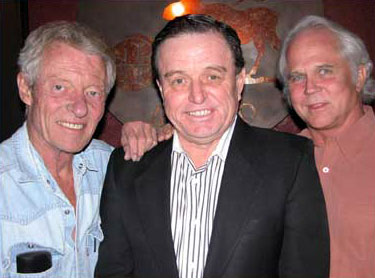
If you don’t know who Eddie Haskell, Wally and Beaver Cleaver are… the photo above is sad but doesn’t make you want to blow your brains out. [Thanks, Lew. Thanks a lot.]

If you don’t know who Eddie Haskell, Wally and Beaver Cleaver are… the photo above is sad but doesn’t make you want to blow your brains out. [Thanks, Lew. Thanks a lot.]
Good Will Hunting is ten years old, but this scene seems as fresh as today’s news:
NSA Guy: The question isn’t… why should you work for the NSA… the question is…why shouldn’t you?
Will Hunting: Why shouldn’t I work for the NSA? That’s a tough one. But I’ll take a shot.
Say I’m working at the NSA and somebody puts a code on my desk. Something no one else can break. Maybe I take a shot at it and maybe I break it.
I’m real happy with myself because I did my job well. But maybe that code was the location of some rebel army in North Africa or the Middle East and once they had that location they bomb the village where the rebels are hiding… fifteen hundred people that I never met, never had no problem with get killed.
Now the politicians are saying, oh, send in the Marines to secure the area ’cause they don’t give a damn…it won’t be their kid over there getting shot, just like it wasn’t them when their number got called cause they were off on a tour in the National Guard.
It’ll be some kid from Southie over there taking shrapnel in the ass who comes back to find that the plant he used to work at got exported to the country he just got back from and the guy who put the shrapnel in his ass got his old job ’cause they’ll work for fifteen cents a day and no bathroom breaks.
Meanwhile, he realizes the only reason he was over there in the first place was so we could install a government that would sell us oil at a good price and of course the oil companies use a little skirmish over there to scare up domestic oil prices. A cute little ancillary benefit for them but it ain’t helping my buddy at two-fifty a gallon.
They’re taking their sweet time bringing the oil back, of course maybe they even took the liberty of hiring an alcoholic skipper who likes to drink martinis and fucking play slalom with the ice bergs.
It ain’t too long till he hits one…spills the oil and kills all the sea life in the North Atlantic .
So now my buddy’s out of work, he can’t afford to drive, so he’s walking fucking job interviews, which sucks because the shrapnel in his ass is giving him chronic hemorrhoids, and meanwhile he starving ’cause every time he tries to get a bite to eat, the only Blue Plate Special they’re serving is North Atlantic Scrod with Quaker State.
So what did I think?
I’m holding out for something better.
I figure while I’m at it… why not shoot my buddy…take his job…give it to his sworn enemy…hike up gas prices…bomb a village…club a baby seal… hit the hash pipe and join the National Guard. I can be elected president.
What is really amazing to me is that gasoline today –at my local pump– is very close to $2.50/gallon. Nothing close to that when GWH was filmed, let alone written. Interesting, no? If I could ask Matt Damon and Ben Affleck just one question, it would be… tell me how you came to write that scene.
Reminds me of this post from 2004.
David Fincher’s new film, Zodiac, runs 2 hours and 40 minutes and doesn’t have a chase scene or an explosion and only a couple of moments of violence and held my attention from start to finish.
Other films by Fincher: Panic Room (good); Fight Club (I was confused); The Game (very good); Se7en (very good); Alien3 (no so good).
Throughout Zodiac, I kept whispering to Barb, “Where have we seen him/her?”
Brian Cox –the original/best Hannibal Lector played Melvin Beli; John Carroll Lynch is the Zodiac and saw him on the HBO series Carnivale. Same for Clea Duvall (if you didn’t watch Carnivale, it doesn’t matter); If you’re old enough to remember Candy Clark from American Graffiti (’73), you might have spotter her brief appearance; John Mahoney –Frasier’s dad– had a small part; and Phillip Baker Hall plays a document expert. I remember him as Lt. Bookman, the library cop on Seinfeld.
Good movie.
Campus Ladies follows Joan & Barri, two middle-aged best friends who decide it’s better to be a freshman at 40 than unhappy housewives forever. Ditching the suburban life of minivans and malls for keg stands and co-ed dorms, Joan and Barri enroll in school in search of the wild college years they missed the first time around.
Campus Ladies is based on characters created by comediennes Carrie Aizley (Joan) and Christen Sussin (Barri) while performing with the famous comedy troupe, The Groundlings. The series is executive produced by Cheryl Hines (Curb Your Enthusiasm) and co-executive producer E. Brian Dobbins (Reno 911). Among others.
 It took me a while to become a fan of the U.S. version of The Office but I’m there. It rivals the original UK verson. But I’ve got some catching up to do and started this weekend by watching the entire first season on DVD. Including deleted scenes. The second season DVD is calling to me but I fear if I put it on I’ll watch the entire season in one setting. Comedy this good should be savored.
I think a lot of movie goers will hate The Good Shepherd, a story about the early history of the Central Intelligence Agency, starring Matt Damon, Angelina Jolie, Alec Baldwin, William Hurt and directed by Robert De Niro (I didn’t recognize Keir Dullea and Timothy Hutton).
I was lost and confused for much of this story. I found the plot very complicated and difficult to follow. But I really liked the movie. I came away with the sense that this is what this world is really like: you don’t know what’s really going on, whom to trust. This ain’t your standard Hollywood spy story. Skip it unless you willing work pretty hard for almost three hours.
I’m still searching for an explanation that will untangle the plot for me.
Sheryl Crow received (a couple of weeks ago) a Golden Globe nomination (Best Original Song) for her performance of Try Not to Remember from the film “Home of the Brave.”
The movie tells the story of returning Iraqi war veterans who have to adjust to life again. I had not heard the song but just watched/listened to a “behind the lyrics” video at TMZ.com. A pretty –and heavy– song.
Computer usability expert Jakob Nielsen has compiled a top 10 list of the most egregious mistakes made by moviemakers. My favorites are:
The Hero Can Immediately Use Any UI
Break into a company — possibly in a foreign country or on an alien planet — and step up to the computer. How long does it take you to figure out the UI and use the new applications for the first time? Less than a minute if you’re a movie star.
Integration is Easy, Data Interoperates
In the show 24, Jack Bauer calls his office to get plans and schematics for various buildings. Once these files have been transferred from outside sources to the agency’s mainframe, Jack asks to have them downloaded to his PDA. And — miracle of miracles — the files are readable without any workarounds.
Remote Manipulators
In Tomorrow Never Dies, James Bond drives his BMW from the back seat with an Ericsson mobile phone that works as the car’s remote control. And 007 drives fast, while also evading bad guys.
You’ve Got Mail is Always Good News
In the movies, checking your mail is a matter of picking out the one or two messages that are important to the plot. No information pollution or swamp of spam.
“This is Unix, It’s Easy”
In the film Jurassic Park, a 12-year-old girl has to use the park’s security system to keep everyone from being eaten by dinosaurs. She walks up to the control terminal and utters the immortal words, “This is a Unix system. I know this.” And proceeds to (temporarily) save the day.
In the Sci Fi Channel’s “The Lost Room” miniseries, homicide cop Joe Miller (Peter Krause) stumbles upon a key that turns any door into a gateway to this unassuming motel room that’s been frozen in time. Aside from being able to access the room from anywhere, there’s something else odd about it: no matter what you do inside it – sleep in the bed, set fire to the carpet or add an assortment of Ikea table lamps – it always “resets” itself to its original orderly configuration the next time you enter. [AZ Central]
The first (of three) installment of this miniseries was pretty damed good. Sci Fi is airing the first part again this evening at 6pm Central…followed by part two.
In May of 2004 I posted: “If you experienced the worst day of your life… something truly horrible…and there was a drug that made you forget the previous 24 hours, would you take it? If not, why?”
Last Sunday on 60 Minutes, Lesley Stahl did a segment titled “A Pill to Forget?” From the 60 Minutes website:
“If there were something you could take after experiencing a painful or traumatic event that would permanently weaken your memory of what had just happened, would you take it?”
Turns out there is such a pill. Sort of. It’s called propranolol, a medication commonly used for high blood pressure … and unofficially for stage fright.
It turns out our memories are sort of like Jello – they take time to solidify in our brains. And while they’re setting, it’s possible to make them stronger or weaker. It all depends on the stress hormone adrenaline. Propranolol seems to make the memories less intense.
The people in the 60 Minutes story had no trouble answering the question I posed back in 2004: Hell yes!