
Credit Freeze

A couple of years ago UnitedHealthcare was hacked and customer data was compromised. The company paid for credit monitoring and fraud alert and a bunch of other (probably) worthless stuff. That was my first encounter with a “credit freeze” which I put in place with all three of the credit reporting agencies. The freeze stays in place until I lift it.

I was thinking about this in light of the Equifax cluster fuck and came across a story explaining how these work:

“Credit freezes, also known as security freezes, place a lock on access to a borrower’s credit report. With a credit freeze in place, lenders and other companies cannot view the borrower’s credit. As a result, freezes prevent the consumer from gaining access to new loans, such as credit cards and mortgages, but they also keep fraudsters from opening new accounts in that person’s name. […] Credit freezes go further than either credit monitoring or alert by making credit reports inaccessible to lenders and others who might have an interest in viewing a consumer’s credit history.”

Here’s my favorite line from the article:

“Those who sell credit freezes don’t like them much. “Freezing your credit file is an extreme step that removes you from the credit marketplace,” says Rod Griffin, director of public education with the credit bureau Experian.”

Hey, Roger? Tough titty. I can say that because I’m well past the age where credit is important. (Yes, lucky me) And a credit freeze doesn’t protect you from everything. It’s probably like The Club… the crooks just move on to an easier target.

Eventually every hacker will have every piece of personal information on every person on the planet. It will be like all baseball card collectors having every single card for every team. Nobody to trade with.

Here’s a puzzler: have you ever heard of a member of Congress having their identity hacked? I haven’t either and perhaps that’s because such a breach would be kept very quiet. I like to think that it happens. I hope it happens.
What happened when Walmart left

In West Virginia, the people of McDowell County recently lost their biggest employer – the local Walmart store. The story is bleak.

For Dan Phillips, Walmart was a way of coping with bereavement after his wife died a few years ago. “If you were lonely and had nothing to do, you’d go to Walmart to talk to folk. It was a great social network. […] Now it’s hard to keep track of people, there’s no other place like it where you can stand and chat.”

“I went to Walmart for the walk,” she says. “I went early and I got a cart and I walked all over the store. I loved walking around it. I would walk and talk, talk and walk. I could walk the store all day.”

Will demand for oil plummet?

It would be like a game of Risk that’s been going on for three days and your three-year-old comes in and gleefully turns the board over. [CNBC]

RethinkX co-founder and Stanford University economist and professor Tony Seba told CNBC’s Street Signs that the rise of self-drive cars will see oil demand plummet, the price of oil drop to $25 a barrel, and oil producers left without the political or financial capital they have today.

“He says we are not going to stop driving altogether, just switch to self-drive electric vehicles, which will become a much larger part of the sharing economy. And these electric vehicles are going to cost less to both buy and run. […] There will be no more petrol or diesel cars, buses and trucks sold anywhere in the world within 8 years. Which also means no more car dealers by 2024.”

“China wants to get electric, plug-in hybrids and fuel cell cars to account for 20 per cent of all auto sales by 2025, while India aims to electrify all vehicles in the country by 2032.”

Echo Look: Hands-Free Camera and Style Assistant

“Using just your voice, easily take full-length photos and short videos with a hands-free camera that includes built-in LED lighting, depth-sensing camera, and computer vision-based background blur. See yourself from every angle with the companion app. Build a personal lookbook and share your photos. Get a second opinion on which outfit looks best with Style Check, a new service that combines machine learning algorithms with advice from fashion specialists. Over time, these decisions get smarter through your feedback and input from our team of experienced fashion specialists.”

Echo Look from Amazon »

When newsletters were printed and mailed

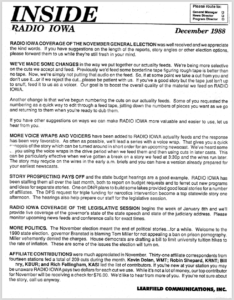
In 1988 if I wanted to communicate with the 60 radio stations affiliated with our news networks, I printed it and put it in an envelope and mailed it (USPS). Took as long as four days to reach some stations. No fax machines yet and email still years away.

This has such a Pony Express feel to me, here in 2017. The idea of a monthly, printed newsletter seems… quaint. But I recall almost every company and association doing a monthly (sometimes quarterly) newsletter. Somebody spent hours writing these things, often with multiple managers “signing off” before they went out.
When desktop publishing (and laser printers) came along, newsletters got ugly, fast. That was my opinion and I my philosophy was text-only; short paragraphs; one page, front and back. I read somewhere, “No more than an hour to write and a minute to read.” I think I knew, in my secret heart, that nobody read these things anyway. But I did them, every month for years. I kept most of them and they provide tiny snapshots of what was going one with our networks at the time.

Today we have Facebook pages and Twitter feeds and maybe even a blog or two. But I’m seeing some Big Names moving back to newsletters. Easier to monetize? More likely to be read?

Clyde’s first business plan

It’s pretty easy to come up with an idea for a new business. It’s really hard to write good business plan for a new business. In 1972, 28-year-old Clyde Lear put together a proposal for regional radio network. He showed it to a half dozen local businessmen who invested in him and his idea. Last year Clyde’s company was valued at more than one billion dollars. It’s not really his company anymore, he sold it a few years ago.

Clyde kept that first business plan and it’s interesting reading. I worked for Clyde for 30 years and have known him for 40 so it might be more interesting to me than you. He’s graciously allowed me to share some of it here. It begins with the concept, his “big idea.” An excerpt:

Regional news and farm networks have been especially lucrative. The growing farm economy required quick dissemination of farm information. Much of this information is a necessity to the agribusinessman. Further, the advertiser wanting to market his good — machinery, seeds, services, fertilizer, feed, chemicals — looks for the way he can get the greatest number of farmers and ranchers to hear his message at the lowest possible cost. The regional farm network is the answer.

Advertising rates, proposed programs, projected expenses, descriptions of other networks. In 1972 there were 113 radio networks in the U. S. and Clyde researched eleven of them. Clyde’s First Business Plan – Other Networks (PDF)

Ohio Farm Network: This is a full-time farm network, but distribution is by tape, and five days late. Programming is entirely morning about 20 minutes in length. It is entirely a pre-sold program, based on a percentage of the rate card of each station. One man handles all the programming and all the selling. The overhead is low, and sales, by comparison to the others, are moderate at best, seldom reaching $10,000 per month.

If you’ve ever thought about starting your own business, or if you started your own business, you might find this bit of history interesting. The company that Clyde and others built from his original idea doesn’t look much like his original dream but that was never a static thing. Clyde’s First Business Plan – Background (PDF)

State Farm Drive Safe & Save Mobile

If you don’t know this about me already, I’m not very concerned about privacy. I think you should have it if you want it and are willing to make the necessary sacrifices to get it, but it’s not a high priority for me. Might be someday. Not today. As Estelle Costanza said, “I’m out there, Georgie!” I’m willing to give up some (a lot of) privacy to get some conveniences.
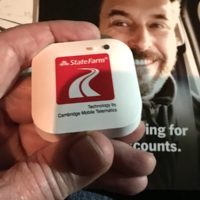
That said, today I activated State Farm’s Drive Save & Save program. Keep a little Bluetooth beacon in my car that works with an app on my iPhone to track my driving. According to their website the track acceleration; braking; turns; mileage; speed and time of day (rush hour, late night, etc)

According to the marketing material (and my local agent) I’ll get an immediate 5% discount and another 20% if I don’t go above the national average of 12,000 miles a year. “More small discounts may be tallied if you prove to be a safe motorist, do not drive over 80 mph and avoid driving between midnight and 4 a.m.” I think I meet all of those goals but we’ll see.

I found this while googling around: “State Farm warns that some drivers already getting a low-mileage discount may see a rate hike. “If you currently receive a premium reduction for low estimated annual mileage (under 7,500 miles annually for personal use) and your vehicle is actually driven more than that, your premium may increase at a future policy renewal period.”

I know this kind of thing freaks a lot of people out. But not me. I’ll try it and if I don’t like the results I’ll stop. And if State Farm fucks me over, I’ll just switch providers.

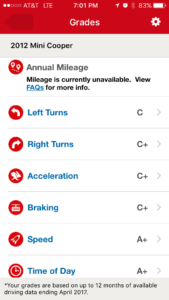
Update (5/22/17): A couple of months ago I mentioned adding a little gizmo from my insurance company (State Farm) that tracks my driving and — depending on my grades — lowers my rates or saves me some money or something. As you can see from the screenshot below, I’m doing fine in a couple of categories and not so good in some others. I do jump off the line and brake too hard but was unaware of my hard turns. I put that on the MINI which handles so beautifully. I do zip around corners. So far all of this has saved me about $11 and change. But I am going to work on my starts/stops/turns.