
Marketing through cell phones

Brandweek has a good article on how marketing on cell phones is finally starting to work:

“Crammed into his seat on his way into Manhattan, a businessman uses his cell phone to log onto Weather.com just to see if there’s some sunshine on the way (“Seventeen inches of snow expected by the weekend.”) Just then, a bright blue banner ad with white lettering pops up on and grabs his attention: “Aruba” …He clicks on the banner ad, and his phone dials an 800 number, connecting him to an Aruba Tourism booking agent. “

The article includes several good examples.
Why social media is important to marketers

I don’t know how old this info is (or how accurate) because I can’t find the original post, which is somewhere on the Church of the Customer Blog. Bart Cleveland includes these factoids in a recent post at Small Agency Diary (AdAge.com) to underscore why social media is important to marketers:

  • By March 2006, 84 million Americans had broadband at home, a 40% jump from 2005 figures
  • By March 2006, Pew estimated 48 million Americans were regular online content creators
  • By the end of 2005, 139 million people in the world had a DSL (broadband) connection
  • In 2005, $6.7 billion worth of digital cameras were sold in the U.S.
  • About 41% of all cell phone owners use them as content tools
  • By the end of 2005, just over 1 billion people were online — that’s 1/6th of the world
  • Asia represents the world’s most populous online segment
  • By July 2006, 50 million blogs had been created and their number was doubling every 6 months
  • About 7,200 new blogs are created every hour
  • By 2006, 10 million people were listening to podcasts in 2006; by 2010, it’s expected to be 50 million people
  • About 100 million videos are viewed every day on YouTube; about 65,000 videos uploaded every day
  • In 2006, MySpace had over 100 million registered members, most of them from the U.S.

When advertisements become recommendations

“As we move to an age where the only true advertisements are recommendations, what is the role of the traditional advertisement going forward? Recommendations I understand. They can come in many shapes and forms. People you know and trust telling you about products and services they like … A matching engine that takes your “buying” intentions and connects them with someone else’s “selling” intentions.”

[JP Rangaswami via gaping void]

How Google Audio Ads work (PowerPoint slides)

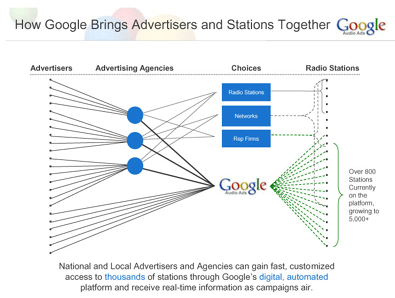
The folks at ZDNet’s Digital Markets have some PowerPoint slides that illustrates how Google Audio Ads work. And this from Voices.com:

“Google has positioned the Audio Ads system to serve both top-level advertisers, as well as the advertising agencies themselves. The graphic also shows 75% of the transactions coming from the agencies, and only 25% from independent advertisers. This is likely because advertising agencies already have media planning and media buying personnel, not to mention existing relationships with local and regional radio stations.”

The lables in the little blue rectangles are: Radio Stations, Networks and Rep Firms. Which suggests that advertisers will simply have another option for placing their ads on radio stations. And if Google can make it easier or cheaper or more effective (i.e. feedback, reports, etc)… they’ve added value to the process.

George Carlin on mindless marketing blather

AdRants points us to a wonderful 4 min bit of a George Carlin performance:

“More than half of what comes out of your mouth in that client presentation is mindless, pointless, idiotic sounding, space-filling blather. Don’t you want meetings to be shorter? Aren’t you sick of fake words that mean nothing? Wouldn’t you rather be actually creating something rather than killing it with the boatload of words you throw at it before you ever show it to the client? Of course you would. So stop talking like an idiot.”

I’ve been working hard in recent years to do more listening than talking in meetings with clients. I’m not there. I still talk too much. But I’m making progress.

The experiment I’m dying to try is to record (audio) one of the client presentations. And then transcribe it. That is when we will see just how mindless and pointless most of our blather is. The simple truth is, we can’t hear how dumb we sound while we’re talking.

Why you didn’t get the business

Mary Schmidt (“Business Developer, Marketing Troubleshooter”) explains why you didn’t get her business. Her original list grew so long she’s posting these little goodies in three parts. Here are a few of my favorites from her first batch:

4. Your web site looks abandoned. (Copyright 2004? Are you even still in business?)
5. Your web site doesn’t tell me how to call you.
6. You never, ever answer your phone. It always go to voice mail.
7. You did more talking than I did in our first meeting.
8. You insisted on going through your entire sales presentation, slide by slide, line by line – even when I said, “I already know that” and “Yes, I already saw that.”
9. You talk about “solutions” but never tell me how you’re going to solve my problem.
10. You’re “invisible.” Like it or not, showing up in a Google search (or not) is a credibility factor these days.
11. You only call or email when you’re trying to sell me something.
12. You think having my business card with my email address is the same as having my permission to flood my inbox with junk.
16. Your “free education seminar” was nothing more than a sales pitch

This should be required reading before every sales presentation. Thanks to David for the pointer.

Apple ditches “Mac Guy” in new ads

Apple’s “I’m a Mac” campaign is almost perfect: It’s funny, memorable, and efficiently lays out the advantages of Macs over PCs. Its only defect: Virtually everyone who watches it comes away liking the “PC guy” while wanting to push the “Mac guy” under a bus.

Justin Long (the “Mac guy”) is out. The campaign’s other principals, director Phil Morrison and journo-humorist John Hodgman, are both returning for another round of spots.

According to Seth Stevenson, ad critic for Slate, Long is “just the sort of unshaven, hoodie-wearing, hands-in-pockets hipster we’ve always imagined when picturing a Mac enthusiast…. It’s like Apple is parodying its own image while also cementing it.” Of the polymathic Hodgman, Stevenson writes, “Even as he plays the chump in these Apple spots, his humor and likability are evident.” — Radar Online

I didn’t find the Mac guy ‘a smug little twit.’ Hmmm. I shudder to think what that says about moi.

Scott Adams: Knowing when to quit

“You usually have to try a bunch of things before luck has an opportunity to find you. So how do you know when to bail out of a losing idea? … I heard a useful rule about predicting success during my (failed) attempt at creating a hit Dilbert animated TV show: If everyone exposed to a product likes it, the product will not succeed. The reason that a product “everyone likes” will fail is because no one “loves” it. The only thing that predicts success is passion, even if only 10% of the consumers have it. … Great ideas catch on immediately, and passionately, at least with the early adopters.”

— Scott Adams