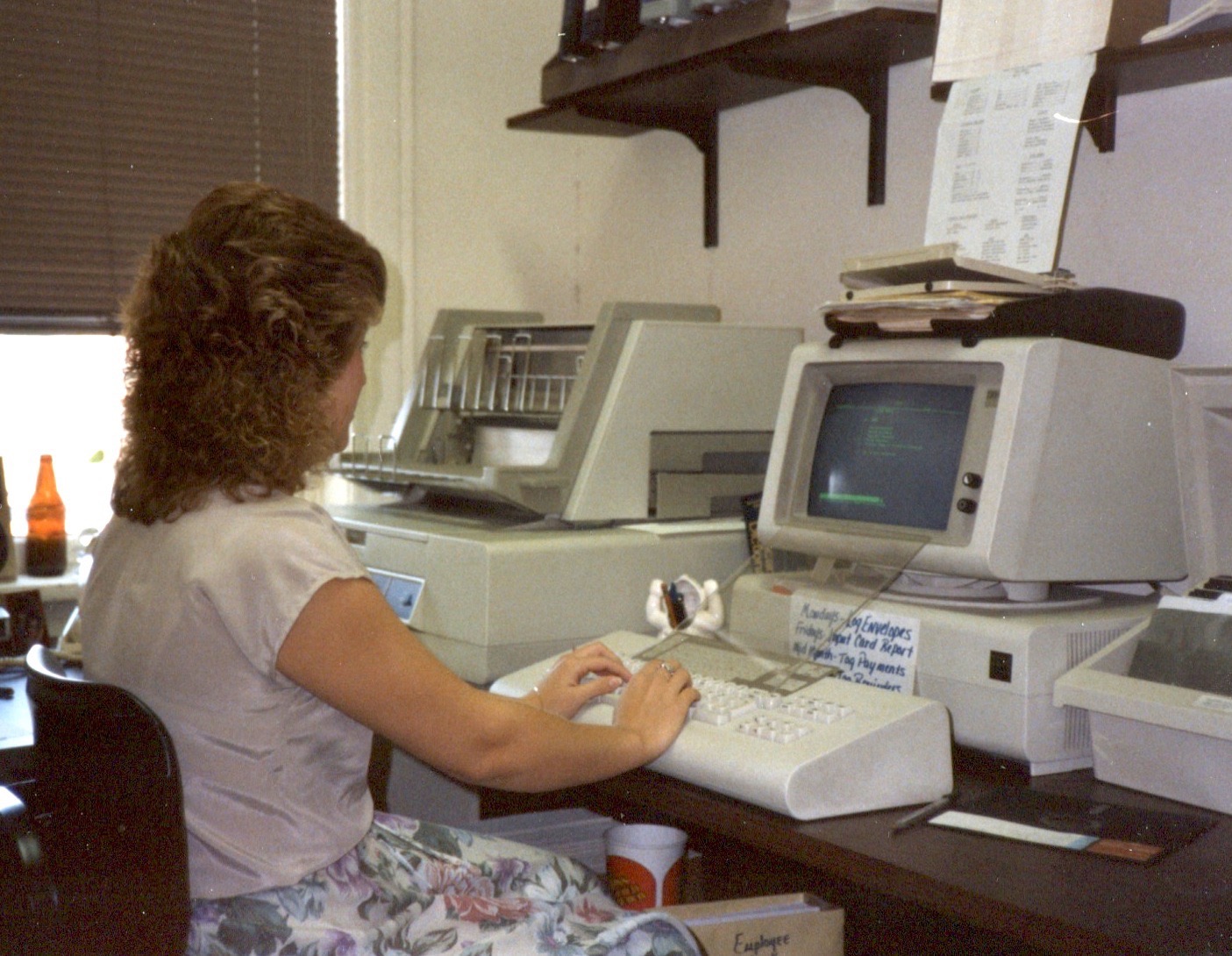
“Your future employer is watching you online”

Please don’t stop with these two paragraphs from Michael Fertik’s excellent post on one of the Harvard Business Review blogs. It’s not overly long and filled with interesting nuggets. To wet your whistle:

“Using today’s technology, an employer can search 1,000 submitted resumes for keywords such as university name, previous employer name, and specialty. The computer can serve up the three people who fit the employer’s criteria. The employer reaches out, interviews them, and hires one. More than 99% of candidates didn’t even get at bat. No human evaluation — for subtlety, interesting career paths, etc. — was needed or utilized to get to the top of the pile.”

“Let’s imagine what this looks like with tomorrow’s technology. The computer knows the digital profiles of top employees at the employer’s company. It knows their backgrounds; their reputation on the internet for professionalism, hard work, and achievement; their previous patterns of work history and tenure; their collaboration styles; what the internet thinks their personal interests and habits are; what their friends are like; what their family lives are like, etc. The employer tells the machine that she’d like to get a terrific new employee for the Customer Service department. The machine then researches the million people who live closest to her office, surfaces three names based on their digital reputations and how similar they are to top employees at the company, and she reaches out to them. She and the candidates are mutually delighted with the result.”

I think I’ve always (since I got online) known we were headed here and (subconsciously?) conducted myself accordingly. But then, I was sort of an adult by the time the net came along, with youthful indiscretions confined to some fading photos (which I put online).

I know some will be disturbed by the this post and perhaps I should be, but I’m not.
Making It in America

I was/am clueless about changes to American manufacturing in the last half century. I know a little bit more after reading an essay by Adam Davidson in The Atlantic. It’s long (by web standards) but worth a read if you wonder where the jobs went and why they’re not coming back.

In the 10 years ending in 2009, factories shed workers so fast that they erased almost all the gains of the previous 70 years; roughly one out of every three manufacturing jobs — about 6 million in total — disappeared. About as many people work in manufacturing now as did at the end of the Depression, even though the American population is more than twice as large today.

One of Davidson’s questions jumped off the page at me: Why are there any manufacturing jobs left in America? The story of Maddie, one of the people featured in the essay, offers a partial answer:

Maddie makes less in two years than the machine would cost, so her job is safe—for now. If the robotic machines become a little cheaper, or if demand for fuel injectors goes up and Standard starts running three shifts, then investing in those robots might make sense.

“What worries people in factories is electronics, robots,” she tells me. “If you don’t know jack about computers and electronics, then you don’t have anything in this life anymore. One day, they’re not going to need people; the machines will take over. People like me, we’re not going to be around forever.”

None of this is news to those who run our companies and countries. They just don’t know a) what to do about it, and b) how to break that news.

Throughout much of the 20th century, simultaneous technological improvements in both agriculture and industry happened to create conditions that were favorable for people with less skill. The development of mass production allowed low-skilled farmers to move to the city, get a job in a factory, and produce remarkably high output. Typically, these workers made more money than they ever had on the farm, and eventually, some of their children were able to get enough education to find less-dreary work. In that period of dramatic change, it was the highly skilled craftsperson who was more likely to suffer a permanent loss of wealth. Economists speak of the middle part of the 20th century as the “Great Compression,” the time when the income of the unskilled came closest to the income of the skilled.

I hope you don’t stop with these excerpts. The article illuminating and worth the read.

Learfield 2.0

Latest release dropped on Friday with the announcement that our company had been purchased by a private equity firm.

Learfield was founded (co-founded, actually) by Clyde Lear, forty years ago. He borrowed $24,000 from some local businessmen and grew the company by ploughing back profits and — later– borrowing from a local bank. A great entrepreneurial story.

For the first dozen years of the company (ver 1.0), Clyde managed everything. Around 1984, he started growing the company and needed to delegate some the work. I was part of that hiring spurt (ver 1.1).

It wasn’t long before our sports division took off and we opened an office in Dallas. Our news division was growing, too, but not as fast (ver 1.2).

Sometime in the 90s we had a major restructuring of management, with Clyde handing off CEO duties. This was Learfield 1.3 and as the dust settled, I slipped out the window and began easing myself down the corporate ladder.
A couple of years ago, Clyde shuffled the cards again and Greg Brown took over as President and CEO (let’s call this ver 1.8)

Learfield 2.0 is a major update. Clyde still has a “minority interest” in the company but prior to Friday, he had the final word on anything big (if he wanted it). That’s a big change for those of us that were personally brought into the company by Clyde. And doubly so for those charged with the running the new company.

Let’s just call this a soft reboot. Control+Alt+Delete.

“A rejection of what our society has become”

Excerpts from How I Stopped Worrying and Learned to Love the OWS Protests by MATT TAIBBI in the November 10, 2011 issue of Rolling Stone

“We’re all born wanting the freedom to imagine a better and more beautiful future. But modern America has become a place so drearily confining and predictable that it chokes the life out of that built-in desire. Everything from our pop culture to our economy to our politics feels oppressive and unresponsive. We see 10 million commercials a day, and every day is the same life-killing chase for money, money and more money; the only thing that changes from minute to minute is that every tick of the clock brings with it another space-age vendor dreaming up some new way to try to sell you something or reach into your pocket. The relentless sameness of the two-party political system is beginning to feel like a Jacob’s Ladder nightmare with no end; we’re entering another turn on the four-year merry-go-round, and the thought of having to try to get excited about yet another minor quadrennial shift in the direction of one or the other pole of alienating corporate full-of-shitness is enough to make anyone want to smash his own hand flat with a hammer.”

“People want to go someplace for at least five minutes where no one is trying to bleed you or sell you something. It may not be a real model for anything, but it’s at least a place where people are free to dream of some other way for human beings to get along, beyond auctioned “democracy,” tyrannical commerce and the bottom line.”

“It’s not that the cops outside the protests are doing wrong, per se, by patrolling the parks and sidewalks. It’s that they should be somewhere else. They should be heading up into those skyscrapers and going through the file cabinets to figure out who stole what, and from whom. They should be helping people get their money back. Instead, they’re out on the street, helping the Blankfeins of the world avoid having to answer to the people they ripped off.”

The class war has begun

So says Frank Rich in this NY Magazine piece. A little long (by web standards) but worth a read. To wet your whistle:

“Elections are supposed to resolve conflicts in a great democracy, but our next one will not. The elites will face off against the elites to a standoff, and the issues animating the class war in both parties won’t even be on the table. The structural crises in our economy, our government, and our culture defy any of the glib solutions proposed by current Democrats or Republicans; the quixotic third-party movements being hatched by well-heeled do-gooders are vanity productions. The two powerful forces that extricated America from the Great Depression—the courageous leadership and reformist zeal of Roosevelt, the mobilization for World War II—are not on offer this time. Our class war will rage on without winners indefinitely, with all sides stewing in their own juices, until—when? No one knows. The reckoning with capitalism’s failures over the past three decades, both in America and the globe beyond, may well be on hold until the top one percent becomes persuaded that its own economic fate is tied to the other 99 percent’s. Which is to say things may have to get worse before they get better.”

The Class War Has Begun – And the very classlessness of our society makes the conflict more volatile, not less.

Are jobs obsolete?

That’s the bold question posed by Douglas Rushkoff. I know this is heresy for many, but as Kevin Kelly might suggest, this is “what technology wants.” A few snippets from the CNN op-ed:

I am afraid to even ask this, but since when is unemployment really a problem? I understand we all want paychecks — or at least money. We want food, shelter, clothing, and all the things that money buys us. But do we all really want jobs?

We’re living in an economy where productivity is no longer the goal, employment is. That’s because, on a very fundamental level, we have pretty much everything we need. America is productive enough that it could probably shelter, feed, educate, and even provide health care for its entire population with just a fraction of us actually working.

Our problem is not that we don’t have enough stuff — it’s that we don’t have enough ways for people to work and prove that they deserve this stuff.

The question we have to begin to ask ourselves is not how do we employ all the people who are rendered obsolete by technology, but how can we organize a society around something other than employment? Might the spirit of enterprise we currently associate with “career” be shifted to something entirely more collaborative, purposeful, and even meaningful?

We start by accepting that food and shelter are basic human rights. The work we do — the value we create — is for the rest of what we want: the stuff that makes life fun, meaningful, and purposeful.

This sort of work isn’t so much employment as it is creative activity. Unlike Industrial Age employment, digital production can be done from the home, independently, and even in a peer-to-peer fashion without going through big corporations.

I plan to eat right, exercise and live as long as I can because I can’t wait to see how this comes out.

“How Google Dominates Us”

James Gleick’s The Information was one of the more interestisng books I’ve read this year. And this piece in the New York Review of Books he talks about “How Google Dominates Us. A few of my favorites:

  • “The business of finding facts has been an important gear in the workings of human knowledge, and the technology has just been upgraded from rubber band to nuclear reactor.”
  • “When (we) say Google “possesses” all this information, that’s not the same as owning it. What it means to own information is very much in flux.”
  • “(Google has) been relentless in driving computer science forward. Google Translate has achieved more in machine translation than the rest of the world’s artificial intelligence experts combined.”
  • “The merchandise of the information economy is not information; it is attention. These commodities have an inverse relationship. When information is cheap, attention becomes expensive. Attention is what we, the users, give to Google, and our attention is what Google sells—concentrated, focused, and crystallized.”
  • “Google makes more from advertising than all the nation’s newspapers combined”
  • “The perfect search engine, as Sergey and Larry imagine it, reads your mind and produces the answer you want. The perfect advertising engine does the same: it shows you the ads you want. Anything else wastes your attention, the advertiser’s money, and the world’s bandwidth.”

Almost every article about Google worries about the potential danger of someone having so much information about us. And yet, few seem concerned about how much power, information and control governments have over us. I’ll trust Larry and Sergey over any politician that has come along in my lifetime.

Robert Reich: The Truth About the Economy

Robert Reich describes what’s wrong with the economy in 2 minutes.

  • The economy doubles since 1980, but wages flat. Where did the money go…
  • All (or most) of the gains went to the super rich.
  • With money comes political power.
  • Taxes on super rich slashed, revenues evaporate.

You might disagree with his economics and/or his politics, but the guy can DRAW!

What did we do before computers?

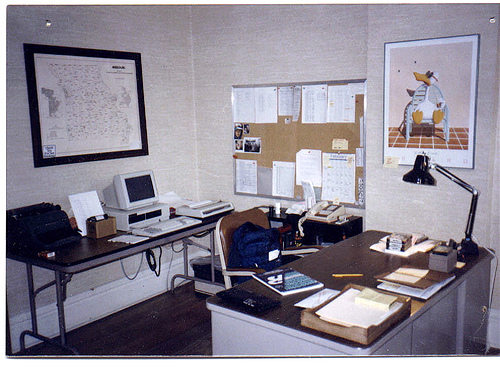
It’s a question I silently ask myself from time to time, so I thought I’d try to reconstruct how I (and others) did my job when I first came to Learfield in 1984. (This photo was taken in 1985 and I’m including it with this post as a memory aid. Annotated version.)

It might be easier to to start with what we didn’t have. I’m going to say no computers even though there was a Lisa II (?) running VisiCalc. No fax machine. No mobile phones.

The bulk of my job was dealing with affiliate radio stations and there was only three ways to do that:

1. Call them on the phone
2. Send them a letter in the mail
3. Get in the car and go see them in person

Each week we would send stations a “log” showing which commercials would be airing in each of the news or farm programs we sent them via satellite. One of the secretaries had drawn a table (6 columns for M-Sa and 13 rows for the number of shows) using a ruler. This was copied (we had a copier) each week and the blank table was rolled into an IMB Selectric typewriter and the names of the sponsors typed in.

This had to be completed by Wednesday of each week in order to get them mailed and to the stations in time for their “traffic” person to insert those commercials into THEIR log for the coming week. And delay and the system fell apart.

The photo above reminds me I used a manual typewriter often enough to keep it close. The computer in the photos is a Zenith and I was the only person in the company with his own personal computer.

We also had a big IBM Displaywriter that allowed us to do mail-merge documents. Amazing tech for the time.

Next to my phone is a Rolodex with all of my contacts, each typed on the big Royal but continuously updated with scratch-throughs and margin notes. If you got fired, you wanted to have a copy of your Rolodex.

If –god forbid– we needed to get information to every network affiliate “fast,” someone had to call each station, one at at time.

One of the tools I relied upon most was my big map. You can’t see them but there is a pin showing the location of each radio station on the network. It was a thrill to add a new pin and agony to remove one.

Long before Google Docs, there was the bulletin board for all the important lists. (this was not portable)

Years later we got our first fax machines, even though most of our stations didn’t have them. We knew they would. Someone stood at the machine and keyed in the name and phone number of every radio station (or advertiser). When you wanted to blast a fax out to a “list,” you fed the document in and it called each number, transmitted the facsimile; printed a “receipt” and then called the next number on the list. It was wonderful. We didn’t have to wait 3 or 4 days for the USPS.

And it got better. As we got more computers and modems, programs like WinFax could do the job of a fax machine but with far less effort and with much greater speed. We could keep a station’s fax machine humming all day and all night, burning up expensive rolls of thermal paper. The term “spam” was years in the future.

Now we post information to our websites and stations download at their leisure. We communicate with them on Facebook and Twitter and all the rest. Email is instantaneous.

Will it get faster/better/easier still? Hard to imagine how but I assume it will

The End of Demographics

In small market radio we were thrilled to have research that told us how many men listened to our station compared to how many women. And, of course, the demos: 12+, 18-24, 35-54… I think I missed one but that’s not the point. From 8 or 10 “diaries” in a county we were supposed to extrapolate useful information for out programmers and advertisers. Uh huh.

This article illustrates how much things are changing.

“The rise of mass-produced consumer goods also brought the rise of mass-market advertising. In the 1950s and 1960s, the goal of television was to aggregate the most possible eyeballs for advertisers. In order to convince consumers that an advertising message was relevant to them, consumers had to buy the idea that they were just like everyone else. The year that someone was born will not tell you how likely he is to buy your product.”